The .NET Day on Agentic Modernization agenda is live—see the new blog for what's in store, then join us to learn how to modernize apps without the rewrite. https://t.co/oKep8r3mpj
#modernize#dotnetday#githubcopilot#azurepaas
Microsoft just solved the biggest unsolved problem in AI engineering.
And they put the entire blueprint on the internet for free.
CI/CD for AI Agents on Microsoft Foundry. Their internal playbook. Now public.
Here is what it actually does:
→ Before your agent ships anywhere it gets automatically scored on accuracy, safety and factual grounding. Not vibes. Actual scores.
→ Each environment, Dev, Test and Prod, has its own gate. Your agent has to earn every single promotion.
→ Each deployed agent gets its own unique Microsoft Entra identity so you always know exactly which version did what.
→ Every action the agent takes is fully traced. You can see what it did, when it did it and why.
→ If your agent drifts in production, you roll it back instantly. One command.
The reference repo is live on GitHub right now. GitHub Actions and Azure DevOps both support out of the box.
This is the moment AI agents became real software.
Full blueprint here: https://t.co/lCyqNKC49S
Learn Coding by playing games
1. Kubernetes
https://t.co/e2lskAhkSb
2. DevOps
https://t.co/JqMwECBqVL
3. Linux
https://t.co/8AZMxUVUTN
4. Git
https://t.co/7gn24CyQik
5. Python
https://t.co/K6KnVWxqj1
6. CSS & HTML
https://t.co/sgooWVCQ4u
7. Cybersecurity
https://t.co/mwso7Evxtj
8. Mobile Coding (like Duolingo)
https://t.co/DumVCTo4F9
9. For Complete Beginners
https://t.co/kfSqv3Daac
10. 25+ Programming Languages
https://t.co/3SeeGxFWNl
Follow @ghumare64 for more such tips!
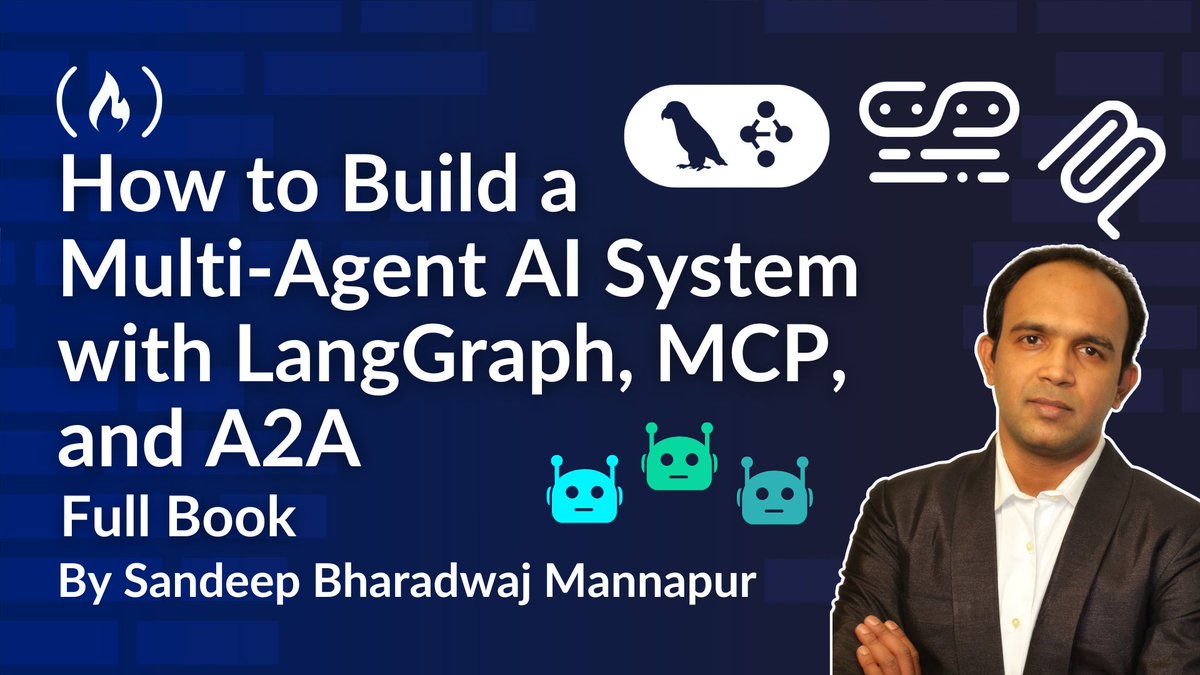
Multi-agent systems need more than just prompts: they need structure, too.
In this book, you’ll use LangGraph to model workflows, MCP to access tools and data, and A2A for agent coordination.
Sandeep walks you through building scalable agent pipelines that can actually run in production.
https://t.co/VwrgXM0v9l
Recently Meta made headlines with unprecedented, massive compensation packages for AI model builders exceeding $100M (sometimes spread over multiple years). With the company planning to spend $66B-72B this year on capital expenses such as data centers, a meaningful fraction of which will be devoted to AI, from a purely financial point of view, it’s not irrational to spend a few extra billion dollars on salaries to make sure this hardware is used well.
A typical software-application startup that’s not involved in training foundation models might spend 70-80% of its dollars on salaries, 5-10% on rent, and 10-25% on other operating expenses (cloud hosting, software licenses, marketing, legal/accounting, etc.). But scaling up models is so capital-intensive, salaries are a small fraction of the overall expense. This makes it feasible for businesses in this area to pay their relatively few employees exceptionally well. If you’re spending tens of billions of dollars on GPU hardware, why not spend just a tenth of that on salaries? Even before Meta’s recent offers, salaries of AI model trainers have been high, with many being paid $5-10M/year, although Meta has raised these numbers to new heights.
Meta carries out many activities, including run Facebook, Instagram, WhatsApp, and Oculus. But the Llama/AI-training part of its operations is particularly capital-intensive. Many of Meta’s properties rely on user-generated content (UGC) to attract attention, which is then monetized through advertising. AI is a huge threat and opportunity to such businesses: If AI-generated content (AIGC) substitutes for UGC to capture people's attention to sell ads against, this will transform the social-media landscape.
This is why Meta — like TikTok, YouTube, and other social-media properties — is paying close attention to AIGC, and why making significant investments in AI is rational. Further, when Meta hires a key employee, not only does it gain the future work output of that person, but it also potentially gets insight into a competitor’s technology, which also makes its willingness to pay high salaries a rational business move (so long as it does not adversely affect the company’s culture).
The pattern of capital-intensive businesses compensating employees extraordinarily well is not new. For example, Netflix expects to spend a huge $18B this year on content. This makes the salary expense of paying its 14,000 employees a small fraction of the total expense, which allows the company to routinely pay above-market salaries. Its ability to spend this way also shapes a distinctive culture that includes elements of “we’re a sports team, not a family” (which seems to work for Netflix but isn’t right for everyone). In contrast, a labor-intensive manufacturing business like Foxconn, which employs over 1 million people globally, has to be much more price-sensitive in what it pays people.
Even a decade ago, when I led a team that worked to scale up AI, I built spreadsheets that modeled how much of my budget to allocate toward salaries and how much to allocate toward GPUs (using a custom model for how much productive output N employees and M GPUs would lead to, so I could optimize N and M subject to my budget constraint). Since then, the business of scaling up AI has skewed the spending significantly toward GPUs.
I’m happy for the individuals who are getting large pay packages. And regardless of any individual's pay, I’m grateful for the contributions of everyone working in AI. Everyone in AI deserves a good salary, and while the gaps in compensation are growing, I believe this reflects the broader phenomenon that developers who work in AI, at this moment in history, have an opportunity to make a huge impact and do world-changing work.
[Original text: https://t.co/5wQe7foww8 ]
Unlock AI's transformative potential for your organization: https://t.co/SnNlUYkS8H
Discover how to prioritize AI initiatives using Gartner's AI maturity assessment and roadmap tools ⬆️
#AI#Innovation#Leadership#Webinar
Check out this #Hackathon hosted by @Devpost ...
HackAI — Dell & NVIDIA Challenge by @Dell
💰 PRIZES: $70,176 in total prizes
📅 DEADLINE: October 02, 2024
🛠️ Build groundbreaking #GenerativeAI projects using #NVIDIA#AI Workbench.
🔗JOIN THE HACKATHON: https://t.co/14vf21NHwE
Avanza TEC, el nuevo programa de MinTIC para emprendedores y profesionales TIC ¿Cómo participar? https://t.co/gJ7fbu7bra #Empresas#AvanzaTEC#cursosgratis
You thought #InformationSecurity domain was overcrowded by vendors" Think again!
Data related vendors, open source projects, and new terminology jargon will drive any application developer nuts.
'Domain specific people' are so blindsided by their own domains that they don't see big picture at systems level.
[my comments are result of listening to Snowflake, Databricks and their partners for two weeks]
#SystemsThinking @furrier@SavIsSavvy@RealStrech
{picture shown is only a subset of data related open source projects}
#Devs #Developers #dataScience #DataEngineering #DataScience #ML #AI #GenAI







![sarbjeetjohal's tweet photo. You thought #InformationSecurity domain was overcrowded by vendors" Think again!
Data related vendors, open source projects, and new terminology jargon will drive any application developer nuts.
'Domain specific people' are so blindsided by their own domains that they don't see big picture at systems level.
[my comments are result of listening to Snowflake, Databricks and their partners for two weeks]
#SystemsThinking @furrier @SavIsSavvy @RealStrech
{picture shown is only a subset of data related open source projects}
#Devs #Developers #dataScience #DataEngineering #DataScience #ML #AI #GenAI](https://pbs.twimg.com/media/GQAJDSpaQAIJSLD.jpg)
![KirkDBorne's tweet photo. [Download 541-page PDF eBook] Understanding #DeepLearning: https://t.co/Z3ZjaEnk2m by @SimonPrinceAI
—————
#BigData #DataScience #AI #ML #MachineLearning #NeuralNetworks #ReinforcementLearning #NLProc #ComputerVision #Algorithms #DataScientists #Mathematics https://t.co/KGCoVCEezb](https://pbs.twimg.com/media/GMShTrvaIAAXW5V.jpg)


