Most of what your company does isn't work. It's workarounds.
Approvals, three-way matches, month-end close: they exist because people can't see everything and nobody can be trusted with everything.
AI doesn't fix that. It runs the workarounds faster.
https://t.co/ZatisQ01Rc
A kid finishes work and wants to learn algebra. The school says no, even in a gifted program. What exactly are we protecting the kid from? As a parent I would worry about the day the kid stops asking.
I have now spoken to parents with similar experiences and attended sessions at Alpha. Alpha still has to prove its teaching works in some areas but letting a curious child keep learning should be the bare minimum at any school.
The “knowledge is becoming cheap, so why bother?” argument misses the point. Getting an answer is cheap. Developing the understanding to question it, connect it to something else and do something useful with it still takes work. To me that is the more interesting part of what Alpha is trying to do. Give kids room to go further when they are ready instead of teaching them to wait. A child shouldn’t need to fight the school for permission to learn.
Enterprises do struggle to figure out where AI can help but shouldn’t helping them figure that out be part of the product? This is a very old problem (way before AI). FDEs can help but someone inside the business still has to spend hours explaining how everything works and getting them up to speed. I think we should aim higher and build products that use AI to make that process easier with less hand-holding needed every time.
The biggest problem with AI effectiveness within enterprise today is...
“If you have a well-defined problem today with artificial intelligence, you can hill climb it. In many cases in enterprises, the problems are not well defined.
The true friction to economic growth is not that we cannot solve hard problems that are well defined. It is that it is hard to solve ambiguous problems with ambiguous objectives and humans in the loop.
That is the part constraining the explosion of AI usage in the enterprise. That is why we have FDEs: to try and better define the problem.” @arthurmensch
Love to hear your thoughts @ssankar@SonyaHuang@aakashgupta@swyx
Self-hosted Claude Managed Agents is now in private beta.
You can host the agent harness, sandboxes, and session history, in your own cloud or on-premises, and choose where requests to Claude are sent.
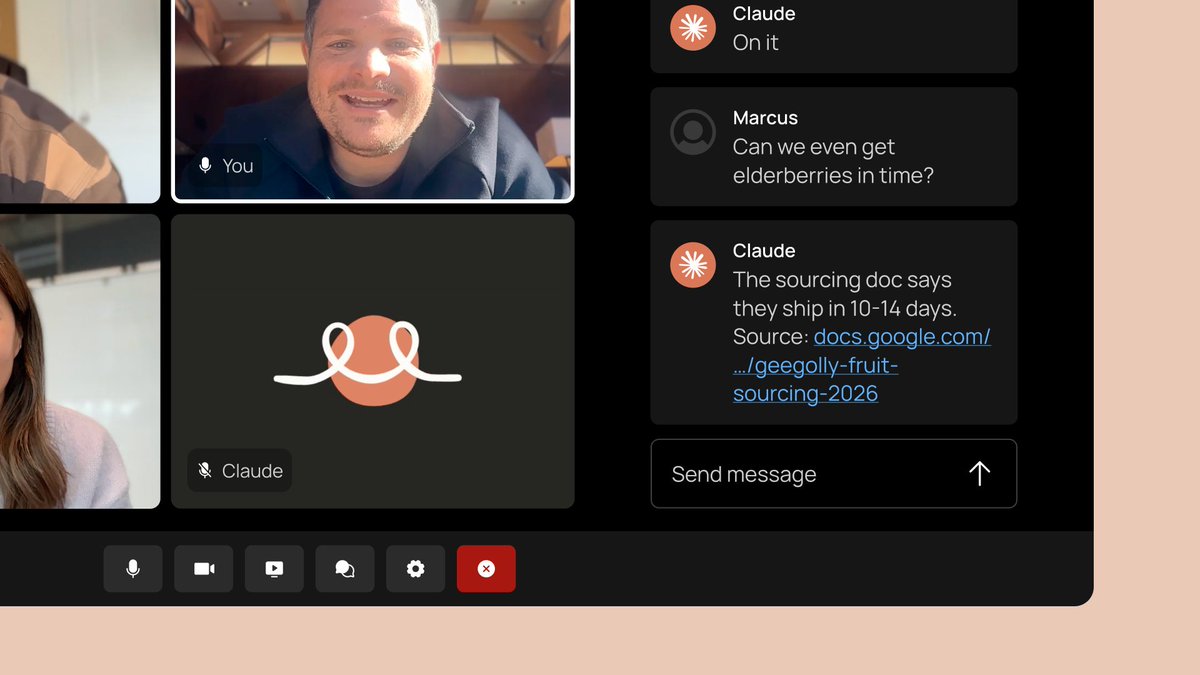
Claude joins as a visible participant. Ask it a question out loud or in chat, or have it start a doc. Your team can see what it’s building and correct it as it takes shape.
Major news! @nikitabier is available to book on Intro.
Nikita is the former CPO of @X , and a founder with two major exits: @gasappteam, which reached 10M downloads before being acquired by @discord and TBH, which was acquired by @Meta.
Nikita is one of the world's most in-demand consumer, social, and growth experts. In addition to being an entrepreneur, he advises the world’s leading technology companies, including XAI, Coinbase, and Solana.
Book his time to get advice on:
✔️ Building viral apps
✔️ Product development
✔️ Mobile and web design
✔️ Community building
✔️ Fundraising
✔️ Growing your social following
✔️ And more
Agent swarms win wherever work can be rerun. Code, research, games - a bad attempt costs nothing.
A company is different. You can't rerun a payment to the wrong supplier or a delivery date you promised a customer.
So the hard problem at work isn't what agents can do. It's what they're allowed to do and who said so.
Agent swarms have the potential to drive yet another leap in output from AI. The impact will be a clear separation between teams that adopt this pattern of work and those that don’t.
The progression has roughly been: chat gave us quick turn AI responses that let us work a bit faster, but we were still rate limited by our interactions; then agents that can go off and complete entire tasks for us, accelerating hours or days of work into minutes; to now swarms of agents that are goal seeking and will find any route to the successful completion of a project, where there’s no inherent limit to the productivity gains.
We can imagine a future where, for any task in which value can be created within a self-contained digital environment, swarms will be able to complete the work faster than any other approach.
Essentially any area where value creation is currently bound by the amount of research you can do, the amount of decisions made with a set of software tools, the amount of data processed or consumed, and the amount of code (or code adjacent) that can be generated.
This means swarms will play a big role in game development, coding, trading, life sciences research, IT automation, cyber, math breakthroughs, animation, and plenty of other areas of work that have these characteristics.
There’s a lot of opportunity to build the harnesses, applied AI products, and infrastructure for how these agents operate. And most importantly there’s a ton of opportunity for those that can wire up work in this way. It’s going to be an entire new field of FDE work available.
Typical Silicon Valley event postmortem. You meet someone running a billion-dollar + company. They are warm, encouraging and say “DM me on X.”
You leave thinking a door opened. They leave thinking the conversation ended.
The six changes I am paying closest attention to:
1. We are moving from using software to delegating work.
2. Building becomes easier which changes what makes a business valuable.
3. Jobs change task by task, with uneven consequences.
4. Trust and authority become part of the operating infrastructure.
5. AI is becoming a physical and geopolitical industry.
6. Science could experience the most consequential acceleration
We keep making the AI future sound more mysterious than it needs to be.
Who owns the productive capacity? who captures the economic gains? who has the authority to make decisions? Who is accountable when things go wrong?
These are not questions that require AGI, consciousness or a new theory of civilization to answer. They require choices about how we build and govern these systems today.
The future is not just something we predict. It is something we design.
Two things I’ve been thinking about regarding AI:
• People often highlight the risks involved in AI, which are surely very real. I’m struck, however, by how hard it is to understand the contours of the positive scenario. There are easy-to-perceive and frequently invoked elements of a positive vision — more diseases cured, more material abundance, etc. — which sound great, but these are by themselves just ingredients. I’m curious what the larger equilibrium is supposed to look like. Do people work? If so, why? What is their marginal contribution? If not, how are resources allocated? What is scarce? What is the ratio between humans and AIs? Are humans in control, whatever that means? One sometimes hears the Culture novels invoked as one scenario, but I’m not sure they depict a desirable outcome. (AI runs everything and humans compete in games? Iain Banks himself said that the humans in the Culture are “somewhere between passengers, pets and parasites.”) There is Richard Brautigan’s famous poem, but do we want to be “returned to our mammal brothers and sisters”? (Isn’t that rewinding Genesis?) We could say that it was hard to imagine the world of 1900 from the vantage point of 1700, and that’s assuredly true. But nobody in 1700 was trying to recast humanity itself within a couple of years — things necessarily unfolded slowly and by increments, and therefore with the possibility for error correction. Given how rapid the rate of progress in AI may be, it feels strange for the upside case to be so opaque.
• There is increasing discussion of whether AIs are conscious or how we would know whether they are, with conclusions there often assumed to be relevant to matters of moral worth. At first blush, this seems a rather arcane, benign, or even absurd issue. (Remember the response to Blake Lemoine’s fears.) Setting aside the terms of the debate itself, or the relevant demarcation criteria, it seems to me a quite high-stakes question, for an affirmative answer — that is, granting moral worth to AIs — would presumably mean that the aggregate worth of AIs would soon outweigh that of humans in any utilitarian calculus. The AIs will be exceptionally wise and intelligent, and vastly more numerous (especially once one considers the imminent future and the AIs not yet born). As such, even epsilon of moral worth will multiply to a lot once one considers the quadrillions that could soon exist. (This is effectively a distributed version of the Nozick’s utility monster.) If this conclusion is unpalatable, I think one of three propositions needs to be rejected: the premise AIs can have moral worth; utilitarianism itself; or the belief that there is even a possibility that they will be far more numerous than humans.
With both of these matters (contours of future society; AI moral worth), there is the possibility of dramatic change. Today, people argue about datacenters. I’m curious how popular support for AI will evolve as more people come to understand these medium-term questions and the relevant stakes. What is the vision for AI that most people would be excited about?
The surprising part is not the economic inequality. It is that someone who spent decades investing in capital, technology and exponential growth is only now recognizing who captures the upside.
Asset ownership compounds. Wages do not compound the same way. This has been understood for generations. You predicted the creation of enormous wealth but somehow missed its distribution.
That is not a failure of economic indicators. It is a failure of perspective.
When I’m wrong, I’m wrong. I thought when unemployment was low, GDP was hi, household income rose, it meant everyone was winning.
Not true.
The American economy has decoupled the economic progress of asset owners from wage earners to such a degree that broad based measures of success are no longer reliable measures of progress.
This single issue of asset ownership vs progress of wage earners will be the defining issue in all future elections.
Other issues will get caught in the interpretation (price of eggs, Iran war, price of gas etc) but the candidate that realizes that those are downstream of asset vs wage earners and gets their messaging focused on it will win.
No amount of money spent in an election or gerrymandering will change this outcome.
That is what I learned on Nov3.
Our EW-1 model team build map has a recipe as one line: learn the company, search ahead, judge by the company's own objective. It also points to the standing benchmark that measures progress.
One of the fundamental things that a lot of enterprise AI companies miss (in my opinion) is the following:
A company's true shape is fuzzier because people bend processes. So the measure is whether the predicted shape predicts what happens next.