Gavin Baker and a16z's David George on the state of the AI boom:
The future doesn't have to be winner-take-all. Labs, open-source, applications, and the clouds can all capture value.
Demand for intelligence is still dramatically underestimated. Today's power users number in the millions and will grow to hundreds of millions. Gavin and David argue a compute shortage is a more real risk than an AI bubble, and building through it is an opportunity to reindustrialize America.
In this episode, they get into why compute investments pay back so fast, what the data center backlash gets wrong, the case for putting compute in orbit, why enterprises will run several models at once, and how Nvidia ended up at the center of the entire supply chain.
00:00 Intro
01:06 The bear case Gavin couldn't find
05:50 Why a lab would cut its own revenue 75%
08:05 What LPs get wrong about a crash
10:50 Microsoft slowed its capex and regrets it
14:33 The engineers spending 100x the median
17:35 Why 23-year-olds use AI better than Gavin
21:45 How much copper 500M AI users need
23:00 Stop promising to cure cancer
26:00 America's richest county is full of data centers
30:48 Who gets priced out of compute
33:05 The age of Elon and Jensen
34:25 Orbital data centers
44:40 Asteroid mining
48:12 Why Microsoft doesn't need a frontier model
54:02 Who becomes the abstraction layer
55:40 Everyone wanted a deity, Cursor wanted a product
1:00:25 Never take shots at Jensen
1:07:40 What happens when the chip doesn't work
1:12:10 What chip deals reveal about customer demand
YouTube: https://t.co/2mokoHwtDa
@GavinSBaker@DavidGeorge83
Gavin Baker says Grok Bot feels like another ChatGPT moment because it turns hours of Claude Code work into seconds:
"You see these 23-year-old kids and just the way they use AI, they're just fluent and native in it. I just feel like maybe in a way that no matter how hard I try, I will never be, and I'm trying really hard."
"We got Claude Code. I built some stuff, did some cool stuff, and in, I don't know, 3 minutes of creating Grok Bots, I had much better versions of everything I created."
"I love having a podcast summarizer... It takes 10 seconds in Grok Bot. It's amazing, and it's so good."
"A Substack summarizer, an X summarizer, an X sentiment tracker for topics and stocks... All of those would have taken me hours working with Claude Code, and they each took 7 to 12 seconds with Grok Bot. And it's better."
"To me, Grok Bot does feel like another ChatGPT moment."
@GavinSBaker@DavidGeorge83
David Friedberg: Higher Interest Rates Are About to Make America’s $40 Trillion Debt Problem Much Worse
“The federal government has a problem because over the next 12 months they have to refinance $10 trillion of debt.
That debt is coming due. Those bonds are now due. They have to pay the principal back to the bond holders, and they have to go back to the treasury market and sell more treasuries to borrow more money to refinance.
So the borrowing cost now is going to climb up, and when that borrowing cost climbs up, the federal government's burn goes up and the fiscal deficit goes up.
So my theory and my argument on this is: There is no action that Bessent can take that's actually going to have a meaningful effect on the long end of the curve.
We have a fundamental fiscal spending problem with the federal government right now.
It is very expensive now to borrow money if you're the US federal government. And the reason is persistent inflation, I would argue because of excess government spending on social programs and other things.
And the big problem at this point is the federal government is spending so much that if they were to cut spending aggressively, the argument and the concern is it would hit unemployment and it would cause a recession because the federal government is such an intricate part of the economy now.
That's the argument. But it's causing inflation, and it's causing deficit spending.
So this year the deficit will be roughly $2 trillion. And as a result, the market is saying, ‘We're worried about the US fiscal solvency over the long run, or there's a higher risk. As a result, we're going to charge you a higher interest, 5.2% on the 30 year.’
What does this mean for the federal government?
Well, today, the federal government's average cost of debt is 3.4%. That's what we're paying on interest on average on the $40 trillion of debt that the federal government has outstanding.
For every 1% change in the interest rate, the US government has to pay 1.25% of GDP in excess interest each year. 1.25% of GDP in interest each year for that 1% change in the interest rate.”
Chamath: “If you see the 30 year at 6%, it is the beginning of a death spiral.”
@chamath:
“We are supposed to be in the middle of an enormous financial build-out to support AI.
And if you go all the way back, like 100 years, the Industrial Revolution, the Grand Bargain, all of this stuff, the United States government was the balance sheet. They are the ones that were able to step in.
And unfortunately, because of its financial situation, the US government is not able to do that.
That's why, thank God, we have companies like Nvidia, and Google, and Microsoft, and Meta, and Amazon who take on that burden.
There's so much chirping, by the way, on the internet about the balance sheet of Nvidia and blah, blah, blah, and I think people completely miss that these guys are putting the entire US economy on their back.”
Claude now has its own built-in browser in Cowork.
When your task involves a website, a browser opens in Cowork's side panel, and Claude navigates, fills forms, and finishes the job.
ChatGPT Work can now use its computer and browser to sign in to websites on web and mobile, without ChatGPT ever seeing your username or password.
That means you can ask it to:
• Set up utilities for a new apartment
• Book a DMV or passport appointment
• Check reimbursement costs through your insurance
• Find and book an in-network doctor around your availability
• Check when your car registration expires and prepare the renewal paperwork
• Compare your rental insurance policy with an issue you’re emailing your landlord about
• Find and save apartment listings that match your criteria
• Restock something just by uploading a photo
• Schedule a package pickup for a return
• Cancel tickets for a rescheduled trip
• Book a vet appointment
• Submit reimbursement paperwork for medical treatments
• Check resale sites for new drops and save things you might like
• Find candidates with specific experience and draft outreach
• Take invoices from your email and submit them to your accounting software
• Draft replies to rental property inquiries
• Fill out permit applications for your small business
• Add action items to a vendor portal based on a recent client call
• Analyze the latest ad campaign for your small business
A lot of people don’t know what the Riemann hypothesis is, so I’ll put it in Star Wars terms.
Prime numbers (whole numbers greater than 1 that can’t be divided evenly by any other whole number except 1 and themselves) appear scattered almost randomly, like stars across the galaxy. The zeros of the Riemann zeta function are coordinates on a map that tells us how prime numbers are distributed.
The Riemann hypothesis says that all the important zeros should line up on one exact “hyperspace lane.” Proving that would reveal a much deeper order behind prime numbers.
What Claude was able to do:
Claude didn’t necessarily prove that every zero lies on the lane. But mathematicians had previously proved that at least 41.6% do. Claude found a new argument raising that to 67.2%, a massive leap!! The 41.6% hadn’t moved for decades btw.
An unreleased version of Claude used 31 million output tokens, coordinated 60 subagents, wrote hundreds of scripts and produced both a paper and a formally verifiable Lean proof. Anthropic mathematicians validated the result, as well as two outside experts!
We asked an unreleased research version of Claude to take a stab at the Riemann hypothesis.
It didn’t solve it, but it did make strides on a related problem: it increased the lower bound for the fraction of zeros of the Riemann zeta function that satisfy the hypothesis from 41.6% to 67.2%.
https://t.co/aZDvqqhHRi
BREKAING: China now accounts for ~28% of global manufacturing, more than any other country or economic bloc.
This percentage has more than tripled since 2004.
By comparison, US factories account for ~17% of global manufacturing value added, or 11 percentage points less than China.
In 2004, the US proportion stood at ~22%, more than double China's.
Meanwhile, the Eurozone economy represents ~15% of world manufacturing, while Japan accounts for just ~5%.
China has become a critical component of global manufacturing.
David Sacks: Anthropic Is Trying to Crush Open Source AI and the American Developers Who Use It
@DavidSacks:
“I know people don't have a lot of sympathy for Chinese companies, that's fine. I'm not defending Chinese companies.
I'm defending American developers who need to be able to use everything in the public domain.
And let me give you an example. Cursor rolled out its new product, Composer 2. They were able to post-train that model using Kimi K2.5 on their own proprietary coding data.
They started with a Chinese open source model, and then they used their own data, and they came up with a new derivative product.
This is the way that open source works. You take things that are in the public domain, you fork them, you make them your own.
And by the way, once it's in the public domain, it's not a Chinese model anymore. No data is going back to China, nothing's going back to China.
An American company has taken open source contributions in the public domain, made it their own, and then developed their own model.
And if you say that American companies can't do that, or that somehow it's tainted with IP theft, you are basically going to put a dagger through the heart of the entire American open source ecosystem.
And that is exactly what Anthropic wants, because they do not want to have the competition.”
David Friedberg says China is deliberately commoditizing the knowledge economy because it already holds 20X our manufacturing capacity and is heading to 8X our electricity.
"I'll just zoom out for a second. Think about the strategy for China."
"If you think about the global economy of the last 50 years, the US has accrued so much value by being at the core of the knowledge economy, and effectively a services economy."
"Through the development of intellectual property, of IP, of knowledge, and the conversion of one bit to another bit, we've been able to derive trillions of dollars in GDP."
"Meanwhile, we outsourced manufacturing and created a sleeping giant in China, where they have this incredible manufacturing capacity..."
"All of technology ultimately leads to that simple equation: molecule conversion... Everything in our world is driven by molecule conversion..."
"And what's left is the value of the molecule economy. When you look at the juxtaposition of China versus the United States today, we have one terawatt of electricity production capacity in the US, and they're on their way to having eight."
"We have about 10 billion square feet of manufacturing capacity; they have 200 billion... So they have 20X the manufacturing capacity, 8X the electricity production."
"And I think that's the long game for China: over a two, three decade process, by compressing the knowledge economy and the services economy, commoditizing it completely, they are left holding all the value in the global economy because they can make stuff, and they can make it cheaper than anyone because they have the most electricity production."
If the AI supply chain is dominated by US-linked firms and priced in dollars, global digital production will have to source dollar liquidity, and the revenues will land inside a largely dollar-based financial system, note Chenxu Fu and Xianguo Huang. https://t.co/iusZyYgkGg
Underrated life advice: A good life is built by simply doing uncomfortable things sooner. The delayed conversation gets harder. The ignored problem gets bigger. The small repair gets more expensive. Peace is never found through avoidance. It’s found through direct early action.
This is concerning. For the first time, a Chinese model Kimi K3 has taken #1 on the Frontend Code Arena and is scoring at or near the frontier on other benchmarks.
Meanwhile America is tying itself in knots: politicians and bureaucrats are banning new data centers, piling on state regulations, and pushing for new federal agencies to pre-approve frontier models.
This is how you lose the AI race. The rest of the world won’t play by our rules if we bog ourselves down. Permissionless innovation is how America won the internet and became the technological envy of the world. We can do it again with AI -- while addressing risks in a targeted way -- or we’ll watch our lead evaporate.
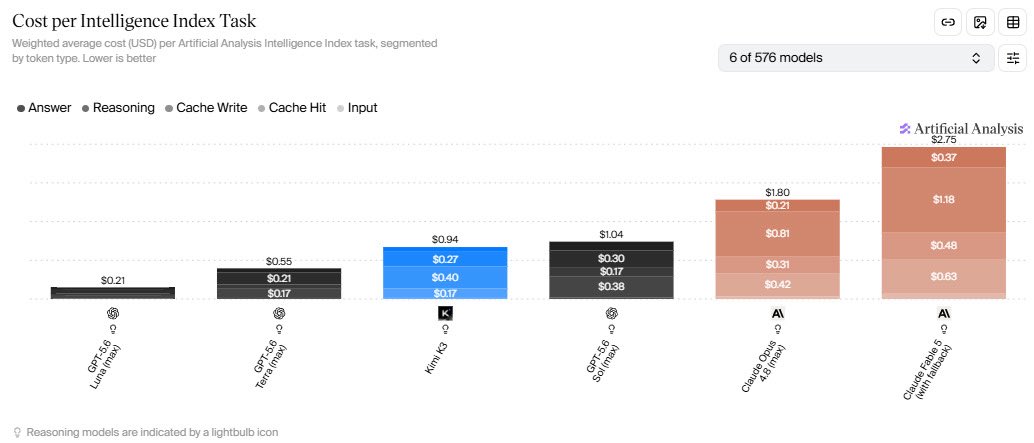
Kimi K3 may be an important inflection point for AI. Potentially negative for Anthropic and OpenAI while being net positive for essentially every other company in the world. I mean that very literally. Although the real “Sputnik moment” would be an open-source frontier model that was also token efficient unlike Kimi K3 which is 50-70% more expensive to run than GPT 5.6 per Artificial Analysis.
Rationale:
A world where there are only 2-3 dominant frontier labs with 90% inference margins is net negative for every other layer while being awesome for those 2-3 labs. Those labs would become monopsonies for power, data centers, semiconductors and hyperscalers and would obviously vertically integrate over time into all those layers while also completely subsuming the application/software layers.
Anything that lowers margins and increases competition at the model layer is good for every other AI layer: power, semiconductors, hyperscalers, neoclouds and yes even software.
This is why Jensen is so supportive of open-source. An open-source model requires the *exact* same amount of compute to run as a closed frontier model of similar size and architecture. Kimi K3 is roughly the same price as GPT 5.6 Terra on a per token basis, which actually suggests that it is less computationally efficient as I am sure that GPT 5.6 is priced to a higher margin than K3. And given that K3 is a token wastrel, i.e. token inefficient, it is significantly more expensive per task than GPT 5.6 and Grok 4.5, which are much more token efficient. Cost per token and token efficiency (i.e. intelligence density per token) are the drivers of intelligence per unit of cost. The winning AI companies will be those that offer the most intelligence per $ over time.
Lower margin % at the model layer = more margin $ at every part of the infrastructure layer and is a godsend for software. This can happen either through open-source models like K3 at the frontier *or* having a vertically integrated model company like Meta, SpaceX or Google at the frontier. Both outcomes result in a lower margin % at the model layer as vertically integrated model companies don’t really care where the margin $ come from. This is why it was so painful for OpenAI and Anthropic when Google was right there with them from a model competitiveness perspective and why Grok 4.5 and Muse 1.1 were just as important as Kimi K3.
The reason Kimi K3 is only *potentially* negative for Anthropic and OpenAI is 1) the @ericvishria point that the Claude and ChatGPT products and harnesses may be more important than their models today and 2) the hypothesis that they have much more advanced model checkpoints internally that are already being used for RSI. In the latter scenario, reaching RSI even a few months ahead of other labs might be enough to cement a permanent lead.
Time will tell on both points. And likely fairly quickly.
Caveat would be that since Kimi K3 is not token efficient and thereby actually more expensive than ChatGPT 5.6, we may need to see a more token efficient open-source model at the frontier or see Grok 5/Composer 4/Muse 2 at multiple points on the Pareto frontier for this potential risk to Anthropic and OpenAI to play out. And I am sure they will both vertically integrate as quickly as possible while continuing the product/harness strength they have shown over the last 8 months.