Carta anual 2025 de Azagala ya disponible.
Reflexionamos sobre nuestra filosofía de inversión en micro caps y compañías poco seguidas, y actualizamos nuestras principales tesis: Zegona, Nekkar, IAC, Clarus, Triumph Financial y Universal Music Group
Enlace
https://t.co/zAcITta5dJ
Lo comentaba con un amigo mientras cenábamos en la verbena de San Juan:
Los grandes laboratorios de IA están contratando filósofos.
Una de esas carreras que hoy a mí me apasionan, pero que, cuando antaño tu hijo que decía que quería estudiarla, le preguntabas “¿y de eso cómo vas a vivir?”
Pues resulta que sí.
Y, según las tendencias de empleabilidad en EEUU, mejor que de estudiar ingeniería informática.
Porque cuando construimos un sistema capaz de razonar, necesitamos a alguien que sepa si está razonando bien.
Y eso no lo resuelve un ingeniero; lo resuelve un filósofo.
Hace 2.400 años, Sócrates desarrolló la mayéutica: el arte de hacer preguntas que obligan al interlocutor a examinar sus propias contradicciones.
Los modelos entrenados con ese método son menos complacientes, más honestos.
O sea, más valiosos.
Descartes convirtió la duda en método (la duda metódica), como disciplina para separar lo verdadero de lo aparente.
Una IA que nunca duda no piensa.
Y hace 250 años, Kant lo remató con su “sapere aude” (atrévete a pensar por ti mismo)
La inteligencia artificial más peligrosa es la que es icapaz de cuestionar su propio razonamiento.
La epistemología es la nueva ingeniería.
Papelón para la Abogacía de Estado y la AEAT. Ahora veremos de quién depende, como dijo de la Fiscalía aquel político que nos gobernaba… https://t.co/oAr0qmm8D8
I can’t stop thinking about these crazy $AAPL price increases.
We’ve never seen anything like this in consumer electronics, ever. It’s not new products, just current or even very old products.
On top of it, iPhone 18 looking at a $200+ bump.
How this will play out for demand?
Tony James on Costco, Starbucks, Blackstone, and Charlie Munger
Tony James is an investor, Chairman of the Board at Costco, and former President and COO of Blackstone. In this conversation, he joins a16z GP David Haber for a conversation on scaling Blackstone from $14 billion to nearly $1 trillion, lessons from 38 years on the board of Costco, the future of private markets, and more.
00:00 Intro
00:45 Starting at DLJ: Getting in on the ground floor
03:05 The LBO revolution & building a merchant bank
09:09 Leading the Series A into Costco & lessons from Jim Sinegal
15:00 38 years on the Costco board & learning from Charlie Munger
25:17 Joining Blackstone: The partnership with Steve Schwarzman
33:44 Blackstone's journey from $14 billion to nearly $1 trillion
44:09 Investment committee culture & the art of robust debate
53:41 The IPO, retail distribution, and building competitive moats
01:05:39 Succession planning & knowing when to step away
01:10:00 The future of private markets
01:15:24 Advice for young people
@dhaber
¿Vas a presentar a VCs?
• Nunca envíes la presentación entera. Sólo un spoiler.
• Poquísimo texto en cada slide. Puede ver lo que le envías en la oficina o desde el WhatsApp en el coche mientras espera a los hijos/as.
• Cada frase se diseña. Crea marcos mentales de categoría, oportunidad y comparación.
• Equipo con cualidad top de cada miembro. No sólo empresas anteriores.
• Y lo que ya sabes: Si la tienes, curva de hockey stick.
Estuve con Ana de @OddersLab donde me flipó saber todo lo q va a pasar con las smartglasses de meta (rayban oakley) y similares. Tiene pinta q ahí habrá chicha. Desde Sevilla sin inversores facturan 5mm€ 🙌 https://t.co/ITRt4oJSuR
Marriott International CEO Anthony Capuano:
"The OTAs have done a fantastic job spending billions of marketing dollars to perpetuate the myth that the only way to get the best rate is to book through them... The best rate you'll ever get at a Marriott hotel is to book directly with us... [With AI agents] that know you, your travel preferences, your status with airlines / rental car companies / hotels, and your priority in certain cases to get the absolute best rate, why would it then go to Expedia?"
https://t.co/T44bO8XcFO
$IDT not only published great Q3 2026 results.
✅They announced the completion the acquisition of a majority stake on a tuck-in to fix their structural problem with advertisement.
🛫The CEO said this about the potential spin-off of Net2Phone
5 years ago $IDT was melting ice cube, with 100% of its EBITDA coming from a soon-to-be-obsolete business.
The EBITDA has doubled over the last 5 years.
Today less than half of the EBIDTA comes from that business. Over the next year it will further reduce to 1/3 of total EBITDA.
Despite $IDT being a conglomerate of predominantly fast-growing and high-margin tech companies, the market still values $IDT as a company with no terminal value.
New 8-K from $PPLI.
Diller just signed a Voting Agreement capping their effective voting power at 48.5%.
Translation: the independent shareholders now decide the MGM vote, not the Diller family.
You don't sign this unless a deal is near to close.
https://t.co/kwz31jd1i1
Hacienda ocultará a los ciudadanos cómo usa la IA para seleccionarlos e inspeccionarlos.
Lo cuenta @soyevadiaz con el escalpelo del meu @EsauAlarcon https://t.co/C2ASfptkru
Great read on $MGM - re: March conference where they commented on $CZR, full quote below. $13 on MGM China + $13 on BetMGM + $34 on RemainCo (which you can get to at ~8.5x EV/EBITDA) is $60. I would be surprised if the $48.30 $IAC bid is accepted.
It's not a coincidence Jamie Dimon, Elon, Jensen, and Barry Diller all share the same management philosophy: getting the truth from the source
Dara on what he learned from Barry Diller in his 20+ years working with him:
"I was an analyst at Allen & Company working on the LBO model for Paramount.
Barry didn't want to talk to the MD or the VP or the associate.
He'd say, 'Who built the model? I'm going to talk to that guy.'
He wanted to hear straight from the source.
It's the filtering that gets the edge out of the situation, and it's often the edge that gives you an edge. It's not the average."
@GavinSBaker in our conversation from 2024 explained how Elon, Jensen, and Jamie work:
"Wherever in the company the problem is, that is who Jensen and Elon go to work with — the subject matter expert, whether they're 23 or 50, there's no hierarchy.
When JPMorgan was buying Bear Stearns, the best modeler in the company was 24 years old.
They set up a desk for him side-by-side with Jamie. Jamie would say, "Change that, change this."
He didn't ask for that guy's boss. He said, 'This guy is the best, I want to work with him.'"
My conversation with @dkhos, CEO of Uber.
Dara took over in 2017, when Uber was losing roughly $4.5B a year.
Today the company generates $10B in free cash flow and is worth about $150B.
We discuss:
- How Daniel Ek convinced him to take the job
- How Uber spent a full year of its AI budget in a single quarter
- Uber's approach to autonomous vehicles
- Drones, hotels, and building a superapp
- Lessons from Allen & Co, Barry Diller, and Reed Hastings
Enjoy!
Timestamps
0:00 Intro
3:44 Bringing Order to Uber’s Chaos
7:22 Managing Stress and Going All In
14:28 Why Uber Is at the Center of AI and Physical
22:39 How to Win in Autonomous Vehicles
32:25 The Trillion-Dollar AV Opportunity
37:05 Drones, Robotaxis, and Global Adoption
38:20 Uber Eats, Uber One, and Aggregating Supply
47:00 The Future of the Uber App
55:55 Lessons from Barry Diller
Dara (CEO of Uber) on their AI spend:
"We blew through our AI budget in a quarter, for the whole year. It is forcing us to adjust.
We are going to meter headcount increases because to the extent that my engineers are getting much more efficient, their throughput is increasing. There's a cost to that, and it's a significant cost.
AI adoption has been occurring in all parts of the business –– whether it's engineers and how they scope projects, how they build, debugging, platform migrations.
I'm pushing the teams to fundamentally use the power of AI to rebuild systems and processes from the bottoms up.
I do think it's a combination for us right now of encouraging adoption, but then driving efficiency.
We're using the more expensive models to explore. Once we scale some of these experiences, we'll look to bring in more efficient models that are more efficient on a token basis or are open source."
"What we announced today were four major services - groceries, airport pickup, luggage storage, and car rentals - but that's just the beginning. You're going to see dozens of additional services, an ecosystem of services for every part of your trip."
https://t.co/y2HIh2oQkp
Es vergonzoso ser español cuando uno comprueba lo que ya sospecha desde hace tiempo: un antiguo presidente del gobierno involucrado en casos de corrupción sistemática junto a dictaduras crueles. Que más adelante un juez pueda determinar que la evidencia está probada más allá de toda duda razonable (un criterio muy estricto) es muy diferente de la clara acumulación de evidencia que ya tenemos sobre la mesa.
Pero si esto fuera un caso aislado de corrupción, la vergüenza podría sobrellevarse. Lo preocupante es que forma parte de un patrón sistemático. Zapatero fue presidente del gobierno bajo Juan Carlos I, quien tuvo que abdicar por casos de corrupción intolerables (corrupción que, por otra parte, ha sido constante e invariable en la dinastía Borbón en España desde la regencia de María Cristina de Borbón).
Y a Zapatero le sucedió Rajoy, sí, el Rajoy de “Luis, sé fuerte”. IU y su espacio (como se llame esa semana) tampoco se han librado de estos problemas cuando han tenido pequeños resortes de poder. Moral Santín es el caso más claro.
Y en Cataluña vimos que la antigua CiU y la familia Pujol eran una mafia. El único sitio donde el sistema no ha generado escándalos vergonzosos es el País Vasco, aunque uno sospecha que es más bien consecuencia de la ausencia práctica de libertad de expresión que de su ausencia real.
En otras palabras: los españoles hemos visto cómo la Monarquía, el PSOE, el PP, IU y los grandes partidos nacionalistas han vulnerado de manera sistemática todo tipo de normas éticas y penales.
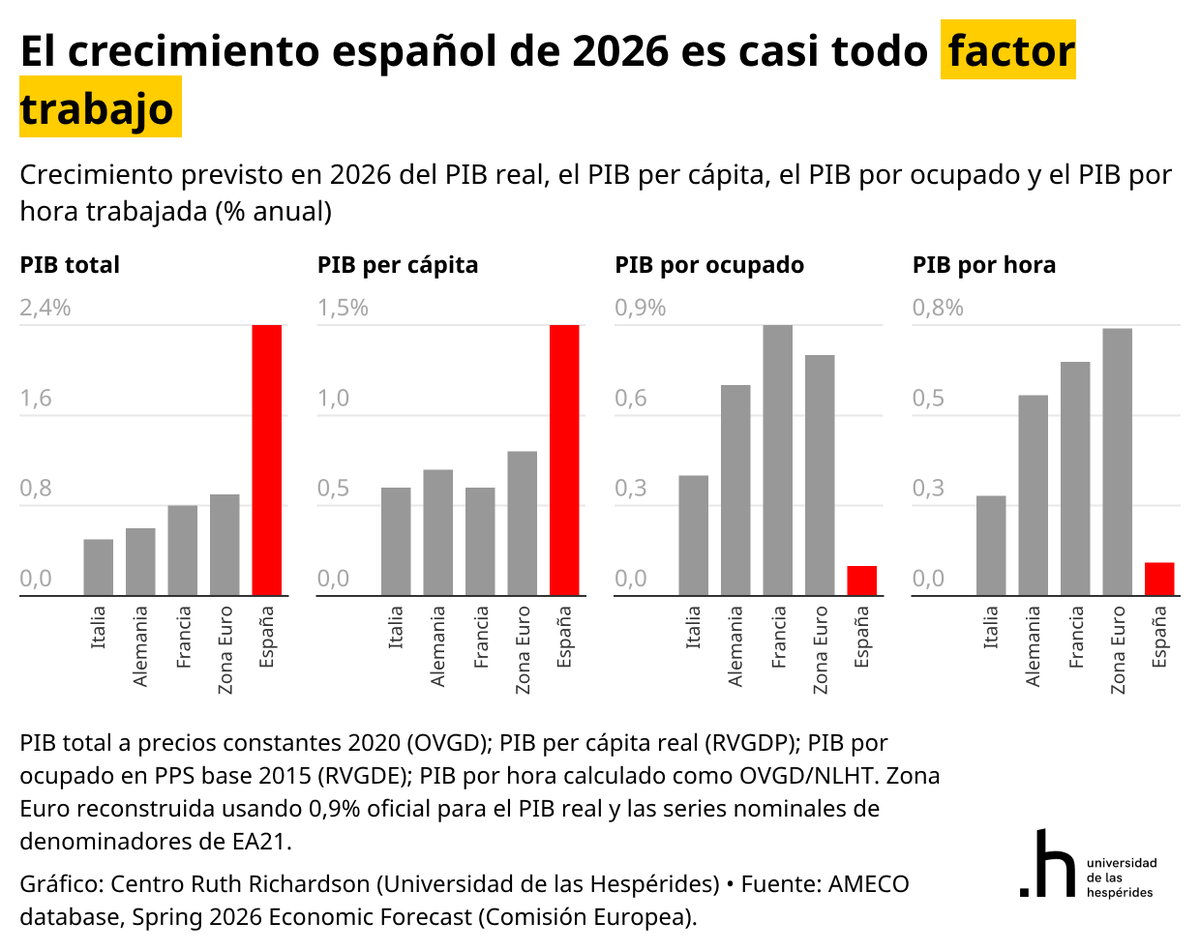
Mientras tanto, los salarios están estancados, la vivienda está por las nubes, la seguridad social está en una situación límite y la prosperidad actual es un espejismo empujado por una inmigración no sostenible que solo traerá problemas profundos a largo plazo (la figura de @SantiCalvo_Eco lo dice todo).
Quizás sea el momento de aceptar que esto no se arregla cambiando a quien gobierna, sino cambiando las reglas que hacen que casi dé igual quién lo haga.