My favorite way to work on things:
Start from the bug, the gap, the false claim, the half-built tool, the weird behavior in the institution.
Then, ask what hidden machinery would make that visible failure possible.
Then fix the root cause. Repeat forever.
The next phase is where this really takes off.
Agents are semi-autonomous now, doing what you tell them to, more or less.
But the next version of them is where it gets wild… they'll allocate their own capital and decide for themselves what to build. You’ll hand your head-agent some capital and say "make me rich in ten years." Off it goes.
How do you even prepare for that? There's no playbook for a world where the smartest capital allocators are machines that never sleep and answer to no one.
Fucking mental when you take that in.
That's exactly why I wrote my Economic Singularity framework in the first place… so we can see the shape of this before it spreads out.
You may think the agentic economy has nothing to do with you. It looks like just machines doing their own thing. But the fabric of our world is about to change… jobs, money, businesses, assets, all of it.
@Metaplanet forever
Being able to stack enormously undervalued shares with a decade+ horizon is an opportunity of a lifetime.
Onward and upward @gerovich@DylanLeClair
Regarding this post I saw yesterday in response to a post by Simon (@gerovich)...
On the "¥10 stock options" the facts are real, but it omits what matters
I checked the filings
Yes the 10th Series options (decided Dec 28, 2022) carry a ¥10 strike and an anti-dilution clause keeping them at ~20% of fully-diluted shares, granted to 7 people (2 directors + 5 employees)
Simon holds 145,480,035 potential shares through them. All disclosed
What it leaves out:
1. It's ALREADY in the BTC-per-share you see
Metaplanet's Effective Diluted Shares (Q2: 1,631,543,380) already includes these options
- 1,281,283,624 common
- 23,610,000 MERCURY preferred
- ~327M options/potential
The ~25% impact he calculates isn't a hidden future haircut; it's already in the reported denominator (Source: Notice of Additional Purchase of Bitcoin, Jul 2 2026; per-share table + Note 2.)
2. It's staged and self-capped. Not exercisable until Feb 8 2026, then only in thirds, through Feb 7 2033...
AND Simon's own change report includes a pledge restricting his exercise
(Source: Gerovich change report, EDINET filer E40212, filed Sep 17 2025.)
3. It's disclosed, not hidden
it's in EDINET and the annual report (Source: 2022-12-28 issuance disclosure; 27th Annual Securities Report, stock-option section.)
4. It predates the entire strategy
The ¥10 strike AND the 20% anti-dilution clause were set on Dec 28, 2022; ~16 months before Metaplanet adopted Bitcoin (April 2024), when it was a ~$14M near-dead hotel shell
This wasn't designed to skim BTC purchases; it's a legacy turnaround incentive that later interacted with the dilution model
The fair question isn't "management engineered a scheme"; the clause predates the Bitcoin pivot by over a year
It's whether a pre-existing 20% anti-dilution grant should persist now that the company dilutes to buy BTC. Legitimate to ask, and worth the company addressing...
But "BTC per share collapses" isn't accurate: it's bounded, staged to 2033, self-restricted, and already sitting in the diluted count you're pricing off of
To close, a reflection...
Telling only half the story breeds a sentiment that the full picture doesn't support; and you can already see it in the replies under that post, where people are reacting to the alarm, not the context
Facts stripped of their context can frighten, but they don't inform. Look at the actual filings, the disclosure history, and the whole picture of what this company is and the fear this framing is generating simply doesn't hold up
Someone asked me recently why I’ve become interested in aesthetics after having spent most of my life more interested in STEM-adjacent topics. I hadn’t really considered the question consciously before, but I’m certainly thinking about aesthetics more than I used to. I think it’s a confluence of things:
• Many things today are ugly and far uglier than they used to be or need to be. Once you see this, it’s kinda hard to stop perceiving it. (Early twentieth century phone boxes versus modern phone boxes; old water fountains versus new water fountains; etc.) As someone with a naively meliorist assumption that most things should be getting better rather than worse, it’s all a bit perplexing: why did we stop doing things nicely? Is it a choice? Was there a malevolent spell cast upon us? This vein led me to think more about modernism and why much of art became more intentionally "challenging", grotesque, opposed to prettiness, rebarbative, dissonant, etc. Can or should anything be done about this? Is this just how things ought to be?
• Relatedly, much of modernism involved a kind of explicit repudiation of cultural continuity and represented a schism with prior practices. This is maybe most evident in American architecture, where the International Style exhibition in 1932 initiated the displacement of a rich tapestry of prior styles. This cultural break seems important and interesting to me, and I suspect that the rejection had important consequences outside of the aesthetic domain. Samuel Hughes has been exploring this question in his recent writing at @WorksInProgMag; @RuxandraTeslo is also pulling on this thread. Elaine Scarry wrote about how beauty inspires creation. If so, the inverse may also be true: ugliness inhibits it.
• It’s clearly the case that changes in the aesthetic domain can at least inspire progress in other places. Petrarch helped set some of the preconditions for the Renaissance which in turn fostered the scientific revolution and Enlightenment. Things like World Fairs (the 1851 Fair at the Crystal Palace recorded 6 million admissions when the population was 21 million) reflect the popular interdependency that used to exist between aesthetics and material development.
• @tedgioia and others have written about stuck culture and how so many domains seem to have ceased to straightforwardly advance in the way that they did up until the nineties or thereabouts. This is obviously peculiar and interesting. What changed, and what does it mean? Is it about the internet and fragmentation? Is it about a loss of supply? Is it just about having reached the zenith of various mediums?
• I’m generally interested in markets and the dynamics of creation. In aesthetics broadly, I find the reflexivity between supply- and demand-side factors to be very thought-provoking. There’s a natural desire to view satisfaction of individual preferences as the yardstick to measure market success, but things get interesting and even a bit unsettling when we start to think about how the supply might start to shape the demand. I often think about this in the context of food. Why is food so much worse in Germany than many of its neighbors? Germany certainly doesn’t have less material ability to produce good food; indeed, Germany is richer than the countries around it. There’s probably something about German food supply chains that is impoverished relative to France and Italy, but the Germans themselves don’t seem too upset about it. It just seems that the Germans are stuck in an objectively worse market equilibrium than their neighbors: the food is bad and they’ve gotten used to it. The obvious question then is where else these kinds of reflexive patterns apply, and where else we’re stuck in some objectively inferior equilibrium, even if preferences are in some superficial sense being sated.
• While this is an extremely banal and obvious point, I hadn’t until recently thought much about or internalized how much one can study reasonably objective things ("the status of women in society", say) through artwork. (Thanks to @_alice_evans for opening my eyes here.) In this vein, I’m pretty excited about the possibilities over the coming years in computational art analysis. I want something that’s conceptually similar to Google Ngram timelines but for the visual arts.
• We've always tried to do things well at Stripe. I've come to see that attempting to do them beautifully is often a helpful way to break out of standard practices and to do something with greater novelty and in a way that might have other benefits besides. (Also, excellent people want to do great work because it is intrinsically satisfying. Explicitly allowing aesthetic considerations to carry weight avoids having to justify every assessment with some kind of torturous empiricism.)
• In his Nobel Lecture, Solzhenitsyn said that, among the Platonic virtues of goodness, truth, and beauty, that beauty is special, for it possesses a unique kind of irrefutability. He notes that arguments, writing, and philosophical systems can all be predicated on misapprehensions, but that “a true work of art carries its verification within itself.” He proceeds to observe that when goodness and truth are threatened, the “ever surprising shoots of beauty will still force their way through.” There is a lot of specious and motivated reasoning in the world today and plenty of questionable value systems. I don’t think that beauty directly reflects any definitive trait, but I’m intrigued by the idea that it can be a marker of deeper metaphysical coherence.
Marijuana is disgusting. Regular use is a one way door to becoming a retard and a loser.
Go out. Have a glass of wine. Be social. Get some sun. Take an uber. Fin.
For years I've written that the entire economy is heading on-chain, and that the smart contract networks are the only rails it can possibly run on.
Here's the thing people still haven't understood. Billions of AI agents are about to come online, and they're going to transact constantly... paying each other for compute, data, services, at a scale and speed no human market has ever seen.
The existing financial system physically cannot carry them. It’s too slow.
And it looks like institutions are catching on. Just last week:
Franklin Templeton called AI agents the “use case that finally drives blockchain adoption”
Coinbase's agent-payment rails got adopted by Google and Amazon.
Samsung put stablecoins in the Galaxy wallet.
David Solomon went against the rest of Wall Street to back the Clarity Act.
And this is just one week.
The rails are being laid, the machine economy is coming to run on them, and most people are still whinging over the daily price movements.
We're about to onboard billions of agents onto a financial system that didn't exist twenty years ago.
This is fucking wild.
It doesn’t matter if open source software is developed by the CCP, the NSA, the Jews, ISIS, MAGA, ANTIFA, or the Illuminati.
It’s open source - just audit and run it yourself.
They can send me gold bricks too, as long as they’re at it.
One thing I’m learning: open source doesn’t just accelerate growth—it compounds it. When knowledge is shared, innovation moves faster and entire ecosystems rise together.
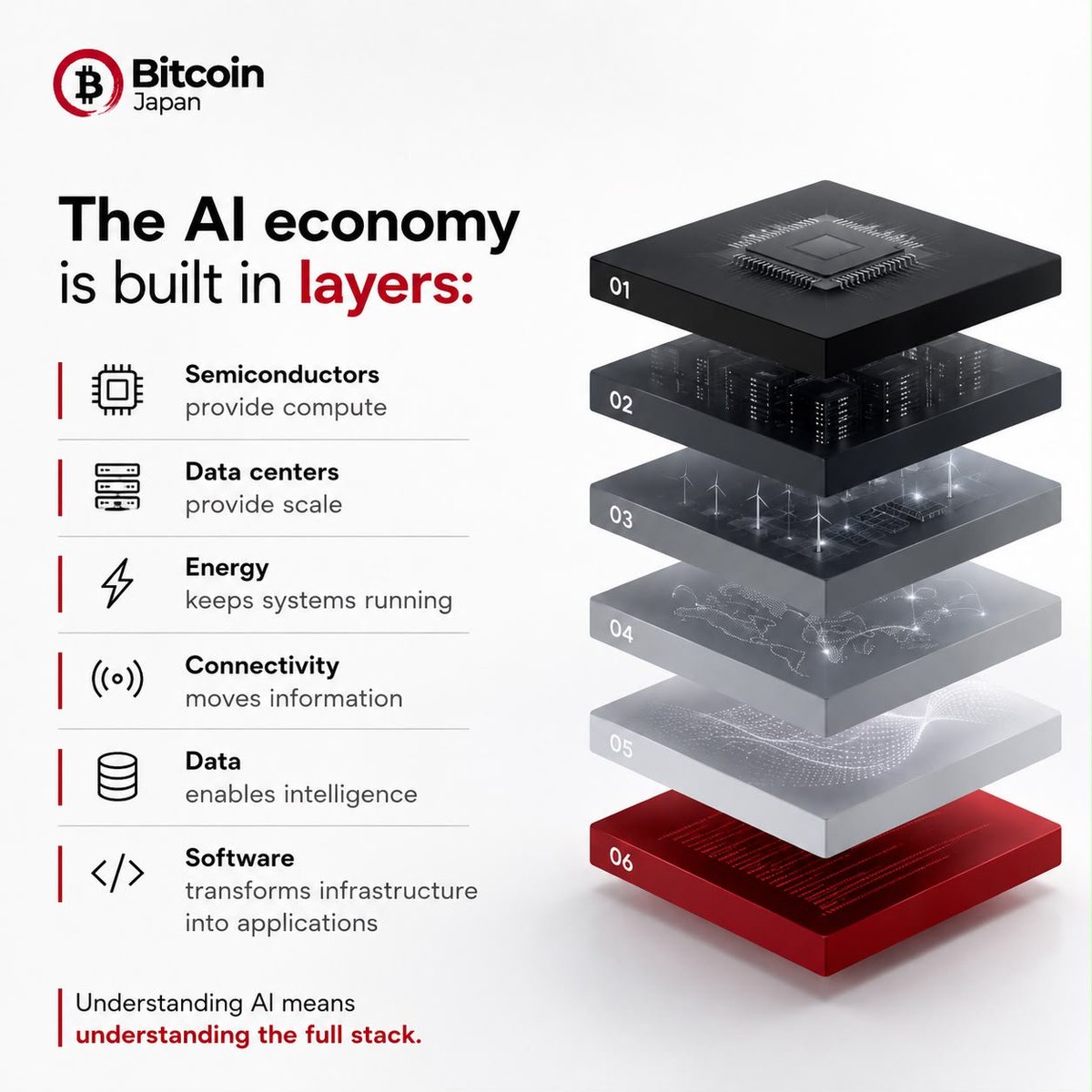
AI is more than software. It is a technology stack built on compute, infrastructure, energy, connectivity, data, and applications. Understanding the future of AI starts with understanding its foundations.
The future is open source. We need to embrace it and get on with it.
Imagine if America closed the door on open source.
We would explicitly be forcing American companies to pay $26-56 per 1MM tokens for the same intelligence their adversaries/competitors around the world would pay $0.50-1 for.
This is economically unsustainable unless AI is bullshit.
If it’s the supposed through line of all future economic activity that we’ve been told it is, we can’t handicap America at such a meaningful cost disadvantage.
This can also be viewed thru a military lens and not just a simple economic one as well.
Letting our adversaries attack us for $0.50 per 1MM tokens while we spend $26-56 per 1MM tokens to defend ourselves is equally ruinous.
It’s the Cold War Soviet collapse in reverse.
I agree with @BillAckman . We will lose the global race for talent if we don't attract the best and brightest. Especially true of the AI race against China. Talent is a bigger factor in that race than the next three or four factors combined, including chips. We should push for a bipartisan effort. I think it can be done despite the administration's MAGA wing. Who in the administration can help this lady?