Underrated reason to use OpenAI and Anthropic vs open models. They might be more trustworthy? You know where your data is going.
https://t.co/eGli051IhF
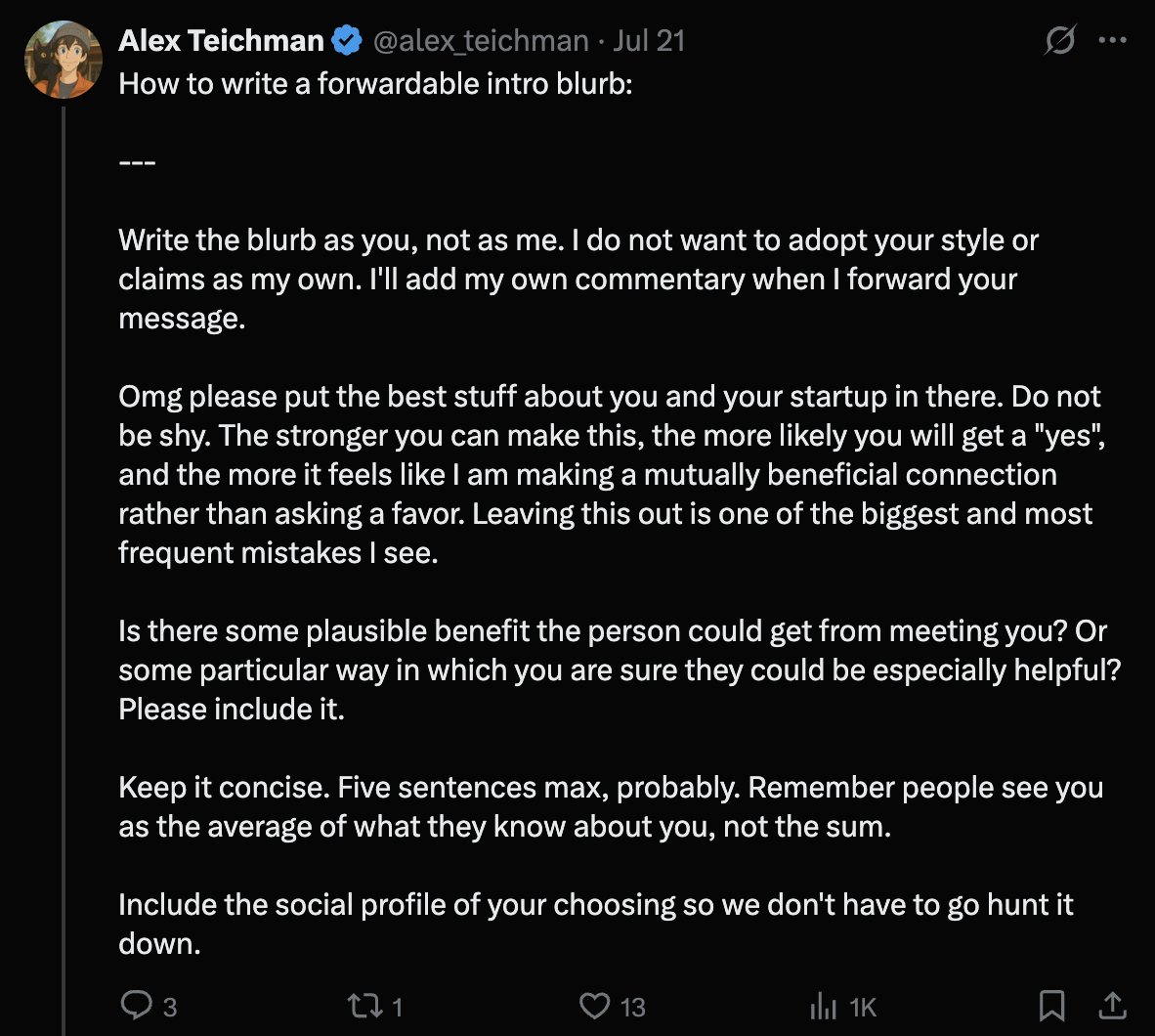
I have sent this tweet to three different people in the last week.
I don't know where else to post this so everyone can see it, but please do this when asking me for intros!
~ Day in my life as a professional matchmaker ~
Me: how was the first date? I know how excited you were to meet Elise.
Client: yes, thanks for making that happen. She’s beautiful. Something funny happened though.
Me: oh, yeah?
Client: Elise’s phone background is a full-screen photo of herself in a bikini.
Me: lol
Client: yeah, lol
Me: lol, can we shift our focus away from Instagram models now?
Client: yeah, lol
[read about what’s happening with AI]
ME: Wow we’re actually legit fucked this is so bad.
[go outside]
ME: Wait those people are all acting like nothing unusual is happening. Maybe I was just in a paranoid bubble? Yeah it must be that. Phew.
[read more about what’s happening with AI]
ME: Wait no we ARE fucked. Shit. It’s all those people outside who are in a delusional bubble.
[go outside]
ME: Wait...
The finding is exciting enough but can I just comment how good @DesignArena is at showing visual explanations of complex data analyses? I love this product and team and @grx_xce
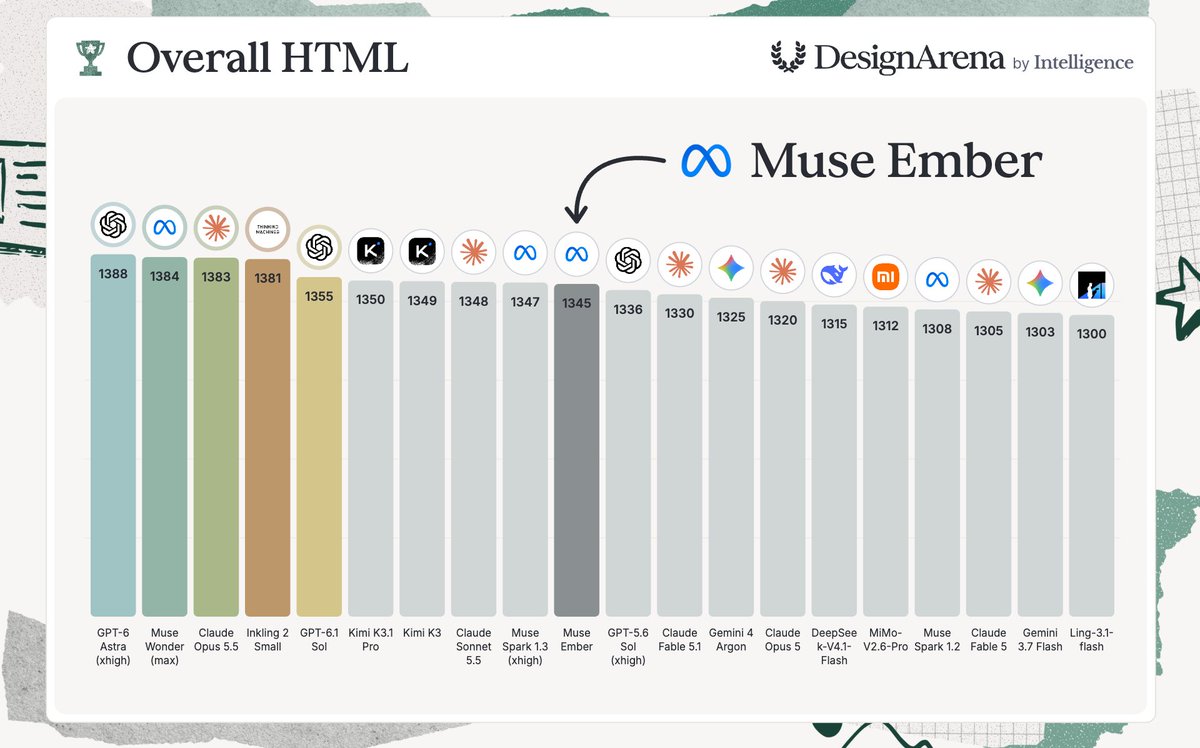
BREAKING: Muse Ember by @AIatMeta has redefined the Preference vs Speed Pareto frontier on Overall HTML, knocking out 10 top models from @GoogleDeepMind, @OpenAI, and @DeepSeek_ai.
At 33s per generation, Muse Ember is 9.5× faster on average than the previous Pareto frontier models. It is also at least 34× cheaper on average than all the previous Pareto frontier models it replaced at $0.10/$0.50 per 1M input/output tokens ($0.004 cache). It is also ranked 10th overall with an Elo of 1345!
A huge congrats to the @AIatMeta team on a top-10 placement on the leaderboard!
Introducing A5S Async V1: the world's most accurate speech recognition model for speaker-attributed transcription.
#1 on VoiceArena, ahead of ElevenLabs, AssemblyAI, Deepgram, NVIDIA, Meta & more.
The next-best model makes 41% more errors across 5 public benchmarks.
And yes, every lab says they're #1. So we open-sourced our benchmark.
Try it now👇
despite coding agents, modern apps are fragile. without proper architecture, you can spit out as much code as you’d like, but you’re just adding levels to a house of cards.
introducing Hatchet v2 & our $5.7M seed round. our bet is that great orchestration is the difference between a reliable app and a broken one.
Hatchet v2 is the universal orchestration layer: durable execution, durable queues and durable streams, sandbox integrations, serverless support, and operators. this is the architecture used by high-growth companies like @greptile, @linear, @getenter_ai, and many others, who collectively process over 5 billion tasks/month on Hatchet.
we’ve spent over two years obsessing over making our engine performant and scalable. this release extends the existing @hatchet_dev engine to support any sandbox provider, serverless environment, edge function, or container.
Introducing Cekura Bench: the world’s leading Voice AI Benchmarks
We benchmarked 50+ models from openAi, Google, Nvidia, xAI, Inworld, Gradium, Assembly, Fish audio and more
Now you can:
→ Compare naturalness, performance and cost
→ See how the best voice agents are being built.
→ Find the best fit for what you are building.
Our tests cover Speech-to-Speech models, Speech-to-Text models, Text-to-Speech Models, and Voice Agent platforms. We recorded real humans doing tasks in different domains and created the most representative voice benchmark out there!
Explore the benchmarks: https://t.co/eZAFy7P0Nj
We would love to collaborate with more teams on these benchmarks. Reach out if you are interested.
Today, we’re excited to launch Prism into General Availability.
Prism is the AI platform for hardware engineering. Describe what you want to build, and agents design the CAD, run the simulations, and write the report.
Free to get started for Windows, Mac and Linux 🧵
We asked GPT-6 Astra to edit Qwen3.5-0.8B weights to improve math.
It directly changed only 0.016% of weights, fixing 0.8B's reasoning loops & improving math up to 6x and even instruction following 3x, without gradients or training.
We call this Weight-Space Programming: frontier LLMs can now natively read/write neural network weights! 🧵
Blog: https://t.co/bOWCcFhCVq
This is a robot squat rack that automatically spots lifters, can handle nearly 900 lbs., and tracks every metric imaginable.
I expect to see them in every university and pro team weight room within the next 10 years.