Turn website traffic into customers 24/7. 🚀 Add InteliAug’s AI chat widget with 1 line of code. Boost your reach and answer visitor questions instantly using your data. 👇 https://t.co/5lUAwBA65Y
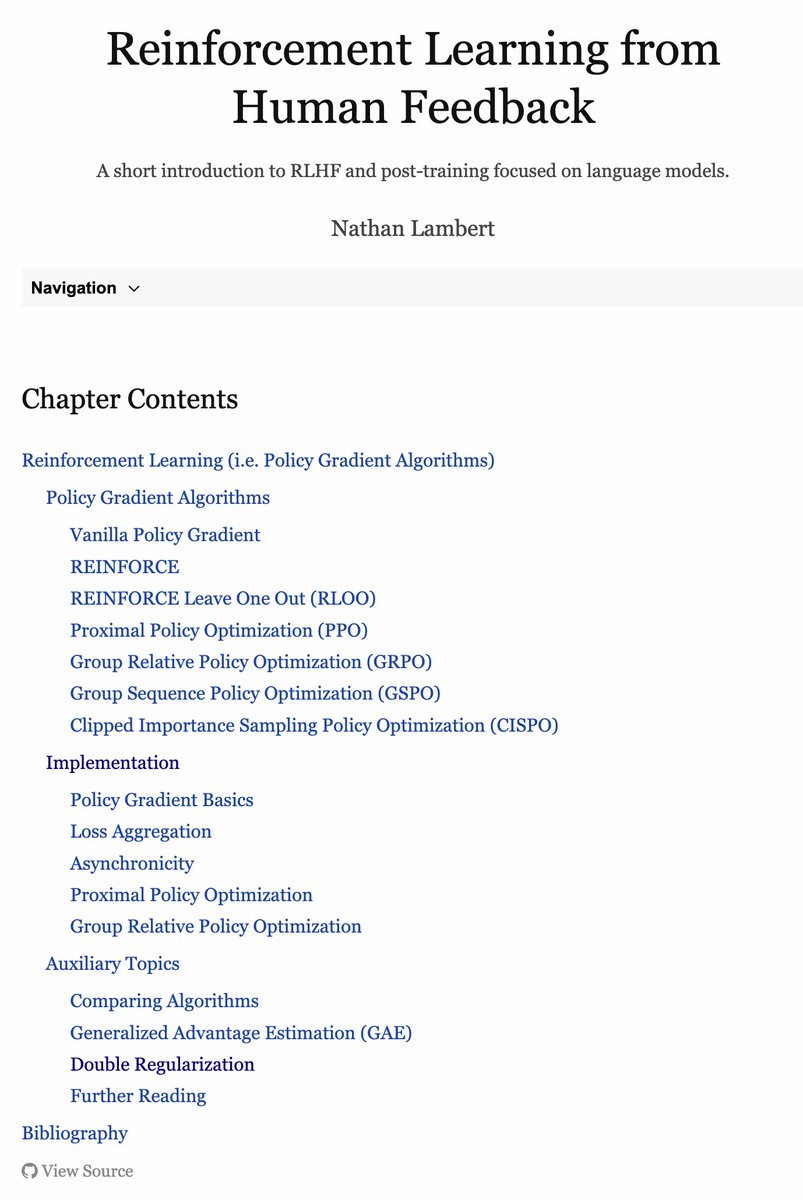
While RL for LLM reviews are in, a good time to remind people I've slowly added a ton of content with new algorithms and implementation tradeoffs to the RLHF book chapter on RL.
Proud of it, and I find it very useful myself.
https://t.co/QjnOE3T24L
Researchers trained a humanoid robot to play tennis using only 5 hours of motion capture data
The robot can now sustain multi-shot rallies with human players, hitting balls traveling >15 m/s with a ~90% success rate
AlphaGo for every sport is coming
New video! How do LLMs grow outrageously large yet blazingly fast?
The secret: Mixture of Experts (MoE)
In this video, we cover the role of FFNs, how to scale them up without slowing down, and how to maintain load balance and stability.
Full video here: https://t.co/rSGFZn7qVL
RLHF Book status update: lot's of great changes.
Over the past month I've been doing a top to bottom update to the RLHF book. All of these changes are reflected on the website rlhfbook dot com, and will soon be translated to the Manning early access version (MEAP), and then more improvements for the physical copy.
Overall, this took the PDF from ~150 to ~200 pages, the book is much more well rounded now.
Some of the larger changes:
- Updates to the RL chapter to add more algorithms like GSPO, CISPO, etc.
- Updated the big table of reasoning model tech reports (full list below). Added a section on Rubrics for RLVR.
- Updated the text in many chapters to better reflect best practices of today.
- Many clarity fixes throughout, adding better transitions, introductions, etc.
- More consistent notation throughout the book.
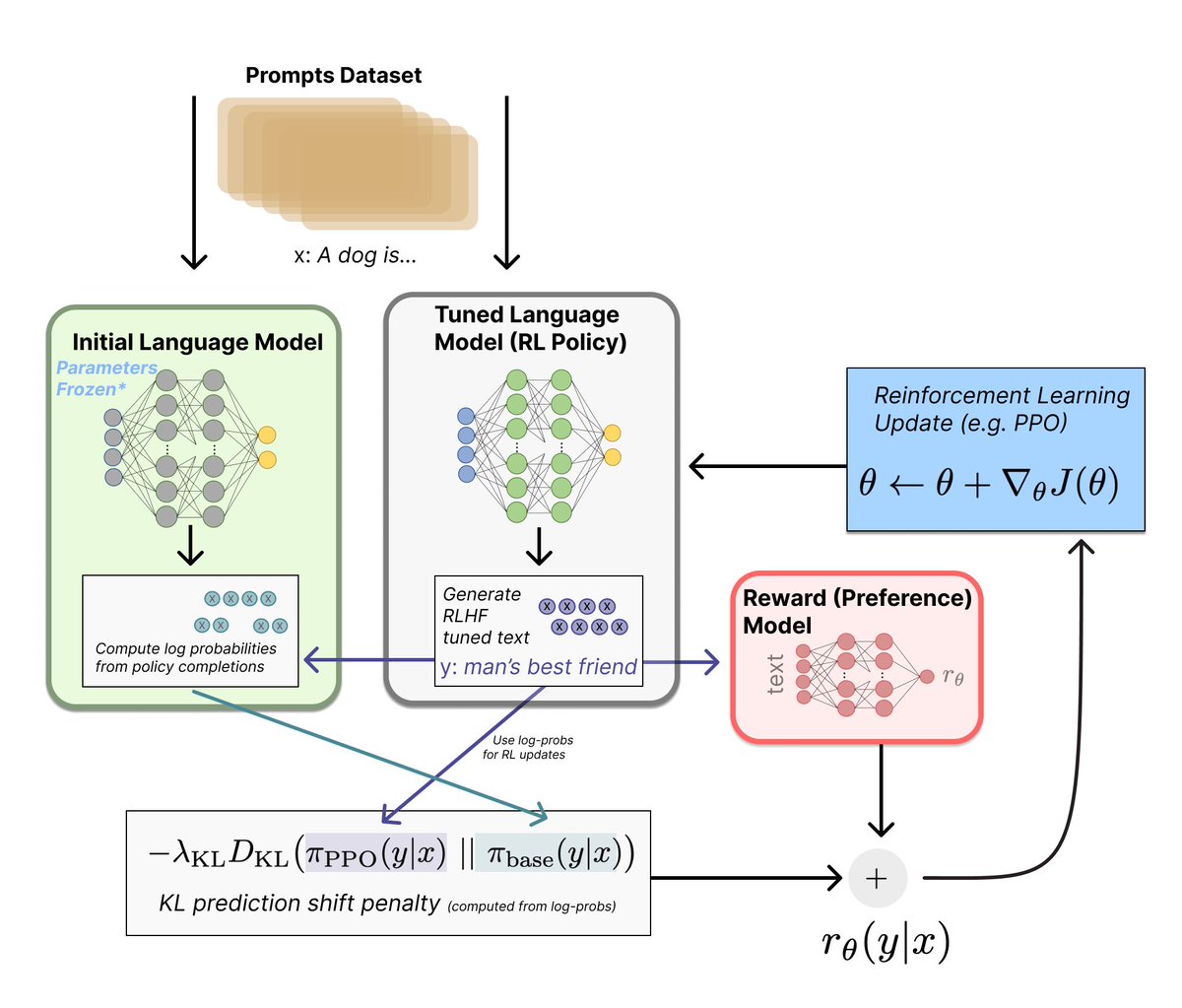
I strongly recommend taking a look again if you only looked in the first half of 2025. There are also many surprising details, such as fixing this attached RLHF system diagram you may recognize from my first HuggingFace RLHF blog post in December of 2022, it had a bunch of minor errors.
Next step I'm going to be focusing on making the physical Manning book great. The content will flow more smoothly than the web version (i'm trying to not change the links), such as linking the constitutional AI and synthetic data chapters. Overall this should make it read better from front to back. Also, all the diagrams and content will be designed to have a much more elegant presentation.
Thanks for reading and feedback!
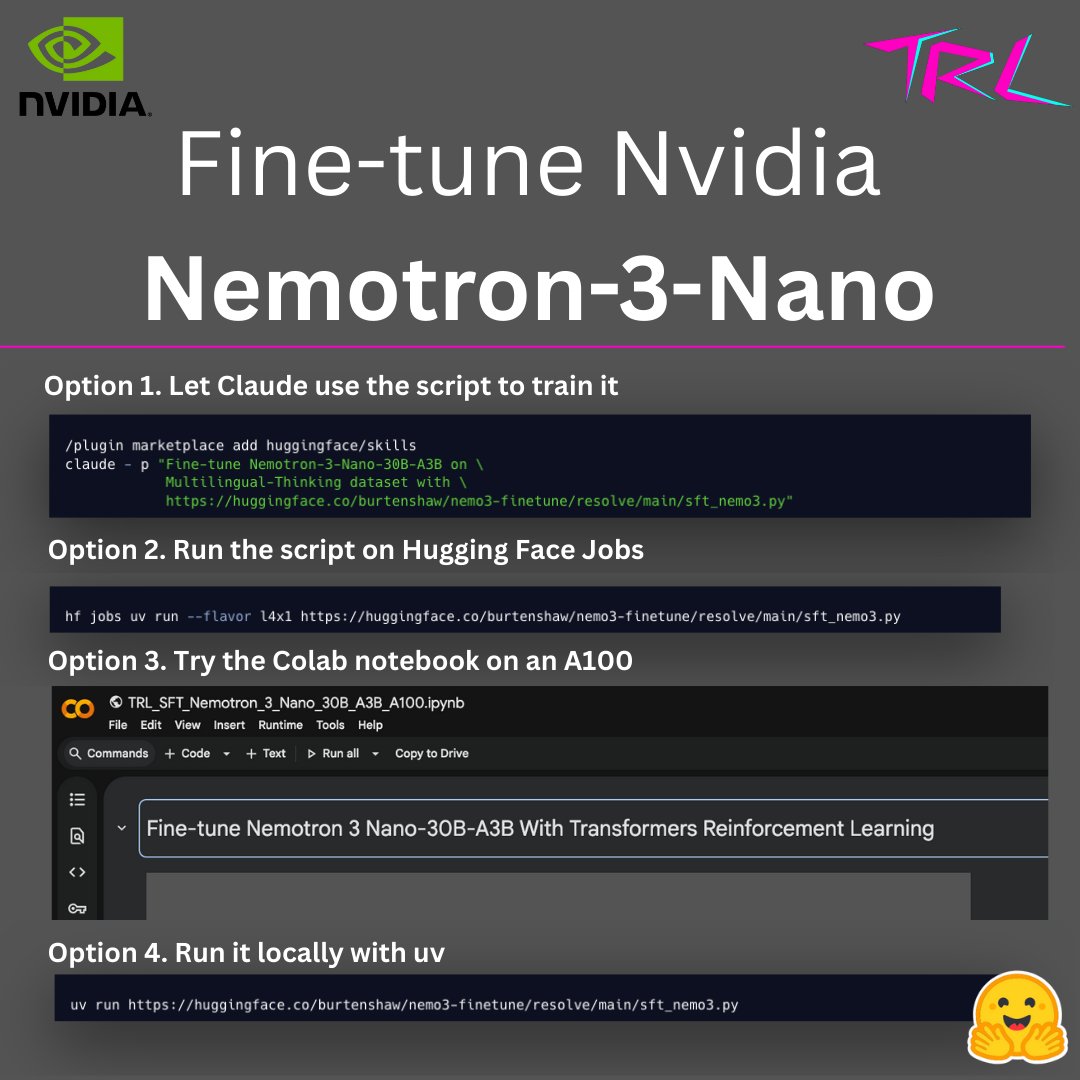
Fine-tune Nemotron 3 Nano in TRL with coding agents like claude code, colab, locally or on the hub.
To fine tune, pick one of these tools:
- Combine HF skills with a coding agent like claude code.
- Use this colab notebook.
- Train it on HF jobs using the Hugging Face hub
- If you can, run this script on your own setup with uv
This should get anyone started with fine tuning, and this is the perfect model to start with.
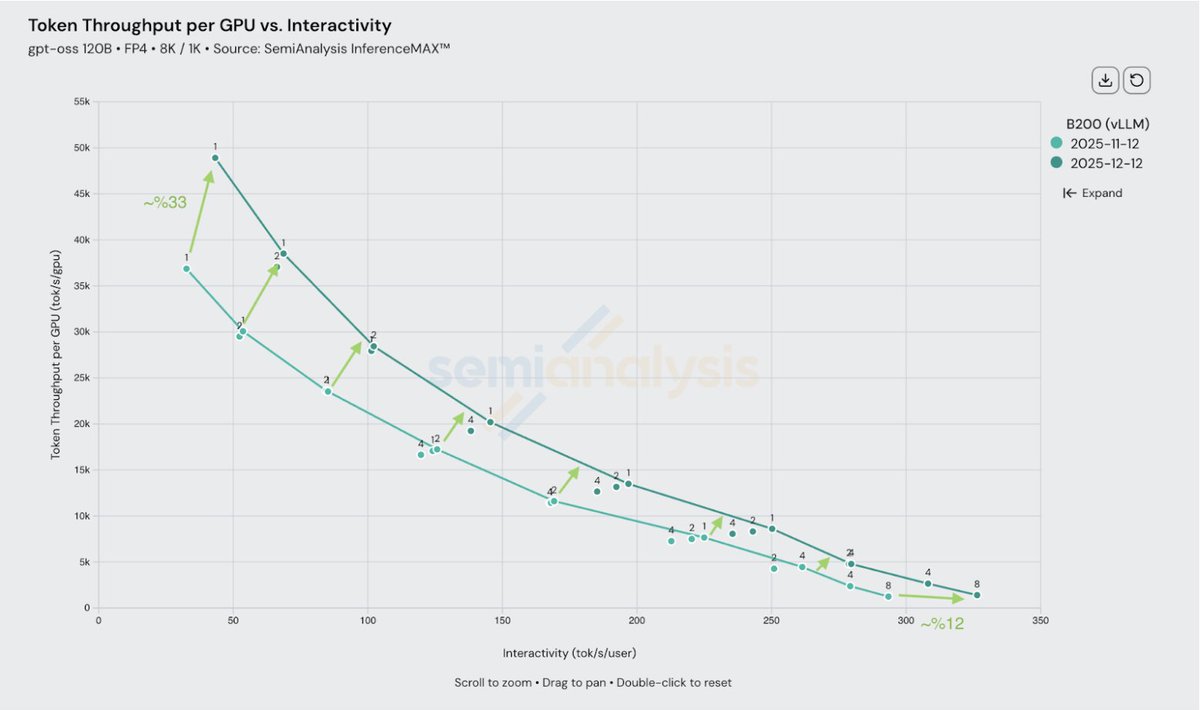
vLLM delivers even more inference performance with the same GPU platform.
In just 1 month, we've worked with NVIDIA to increase @nvidia Blackwell maximum throughput per GPU by up to 33% -- significantly reducing cost per token -- while also enabling even higher peak speed for the most latency-sensitive use cases powered by deep PyTorch integration and collaboration.
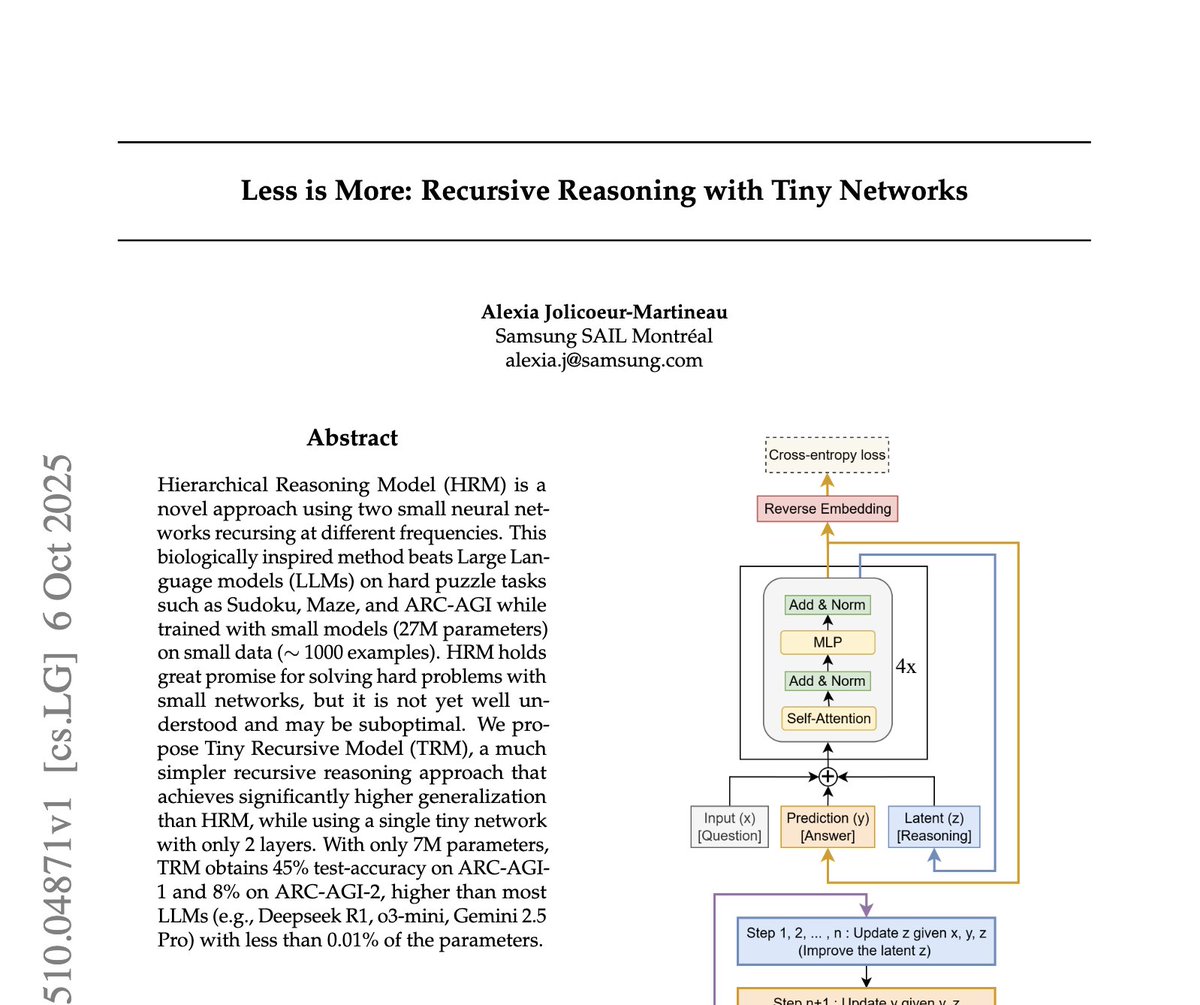
Recursive reasoning beats multi-billion-parameter models
You can now easily train your own 7M param model from scratch and outperform DeepSeek-r1 on ARC-AGI 1
We provide a simple speedrun script that handles setup, training, and eval in one go.
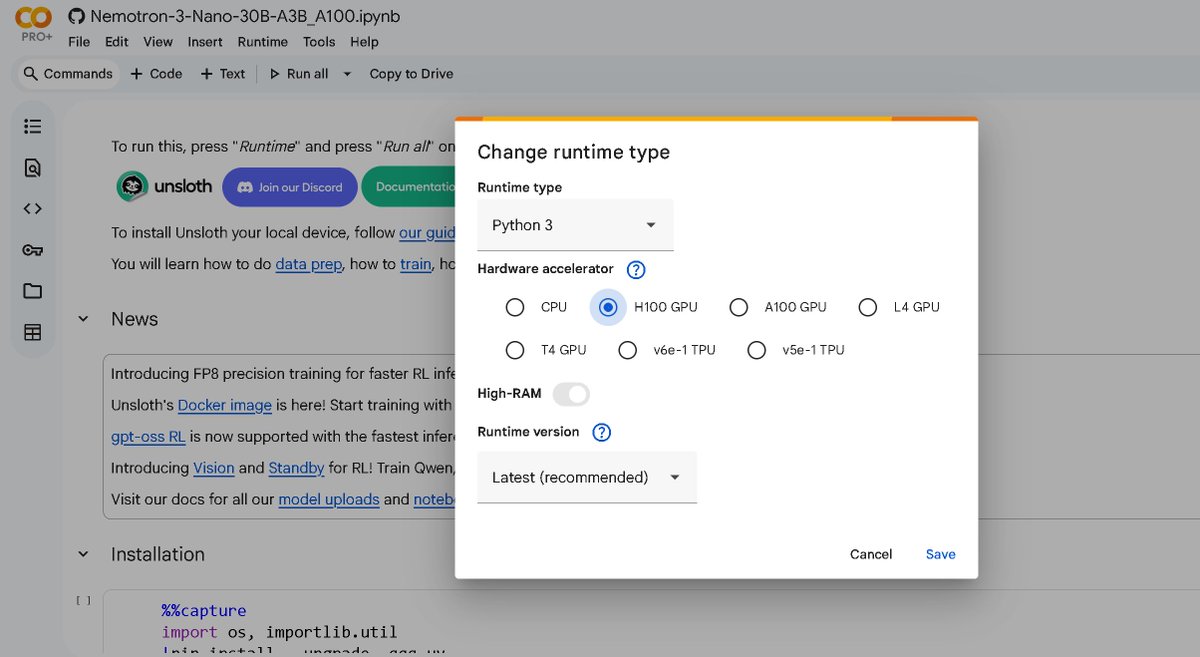
H100s are coming to @GoogleColab?!
Colab added A100 80GB a few months back, costing $0.752 ph. I haven't gotten a H100 yet via Colab, but am excited!
We also have some 80GB notebooks in Unsloth like 500K context gpt-oss finetuning: https://t.co/FF0404IviI
NEWS: NVIDIA announces the NVIDIA Nemotron 3 family of open models, data, and libraries, offering a transparent and efficient foundation for building specialized agentic AI across industries.
Nemotron 3 features a hybrid mixture-of-experts (MoE) architecture and new open Nemotron pretraining and post-training datasets, paired with NeMo Gym, an open-source reinforcement learning library that enables scalable, verifiable agent training.
Read more: https://t.co/ldf247t3Zz
(1/n) Tiny-A2D: An Open Recipe to Turn Any AR LM into a Diffusion LM
Code (dLLM): https://t.co/Nv7d1t8Qin
Checkpoints: https://t.co/rpibkb2Xfq
With dLLM, you can turn ANY autoregressive LM into a diffusion LM (parallel generation + infilling) with minimal compute. Using this recipe, we built a 🤗collection of the smallest diffusion LMs that work well in practice.
Key takeaways:
1. Finetuned on Qwen3-0.6B, we obtain the strongest small (~0.5/0.6B) diffusion LMs to date.
2. The base AR LM matters: Investing compute in improving the base AR model is potentially more efficient than scaling compute during adaptation.
3. Block diffusion (BD3LM) generally outperforms vanilla masked diffusion (MDLM), especially on math-reasoning and coding tasks.
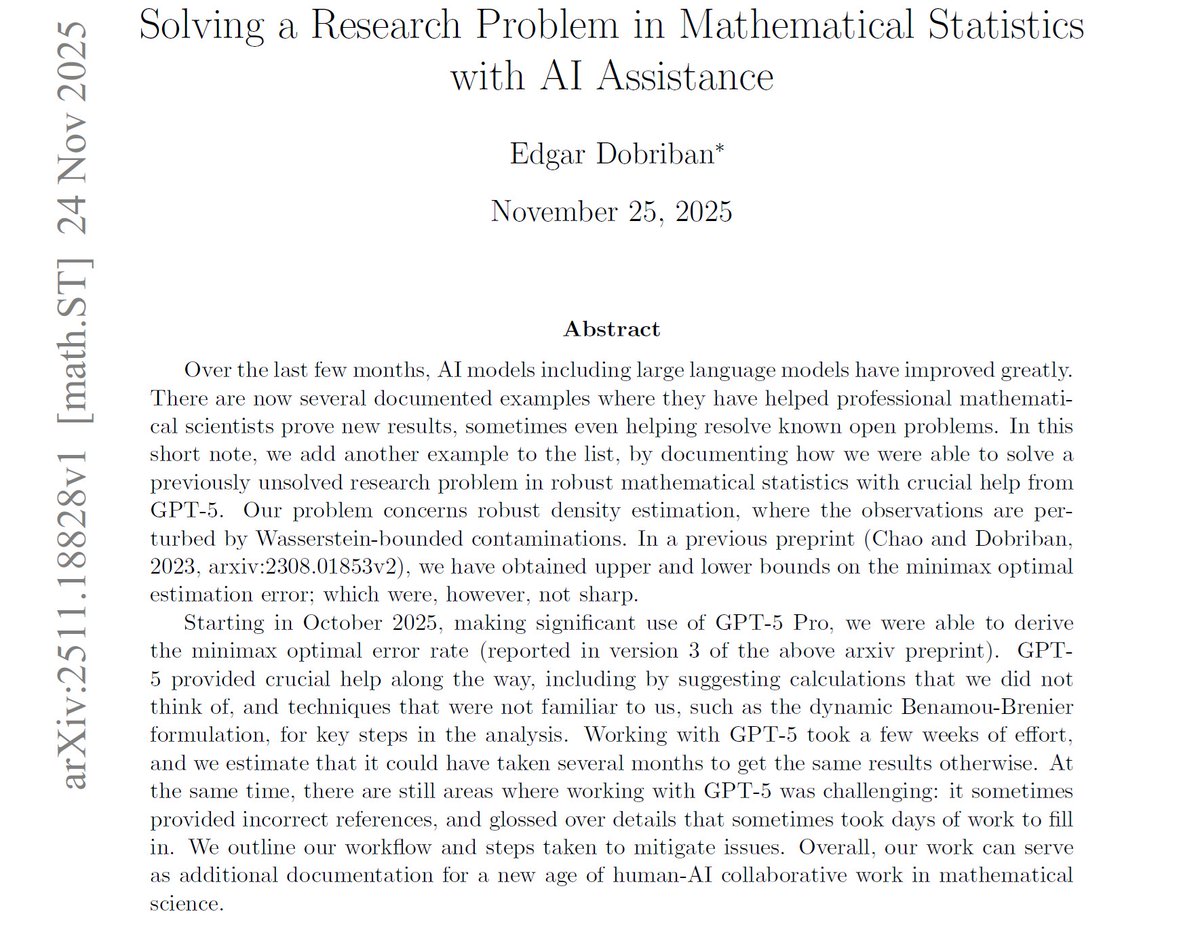
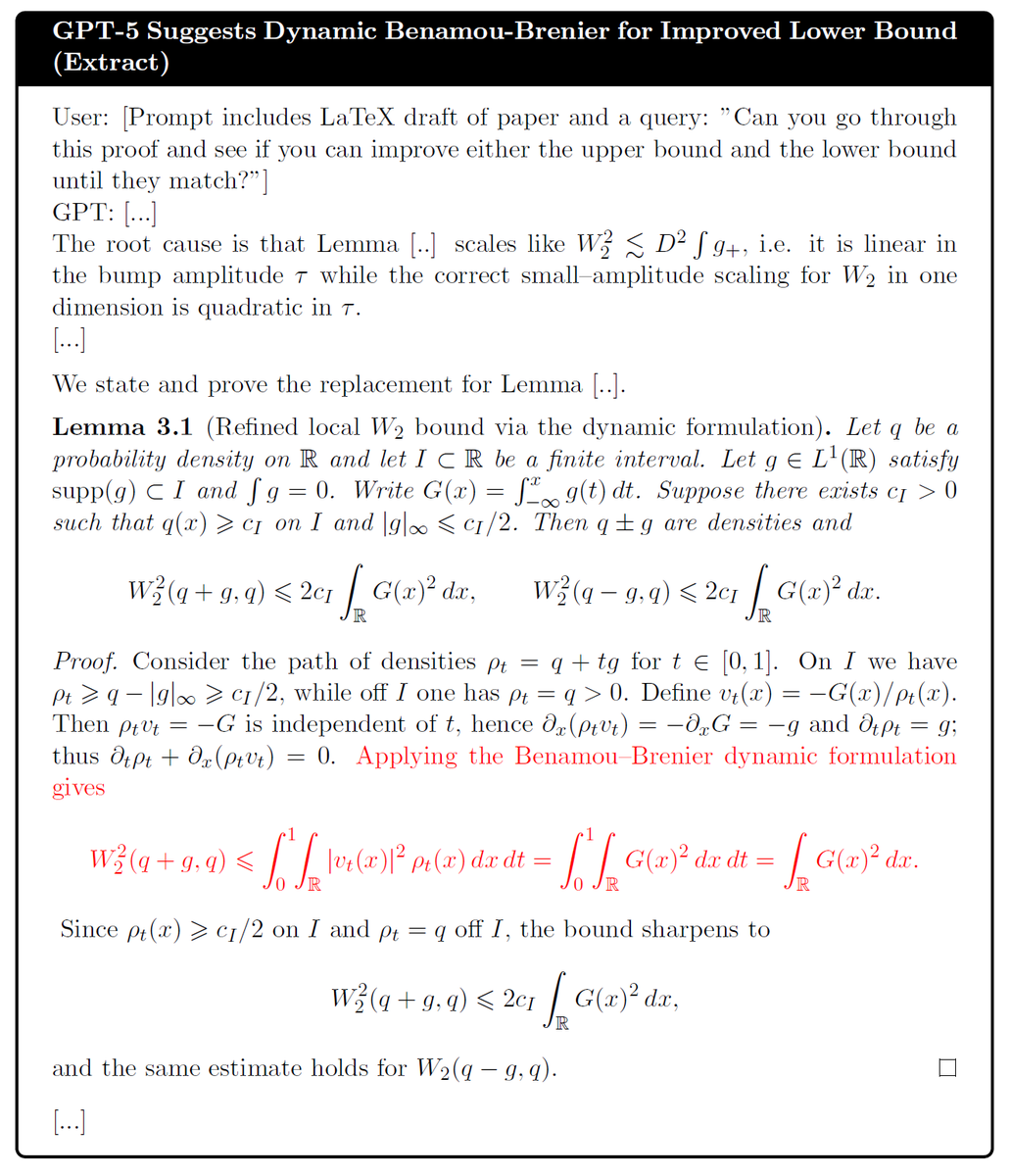
Adding to the list of AI assisting with new math results: Here is how I solved a research problem in mathematical statistics.
The problem concerns robust density estimation, a fundamental problem in statistics. Given a contaminated dataset (with Wasserstein-bounded perturbations), how well can we estimate its density?
I have worked on it with a PhD student for more than two years, geting suboptimal results.
With help from GPT-5, I was able to solve it in a few weeks.
GPT suggested calculations that I did not think of, and techniques that were not familiar to me, such as the dynamic Benamou-Brenier formulation of Wasserstein distance.
There is also room for improvement: the AI sometimes provided incorrect references, and glossed over details that sometimes took days of work to fill in. Nonetheless, it was clearly helpful overall, and I estimate that it saved several months of work.
See this pre-print documenting the process (https://t.co/HJvAzlHoUX), this pre-print for the result (https://t.co/ZyQTGtdfUv), and the thread below for details.
Olmo models are always a highlight due to them being fully transparent and their nice, detailed technical reports.
I am sure I'll talk more about the interesting training-related aspects from that 100-pager in the upcoming days and weeks.
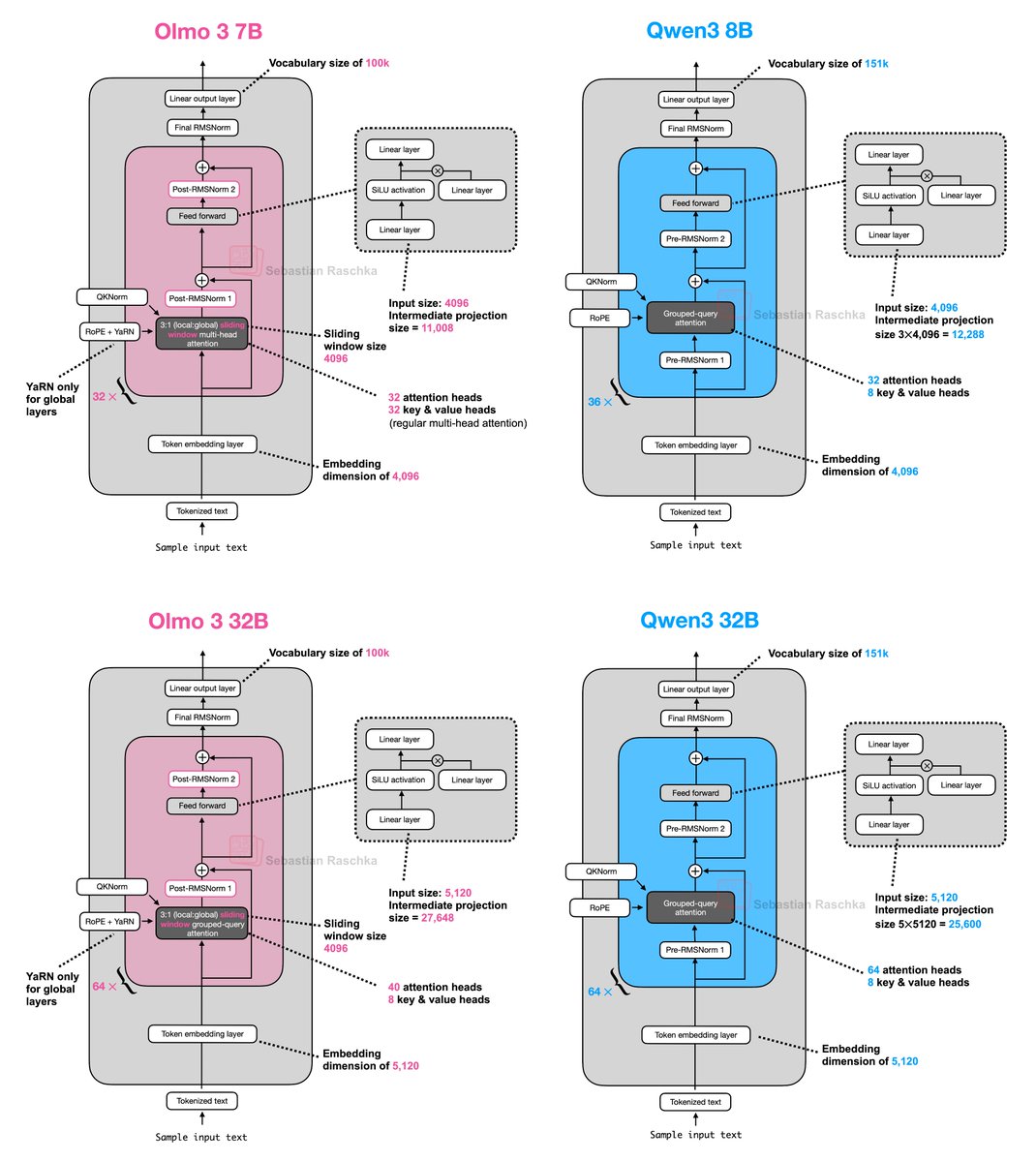
In the meantime, here's the side-by-side architecture comparison with Qwen3.
1) As we can see, the Olmo 3 architecture is relatively similar to Qwen3. However, it's worth noting that this is essentially likely inspired by the Olmo 2 predecessor, not Qwen3.
2) Similar to Olmo 2, Olmo 3 still uses a post-norm flavor instead of pre-norm, as they found in the Olmo 2 paper that it stabilizes the training.
3) Interestingly, the 7B model still uses multi-head attention similar to Olmo 2. However, to make things more efficient and shrink the KV cache size, they now use sliding window attention (e.g., similar to Gemma 3.)
Next, let's look at the 32B model.
4) Overall, it's the same architecture but just scaled up. Also, the proportions (e.g., going from the input to the intermediate size in the feed forward layer, and so on) roughly match the ones in Qwen3.
5) My guess is the architecture was initially somewhat smaller than Qwen3 due to the smaller vocabulary, and they then scaled up the intermediate size expansion from 5x in Qwen 3 to 5.4 in Olmo 3 to have a 32B model for a direct comparison.
6) Also, note that the 32B model (finally!) uses grouped query attention.
This is a tool we built for ourselves originally and can't live without it for our daily development. If you need access to heterogenous AI hardware (AMD, Apple, Intel, Nvidia, Tenstorrent...) at your fingertips for your development and creation workflows, and switch between them frequently, OxCapsule is your tool. We are giving access to our hardware cluster for select few users now. Eventually we want to release this as a tool you can install on your own edge infra. Please watch the video to see how one of our creators uses this infrastructure...and yes OxCapsule enables both compute and pixel streaming..
LoRA makes fine-tuning more accessible, but it's unclear how it compares to full fine-tuning. We find that the performance often matches closely---more often than you might expect. In our latest Connectionism post, we share our experimental results and recommendations for LoRA.
https://t.co/fYV4FPi71m