great pod. great breakdown re: memory into four parallel systems instead of one big thing. don’t think many are breaking it down like that yet. also the example with an agent making the same mistake 50 times doesn’t need a memory - probably needs a better rule or skill. maybe that’s why memory is getting conflated with continual learning (we’re still early)
BUILD YOUR OWN SOFTWARE FACTORY
The best companies in the world are all building their own software factories, using a combination of first party and third party tools.
The software factory is a set of background coding agents running in the cloud. Anyone at the company, engineering or otherwise, can invoke it from their phone or laptop. Different agents spec out the feature, submit a PR, do the review, and merge it into the target branch. (With the right human approvals based on the repo)
As @ericwilliamrea, CEO of @PodiumHQ , says: “one of our customers was having a problem; I tagged our software factory in the feedback on Slack; it went and cut a PR and built it and 15 minutes later we had a fix”.
CEOs: THIS is the best way to get your entire team - your PMs, designers, sales, marketers, execs - involved in the product development process.
Put a small dedicated team on building and continually improving your own software factory. The improvement in your team’s product velocity will be palpable.
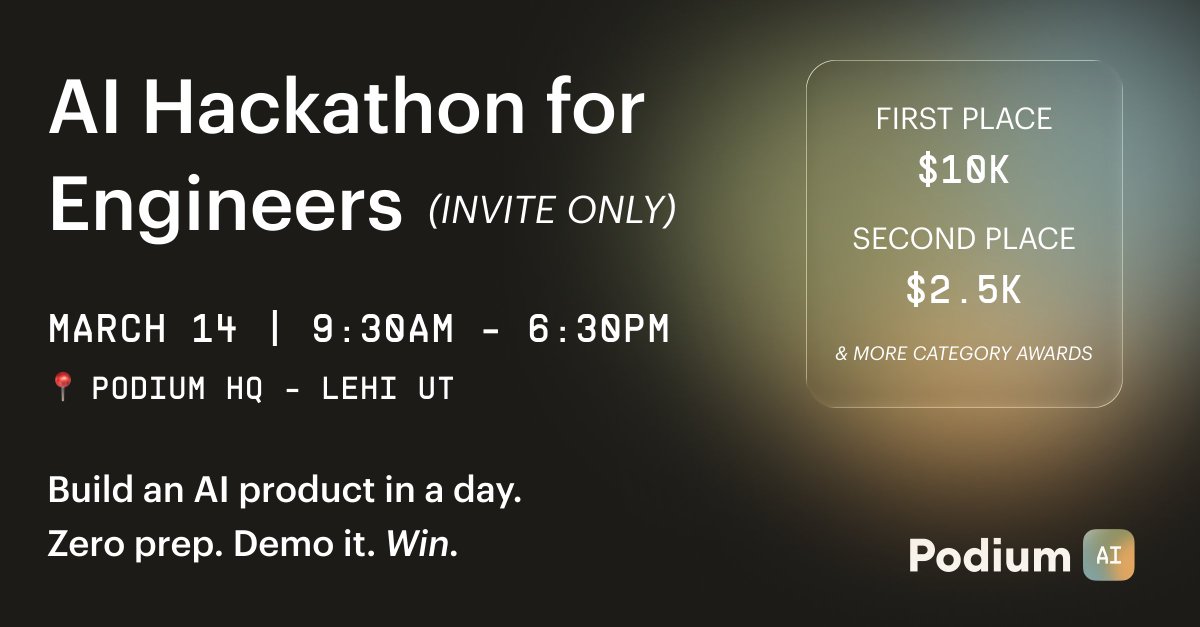
The last time we ran a hackathon at @PodiumHQ , it turned into our fastest-growing product in company history. We're doing it again, and this time anyone can compete.
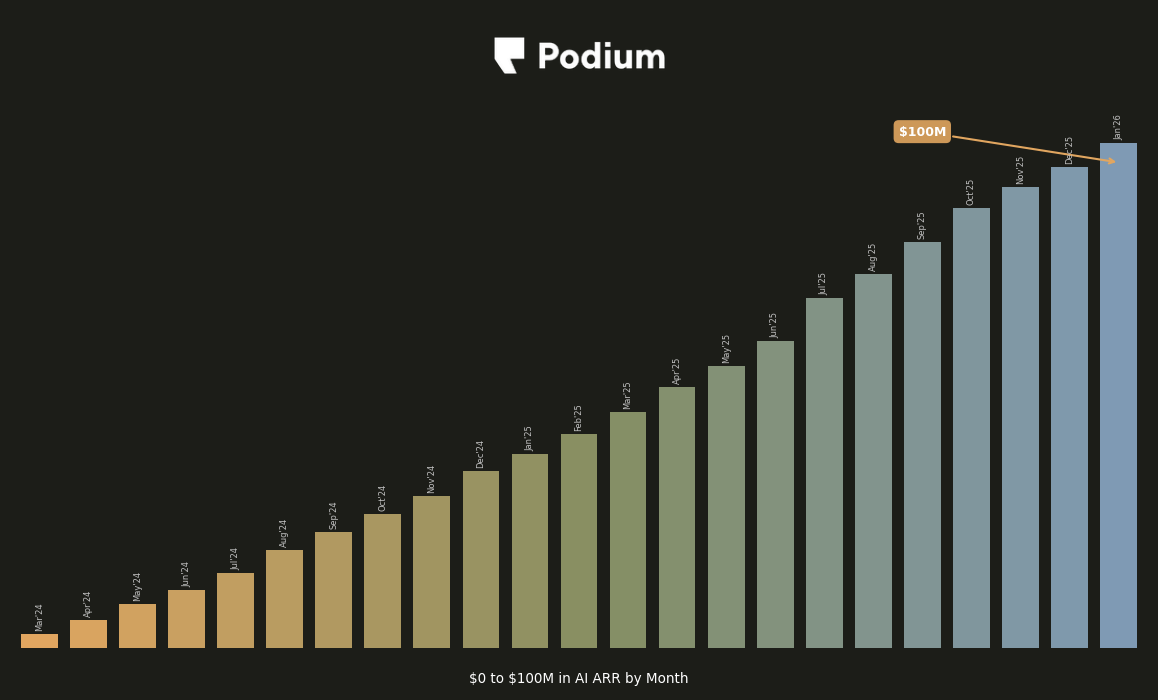
A week after ChatGPT launched, we ran an internal hackathon. One team built an AI sales agent that could convert inbound leads into scheduled test drives. That became Jerry. Jerry scaled from $0 to $100M in AI ARR in under 24 months.
It all started with a weekend and a team willing to just go build something.
We're doing it again. On March 14th, we're opening our doors at our HQ in Lehi, UT for an AI Engineering Hackathon. $10,000 to the winning team.
This will be a competitive, invite-only event where you can explore new ideas and push yourself alongside other top engineers.
Click below to register. We’re excited to see what you build!
Event details and registration: https://t.co/M5NFp6n0PP
We just crossed $100M in AI agent ARR in under 24 months.
Not because of a viral launch or AI hype.
But because of a crazy bet we made in 2023.
At the end of 2023, over 60k local businesses were using @PodiumHQ to centralize their leads and customer communication into one platform.
It’s a great product. Customers convert more leads and make more money with it.
But one reality became impossible to ignore:
Our customers’ biggest constraint isn’t software. It’s staffing.
→ 75% annual turnover
→ 30% of leads come after hours
→ Every missed call can be $20,000+ in lost revenue
Business owners don’t care about software.
They care about making money.
And the best software in the world doesn’t matter if there aren’t enough people to run it.
So we built Jerry, the perfect user of our own platform.
Not a chatbot. An AI employee that uses Podium to:
- Qualify and schedule every lead
- Handle objections and follow up
- Learn through natural-language coaching
- Work 24/7
Demos are easy.
Real AI employees are not.
To work in the real world, AI has to think, act, understand context, and use tools.
It has to handle thousands of edge cases every day.
It has to be coachable. Like a human.
That leap is enormous.
Agents aren’t a feature. They’re the foundation.
That’s why we rebuilt Podium as an AI-first system of agents.
Today:
- 10,000+ AI agents live in production
- AI now outperforms humans in many jobs
- $100M+ in AI agent ARR, and accelerating
This is still day one.
The future isn’t software. It's AI employees that do the work and unlock growth for businesses.
We’re early in building what we believe will become the most impactful AI employee ecosystem for the $3T SMB market.
We’ve seen 300% year-over-year AI revenue growth and we’re just getting started.
This illustrates an aspect of AI that I hadn't thought about till now: it cuts through bureaucracy. If a big organization is paralyzed by indecision, AI doesn't care. It will happily generate a version 1. And that becomes the starting point, because there is no other version 1.
Real talk from the Manus team: whenever a teammate shares a “plan” or “strategy” for what we should do next, I usually don’t read it in detail.
I just say: yes. Because most of the time, the plan itself isn’t that necessary—having one is fine, not having one is also fine.
What actually matters is moving fast, shipping real deliverables, and calibrating constantly through tight loops of action → feedback → adjustment. In a startup environment, things change too quickly. A “perfect roadmap” you write today can become irrelevant tomorrow.
So I care more about making the next move small, fast, and real: ship first, learn fast, then iterate. Over time, that speed builds something even more valuable than a document—it trains intuition. Not guesswork, but intuition forged in uncertainty and sharpened by real feedback.