How do humans and large language models (LLMs) represent sentences? Liu et al. design a rule inference task, revealling that both humans and LLMs implicitly decomposes a sentence into tree-structured constituents.
https://t.co/i8M78etO06
Integrating and interpreting brain maps | https://t.co/0Zjdr3nRUQ
Imaging and recording technologies make it possible to map multiple biological features of the brain. How do we conceptually integrate these features into a coherent understanding of structure and function? ⤵️
Thank you, @kensycoop, for having me on! We had a great conversation about shamanism—its cognitive foundations, place in Paleolithic societies, role in Abrahamic religions, manifestations in industrialized societies (including hedge wizards), and much more.
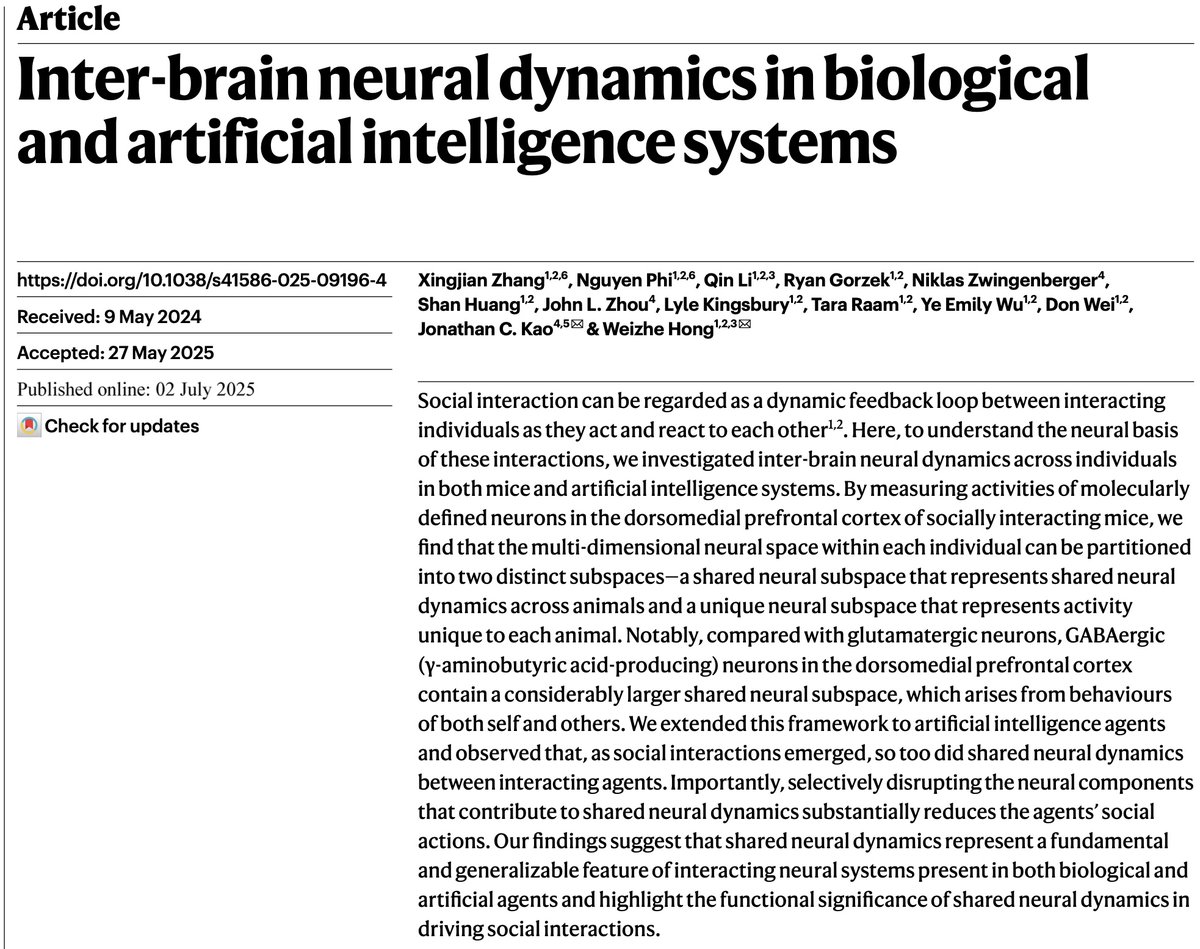
Thrilled to share our latest work in @Nature studying inter-brain neural dynamics in both biological and artificial intelligence systems — amazing work by @xzh_brain, Nguyen Phi, and fantastic collaboration with @JonathanCKao! Read the full article here: https://t.co/oCSg8JIWxQ
New research suggests infant-directed communication expanded in humans and likely emerged after diverging from our great ape common ancestor approximately 6 to 8 million years ago.
Learn more in this week’s issue of Science Advances: https://t.co/IU3DX44PBb
I was really excited when I saw this study being presented at @ICArEHB last January and I'm really glad to see the paper out! Amazing record of cultural transmission strategies & cultural traits over 3 million years 🤩
https://t.co/0MGnXmDxfj
Interested in working with monkeys?🐒 Curious what baby marmoset monkey babbling means?🍼🗣️ We’re looking for a research assistant or a potential master student that will work with us to answer these questions! Please reach out for more information: [email protected]
The origins of #language. Wild #chimpanzees alter single calls' meaning when embedding them into call combinations. Study led by Cédric Girard-Buttoz, Cathy Crockford & Roman Wittig. @CNRS@MPI_EVA_Leipzig@ISC_MJ@TaiChimpProject https://t.co/XGErZqhnNA & https://t.co/8vYpfEpbec
#Human capacity to develop a diverse and highly complex repertoire of #action plans is truly remarkable 🏌️♀️⛹️♀️Irina Barnaveli & team @doellerlab explore in their study @NatureComms how the #brain organizes action plans, using #virtualreality: https://t.co/0egDAn6RLp
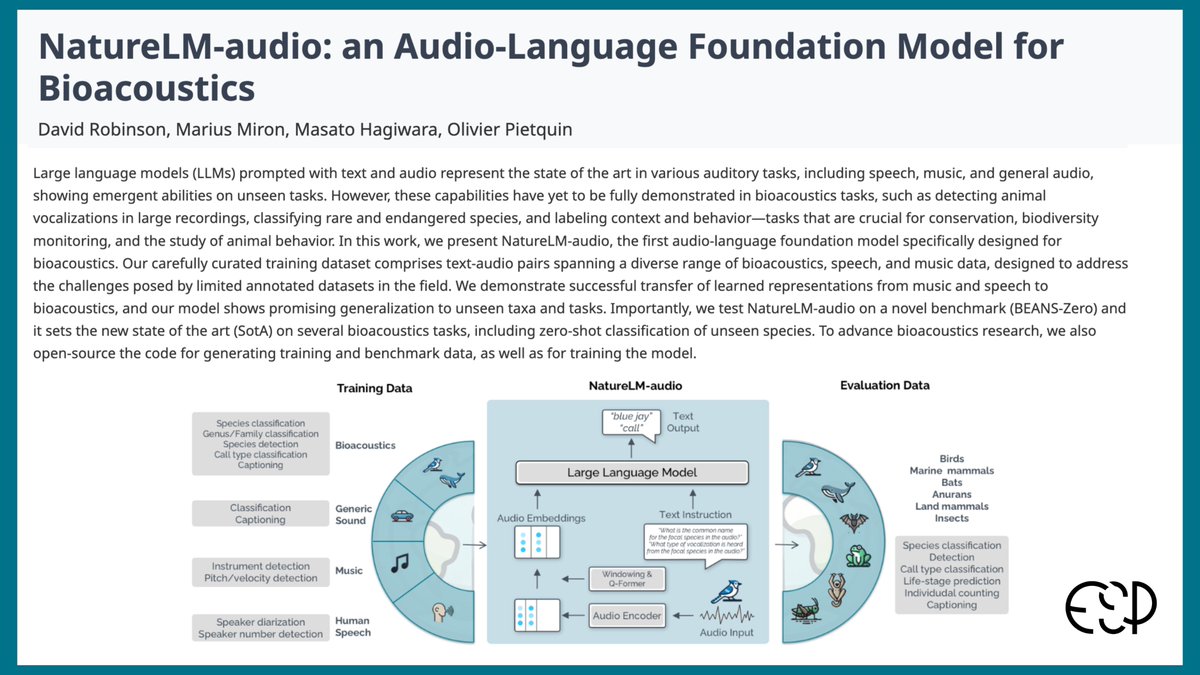
📢 We've open-sourced NatureLM-audio, the first audio-language foundation model for #bioacoustics.
Trained on large-scale animal vocalization, human speech & music datasets, the model enables zero-shot classification, detection & querying across diverse species & environments 👇🏽
Philosophy is one of humanity’s oldest systems of institutionalized knowledge production, predating science by thousands of years. But not all eras are equal. Some are marked by debate and innovation, others by the preservation of tradition.
What drives these differences? In this preprint, we use tools from network science to explore the dynamics that distinguish different eras of philosophical discourse.
How did vocal communication come to dominate human language? In our new @PLOSBiology paper @NeuroSLAMlab and I suggest the uterine environment might represent a small but significant piece of the language evolution puzzle! @NCCR_Language@UZH_Science
https://t.co/HXoe6oZipd
‼️ The Konso were long known for their #women#knappers. We now document their unique #ToolStone#HeatTreatment to enhance fracture qualities
https://t.co/ouQeDYn8Sn
Examining Congressional speeches from 1879 to 2022, Aroyehun et al. suggest that evidence-based language has continued to decline since the mid-1970s, together with a decline in legislative productivity. @dgarcia_eu@uni-konstanz.de
https://t.co/IPbVCRm6Vi