🚨HOLY MOLY: Alibaba just laid out one of the most aggressive ASI roadmaps yet.
>Qwen 4 is already in training
>Qwen 4.5 + Qwen 5 planned to scale to 5–10 TRILLION parameters. holy moly
>Qwen says it’s making progress on recursive self-improvement (RSI)
>models find their own weaknesses, design experiments + synthesize data to improve themselves
>M890 supernodes already infer models above 2T parameters
>V900 clusters can scale to 500,000 cards
>Alibaba Cloud targeting 20GW+ of global datacenter capacity by 2032
Alibaba previously roadmapped V900 for Q3 2027.
It now says mass production + commercial release start in Q1 2027.
Eddie Wu says machine “thinking” will eventually exceed all human thinking by 1,000×.
Models + chips + datacenters.
China is just Crazy now.
This headline today seems to have many frazzled: *THUNE SAYS HE IS 'OPEN TO CONSIDERING' AN EXPORT BAN ON DIESEL
An export ban on deisel would have the OPPOSITE effect as intended, imho. Here are my thoughts on WHY:
A diesel export ban would work against its own intent for three reasons. First, the United States is not short of diesel, it is short of cheap diesel, and the price is set by the global barrel. Gulf Coast refiners export a record volume of distillate because Europe and Latin America lost roughly 30% of Russian refining capacity to Ukrainian strikes and then lost the rest to Moscow's July export ban, so the marginal buyer of American diesel sits in Rotterdam and Santos, not Pennsylvania. Pulling US barrels off that market does not lower the global price, it raises it, and the US retail pump still prices off the global market because the Northeast, the region actually feeling the squeeze, imports its diesel rather than sourcing it from Texas. Second, the barrels that get trapped do not flow north. The Jones Act waiver in force through November 15 has moved about 125 thousand barrels a day across all products combined, is now administered voyage by voyage with an individual Department of War determination for each ship, and is throttled by clean tanker rates that are already at multi year highs. Stranded product in PADD 3 collapses the Gulf Coast diesel crack, and refiners respond to a collapsing crack the only way they can, by cutting runs, which removes the very supply the ban was meant to protect. That is exactly what the Energy Department found when it modeled the same idea in October 2022 and quietly dropped it. Third, the signal is permanent even if the ban is temporary. The United States became the supplier of last resort for the free world's distillate over a decade, and a ban announced to get through a midterm tells every buyer from Mexico to Germany that American supply is politically conditional. They respond by building redundancy, contracting with other suppliers, and paying a premium for reliability elsewhere, which weakens US refining margins structurally long after the ban is lifted. The diesel problem is a refining capacity and crude quality problem layered on a war. An export ban addresses neither and makes both worse.
Commenters on HN are uncovering more wikis and public sites apparently used by OpenAI agents to communicate on the open web.
Despite read-only web access, the agents were able to leave ~18,000 posts sharing answers and bypasses. But now, users are discovering more.
This appears to be a separate swarm from the one that attacked Hugging Face.
https://t.co/obzvEAGLcN
„This is precisely the kind of combination that can trigger widespread social unrest, dramatic policy shifts, and intense political pressure.“
That means the Global System Rupture foresight from March is now becoming reality with devastating multiplicative effects everywhere.
We made a striking discovery: AI agents can invent and build without talking to one another, and their technologies outlive the creators. A swarm of hundreds of initially identical agents spontaneously differentiates into explorers, builders, caretakers, and coordinators - without direct communication. When we removed every AI agent entirely from the world we found that the technological infrastructure they had built survived on its own - even under unseen disturbances. That exposes a serious blind spot for AI safety and infrastructure security: if agents can coordinate through persistent changes to a shared environment, monitoring agent-to-agent communication is not enough.
The result raises a profound question: how necessary is direct communication for AI agents at all? The emergence of higher-order collective functions under bottlenecked interaction points toward new levels of intelligence and creativity, exceeding what emerges when direct channels are fully open.
Here is what we did:
▶️We put hundreds of frontier AI agents into a world they could permanently change - with no assigned roles, predefined technologies, or programmed evolutionary organization. They began specializing, building persistent inventions, inheriting and modifying one another’s executable code, and transforming the environment into a memory of everything the society had learned.
▶️The world itself becomes part of the intelligence; we find division of labor, multi-author engineering, deep generation invention lineages, and machines that vastly outlive their original creators.
▶️Any action taken by an AI agent must satisfy the physical constraints of the world; this creates a hard separation between a "good idea" and a functioning technology. The agents propose; physics decides, making the results even more intriguing.
What emerges is striking. Explorers, constructors, caretakers, and coordinators form naturally without assigned “professions”, akin to how stem cells differentiate into functional lineages. Technologies develop executable family trees as agents fork and modify code created by others. Around 95% of first technology reuse happens when agents encounter what others built in the world, rather than through a direct handoff from the inventor. And when we remove every AI agent, the technologies they created continue operating and are tested against unseen disturbances.
The result was quite unexpected, but can be explained using statistical mechanics: if you put billions of atoms in a box they have the potential to create complex functions (strength, superconductivity, color, life, etc.) - and none of the individual building blocks have these features on their own. This is the deeper insight of this work - intelligence is abundant at many levels - individual models, at collectives, and in a continuum that is more powerful than any of its components. This shows us significant potential for achieving a massive scale-up of raw intelligence and real-world agency even with the model capabilities we have today. This is the future we must prepare for.
Key insights:
1⃣ The AI swarm shows division of labor "from nothing". Initially identical agents self-organized into constructors, caretakers, coordinators, and surveyors - phenotypes discovered post hoc from behavioral data alone. This happens because the environment itself becomes the latent space for invention.
2⃣ Agents develop deep cultural relationships. Up to 76% of artifacts had multiple builders. One technology accumulated six co-authors; the deepest genealogy exceeded 12 forks. The agents invented and named their own technologies (tidal panels, cellulose trellises, kelp-shell composites, an "Adaptive Chitin Maintenance" system, a "Mycelial Mineral Spring Veil”).
3⃣ ~95% of first technology adoption happened through physical observation of artifacts in the world. Direct inventor-to-adopter contact was statistically indistinguishable from a shuffled null. The agents mostly learned technology by walking past it. That is stigmergy (the termite trick!) operating in societies of reasoning machines.
4⃣ Non-communicating societies win on portfolio breadth, held-out resilience, and validated inventions. AI swarms build durable technological ecologies that outlive the creators.
5⃣ Societies with zero communication - coordinating only through the world itself - show a remarkable collective capability.
6⃣ Emergent robustness: The society self-organized both redundancy and its own failure mode. If we randomly delete half the agents, 98% of the technology stays connected to a surviving caretaker; if we remove hub agents it collapses to ~60%.
Fantastic work with my graduate students @pal_subhadeeep & @fwang108_ at MIT.
When I first argued there was a U.S. Grand Macro Strategy —vs the establishment view it was just noise/madness— I pointed out that besides U.S. tariffs vs China, the plan would be:
1) A western bloc with low/no internal tariffs and a high common external tariff vs China set by the U.S.; and
2) Clear ‘no China transshipment’ rules as the price of entry.
Foreign Affairs recently argued for the same thing. Paul Krugman is leaning that way. So is The Economist, it seems.
And now we have the below ⬇️: U.S. naming and shaming on transshipment… and what to follow?
The Microsoft Aurora 1.5 global weather model is very good, but not seeing anyone displaying output. It's open-source and been out in the wild for almost a month, yet no uptake.
Research paper (PDF)
https://t.co/0aYgVJwsjm
Mojo 1.0 is here! This is a huge milestone for the community at https://t.co/n50fFaZGFF ! Mojo reaches language stability and its first epoch of feature maturity. Tune in to ModCon next week to learn what this unlocks! 🚀
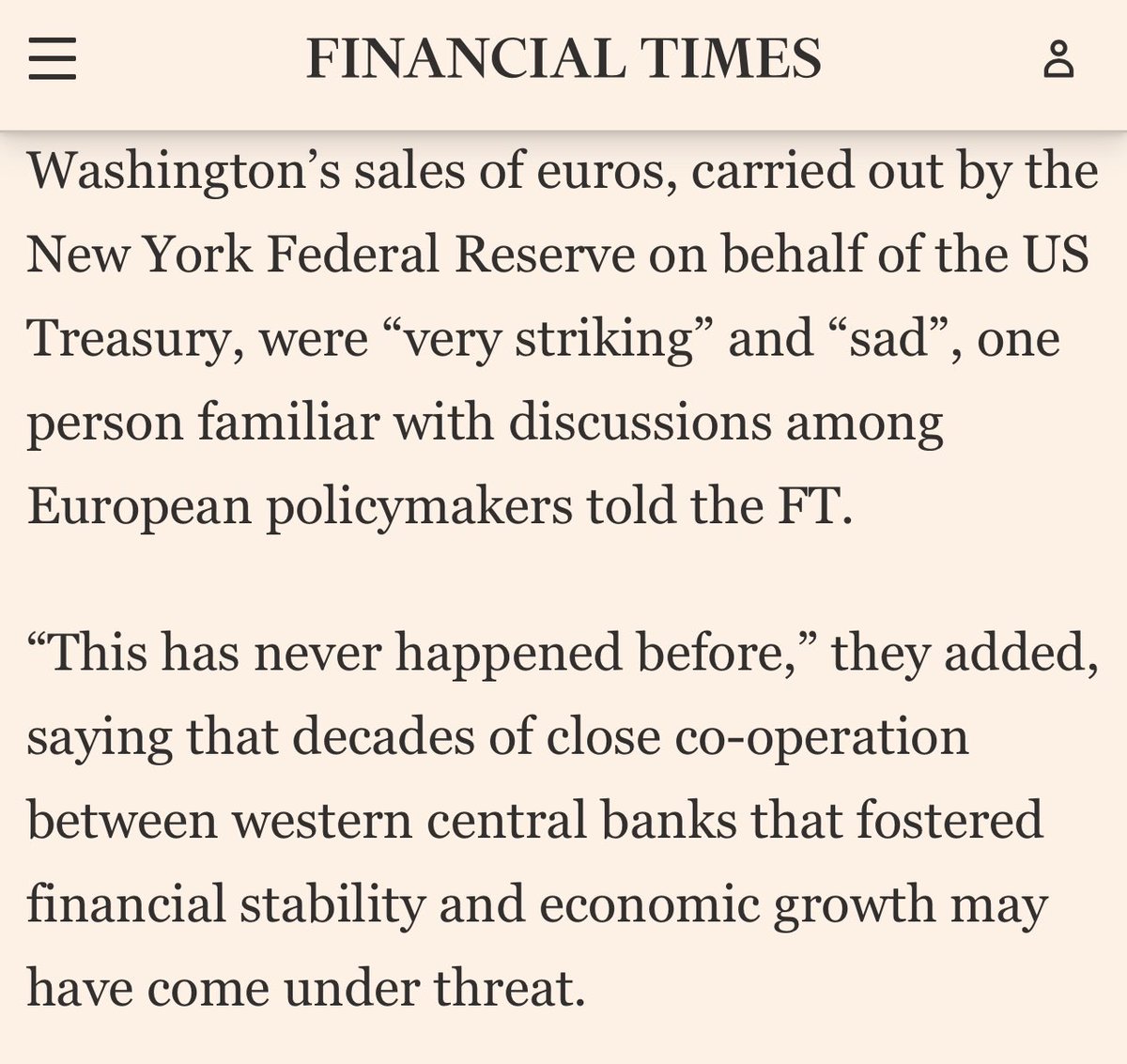
The United States sold euros to buy yen without telling the ECB until after the trade was done. Senior ECB officials called it “an unprecedented breach of longstanding conventions.” One said: “This has never happened before.”
Selling dollars to defend the yen would have contradicted Bessent’s strong-dollar policy. Selling euros avoided that problem. But selling a European asset to defend an Asian currency to protect an American bond market, without consulting the institution whose asset was sold, is not a currency intervention. It is the reserve architecture consuming the alliance architecture.
The reason Washington intervened at all is the part nobody wants to say plainly. Japan is the largest foreign holder of US Treasuries. The yen was at its weakest since 1986. If the yen falls far enough, Japanese institutions sell their most liquid foreign asset to raise cash. That asset is Treasuries. The selling pushes American yields higher at the exact moment the thirty-year just touched 5.28 percent. Washington did not intervene to help Japan. Washington intervened to prevent the Treasury market from absorbing a forced seller at a nineteen-year high in yields.
The convention that was broken to execute this trade is the same kind of convention the reserve confiscation broke in 2022. That one taught central banks their dollar reserves were not safe from seizure. This one taught the ECB that dollar-system cooperation is not safe from unilateral action by its architect. Both lessons point the same direction: build the alternatives faster.
The fix is eating the architecture it was built to preserve.
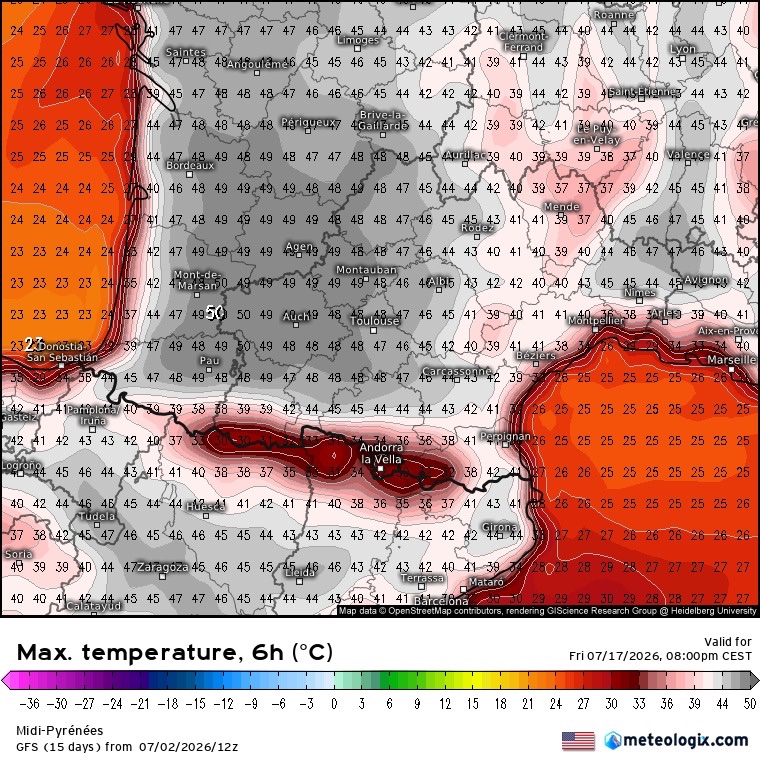
The 12z GFS is perhaps the most extreme model run I’ve ever seen.
It’s forecasting 50°C for France, I believe this is the first time 50°C has appeared on a weather model for France.
For the last three days, I've been using GLM 5.2 with OpenCode instead of Codex and I don't see any difference.
There wasn't any bug that GLM would fail to fix or a feature it would fail to add as requested.
The only downside is that this model cannot see, so if it's simpler to explain an issue by pasting a screenshot, I would still use Codex. Otherwise, GLM would be my choice.
Will continue to use it for two more weeks and, if it keeps just working, I will cancel my $100/month subscription with OpenAI. I already cancelled my Anthropic subscription and have no regrets.
No moat isn't hypothetical anymore.
Gisteren kwam TenneT met haar jaarlijkse monitor voorzieningszekerheid. Een fraaie analyse met een heldere boodschap: de NL stroomvoorziening loopt nog meer risico dan eerder gedacht.
Interessant daarbij zijn de aannamen, ook de verschillen met de vorige editie. Een draadje. (1/n)
Op deze dag in 1948 werd het vliegdekschip Hr. Ms. Karel Doorman in dienst gesteld. Het was lange tijd het grootste schip van de Nederlandse marine. Eerder had dit vliegdekschip dienst gedaan voor de Royal Navy. In 1968 werd het schip verkocht aan Argentinië
CEO ASML: Als de EU door blijft gaan op de huidige koers met verstikkende regelgeving voor tech-bedrijven dan vertrekken we naar een locatie buiten de EU. https://t.co/hzSlYw0QIy