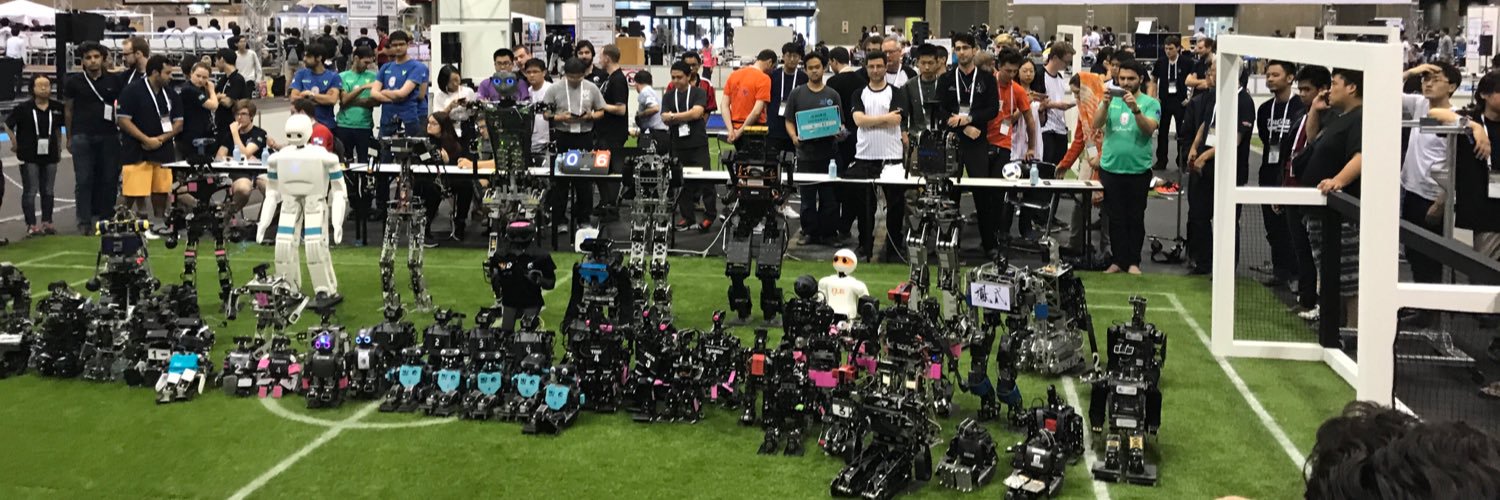
We just wrapped what began as an 8-hour challenge - and it ran for 200 hours without a failure
Shoutout to the team for the hardcore engineering behind F.03 and the robust Helix models powering it
We built a bipedal robot for about $2,500.
A real, mostly 3D-printed robot you can build, repair, simulate, train, and control.
Today we’re releasing LeRobot Humanoid: an open robot-learning platform with hardware, runtime, identification tools, and training environments.
Blog post: https://t.co/zu2etb1NZo
Repo: https://t.co/4myLRUtZ3W
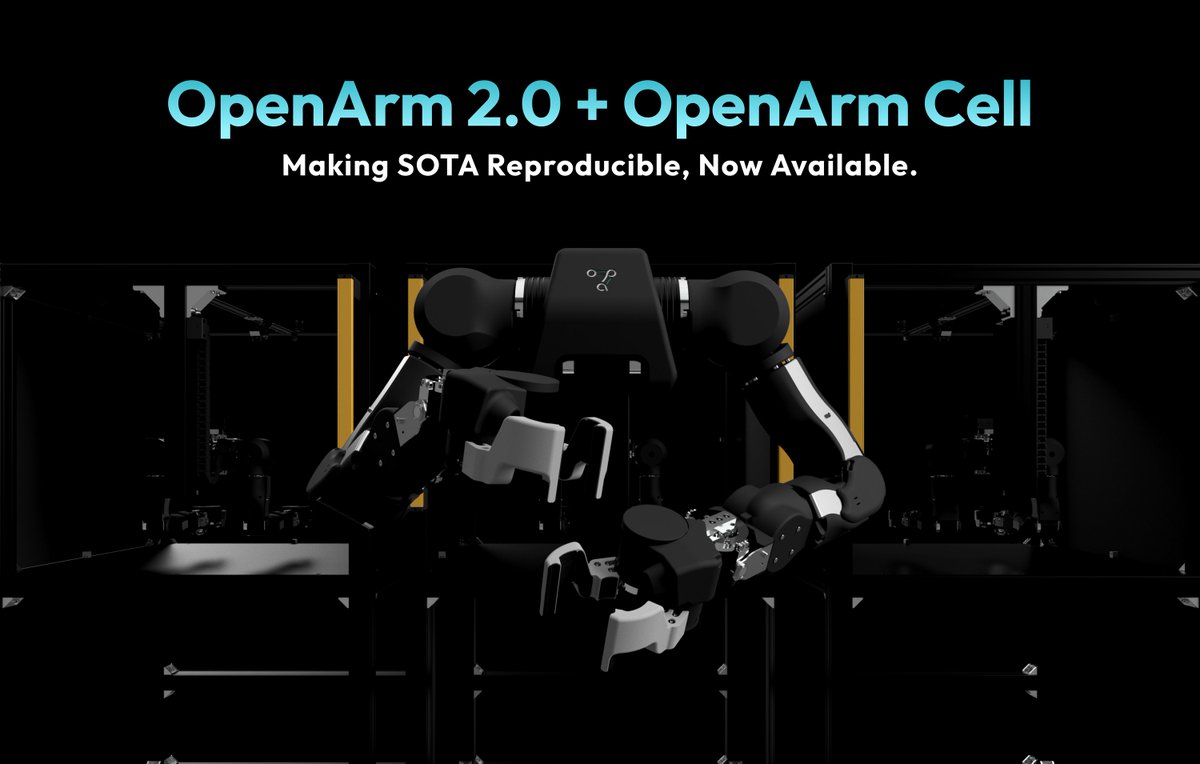
After a long wait since our last announcement, OpenArm 2.0 is finally here.
We're expanding from a robotic arm into a standard evaluation environment for Physical AI research, anchored by OpenArm Cell.
- OpenArm Cell for reproducible eval
- New pinch-type end effector
- Standardized cameras
- Redesigned J5 wrist (natural teleop)
- VR teleop
- Long-term stable release
https://t.co/3UqDHm4qPE
GR00T-VisualSim2Real is now open source!
VIRAL and DoorMan are now available with training code, simulation assets, and the full recipe for bringing visual sim-to-real loco-manipulation skills to your own humanoids.
Repo: https://t.co/vgRsCeRG8w
Open-source tactile sensing just got a lot more accessible.
NYU researchers introduced eFlesh: a 3D-printable magnetic tactile sensor for robots that uses TPU, embedded off-the-shelf magnets, and a magnetometer board.
Why it matters:
- Magnets cost under $5
- Designs are customizable from OBJ/STL files
- Works for grippers, robot hands, feet, and other custom surfaces
- Reports 0.5 mm contact localization RMSE
- Slip detection generalizes to unseen objects with 95% accuracy
- Visuotactile policies improved manipulation performance over vision-only baselines
The cost nuance: the magnets are under $5, while the recommended magnetometer board is listed around $25. Still, this is a meaningful step toward tactile sensing that more labs, builders, and robotics teams can actually fabricate.
Project: https://t.co/4C1dNlbaWx
Open-source magnetic tactile sensor for $5! 🧲
Researchers introduced a magnetic tactile sensor that's low-cost, and easy to fabricate, democratizing tactile sensing for robotics.
Operating in unstructured environments like homes and offices requires robots to sense forces during physical interaction. Yet the lack of a versatile, accessible tactile sensor has led to fragmented solutions and often force-unaware, sensorless approaches.
Building an eFlesh sensor requires four components: a hobbyist 3D printer, off-the-shelf magnets (less than $5), a CAD model, and a magnetometer circuit board.
The sensor is 3D printed with magnets embedded in the middle layer. Based on chosen mechanical properties, magnets displace in response to contact forces, measured by a magnetometer underneath.
An open-source design tool converts simple OBJ/STL files into 3D-printable STLs. This enables application-specific sensors for robot hands, grippers, quadruped feet, and more.
Slip detection generalizes to unseen objects with 95% accuracy. Visual-tactile control policies improve manipulation by 40% over vision-only baselines, achieving 90% success on precise tasks like plug insertion and credit card swiping.
All design files, code, trained models, and conversion tools are openly available.
Project page: https://t.co/gTHpcnja5B
~~
♻️ Join the weekly robotics newsletter, and never miss any news → https://t.co/GoA3ZuwoPB
Vibe coding a robot with GPT 5.5!
This is a URDF of a 7dof robot arm with functional kinematics, a custom gui, and STEP parts/assembly, 100% generated in Codex (minus the gripper).
A similar result would have taken me weeks stitching half a dozen tools together. Insane stuff.
π0.7 just proved that more robotics data can make your model worse.
what this means for robotics teams:
1. scale without metadata is pointless. without annotation density and quality scores, more data averages together conflicting strategies. the model degrades.
2. the data volume race is a trap. the teams that win won't have the most data. they'll have data their models can actually learn from.
3. PI and Standard Bots disagree on where the data should come from. they agree on what matters: structure over volume
4. the bottleneck is the loop on how fast you can organise, annotate, and feed data back into training.