@Turningthe_Tide I disagree a bit. Take the patient in CHF who suddenly has a massive GI bleed. They can be both edematous and hypovolemic at the same time. I know it’s splitting hairs but it can occur.
💧 Fluid Responsiveness ≠ Fluid Tolerance
For years, critical care clinicians have focused on a fundamental question:
Will this patient increase cardiac output if I give fluids?
A new multicentre study from France and China suggests we may need to ask a second question:
What price will the patient pay for that fluid?
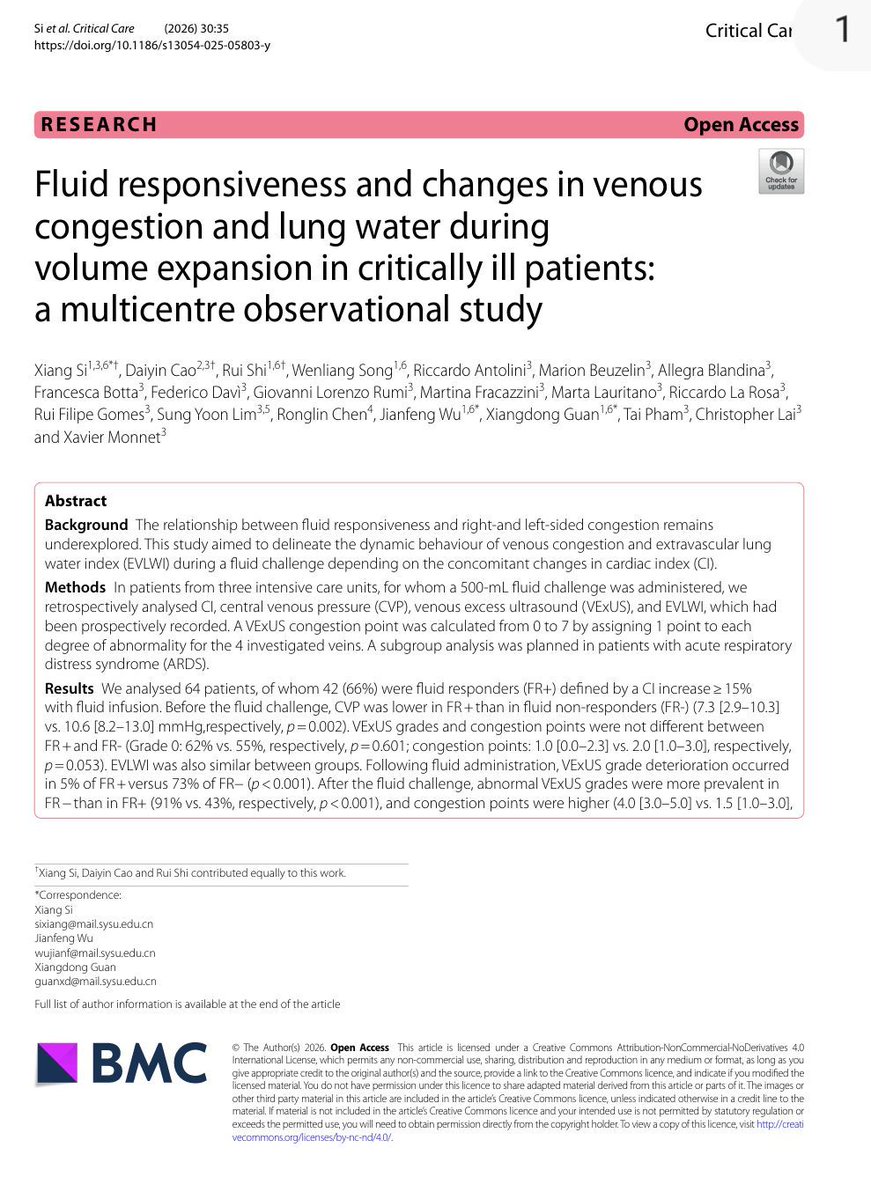
In this observational study of 64 critically ill patients receiving a standardized 500 mL fluid challenge, investigators evaluated not only cardiac index (CI), but also venous congestion using VExUS and pulmonary congestion using extravascular lung water (EVLWI).
The findings are striking.
Before fluid administration, venous congestion could coexist with fluid responsiveness. In fact, many patients remained preload responsive despite already demonstrating evidence of systemic venous congestion.
However, what happened after fluid administration was even more important.
Among fluid responders:
✅ Cardiac index increased significantly
✅ Venous congestion remained largely stable
✅ Only 5% experienced worsening VExUS grade
✅ Lung water remained relatively unchanged
Among fluid non-responders:
❌ Cardiac output barely changed
❌ Venous congestion worsened dramatically
❌ VExUS deterioration occurred in 73%
❌ EVLWI increased significantly
❌ Congestion became evident across hepatic, portal, and renal venous territories
Perhaps the most important physiological message is this:
When the heart cannot convert preload into flow, the fluid has to go somewhere.
And where it goes is congestion.
The study also found a strong correlation between CVP and VExUS, suggesting that while advanced ultrasound provides valuable organ-level information, a carefully interpreted CVP may still remain a useful bedside marker of right-sided congestion.
The ARDS subgroup provides another important lesson.
Even fluid-responsive ARDS patients accumulated more extravascular lung water after fluid administration than non-ARDS patients, highlighting the role of pulmonary permeability in determining fluid tolerance.
This study reinforces a concept that is increasingly central to modern hemodynamic management:
The goal is not simply to identify fluid responsiveness.
The goal is to identify patients who are both:
✔ Fluid responsive
✔ Fluid tolerant
A fluid challenge that increases congestion without increasing flow is not resuscitation.
It is fluid accumulation.
The future of hemodynamic management may lie at the intersection of:
• Fluid responsiveness
• Venous congestion assessment
• Pulmonary permeability
• Organ-specific fluid tolerance
Because the best fluid is not the one that can be given.
It is the one that provides benefit without causing harm.
Reference , 📚
Si X, Critical Care. 2026;30:35.
New publication out!
For decades, hemodynamic management has centered on preload and fluid responsiveness. But as evidence linking fluid accumulation to worse outcomes grows, the conversation is shifting.
Our latest article explores the need for a more dynamic assessment of venous congestion and where critical care physiology may be heading next.
Special thanks to @azevedo_lcp and @edu_kattan for the partnership and contribution!
https://t.co/L0KZ6y0K39
EMCrit 422 - SSC 2026 Guidelines: The good, the Bad, and the UGLY - a discussion with lead author, Hallie Prescott
A fantastic interview on how the SSC guideline sausage was made and the areas I found contentious
[#FOAMed for now]
https://t.co/6fXnmRSzYI
breaking news from @TheOnion:
due to irreconcilable differences between SCCM & ACEP, SCCM now recommends that *all* sepsis resuscitation be done in the back of an ambulance, followed by direct admit to ICU.
“this frees us up from following evidence we don't like” said the SCCM
30 ml/kg for sepsis is a recipe, not a treatment.
Patients aren’t bundles — they’re physiology.
And when it comes to fluids, that difference can be life-saving
This thread by @icmteaching shows why fluid therapy needs to be individualised, not recipe-based
AKI ≠ indication for IV fluid 💧 by reflex. #POCUS first!
In congestive nephropathy (AKI from high CVP/fluid overload), adding more fluid can actually make things worse.
#FOAMed#Nephpearls
@UNMHospital I remember about 28 years ago when the Air Force tried to land an CH-53 at UMN. It did not go so well. That let to much improved communication and planning.
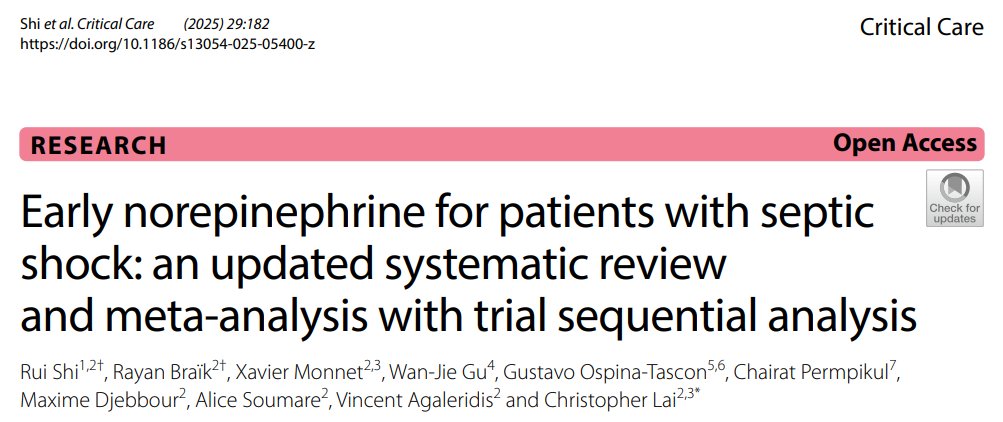
🚨 "Early norepinephrine in #septic shock: SRMA" @Crit_Care
✅↓D28 mortality ✅↓fluids ✅Faster MAP stabilization 🛡️Safe & effective 🔍Trial sequential analysis : more RCTs still needed to confirm
Big thanks to my co-authors! @shiruimaya@Prof_XMonnet
🔗https://t.co/aG2FlIN8ao







![emcrit's tweet photo. EMCrit 422 - SSC 2026 Guidelines: The good, the Bad, and the UGLY - a discussion with lead author, Hallie Prescott
A fantastic interview on how the SSC guideline sausage was made and the areas I found contentious
[#FOAMed for now]
https://t.co/6fXnmRSzYI https://t.co/FDRPsCaIJn](https://pbs.twimg.com/media/HEmZRy6bUAAMybh.jpg)