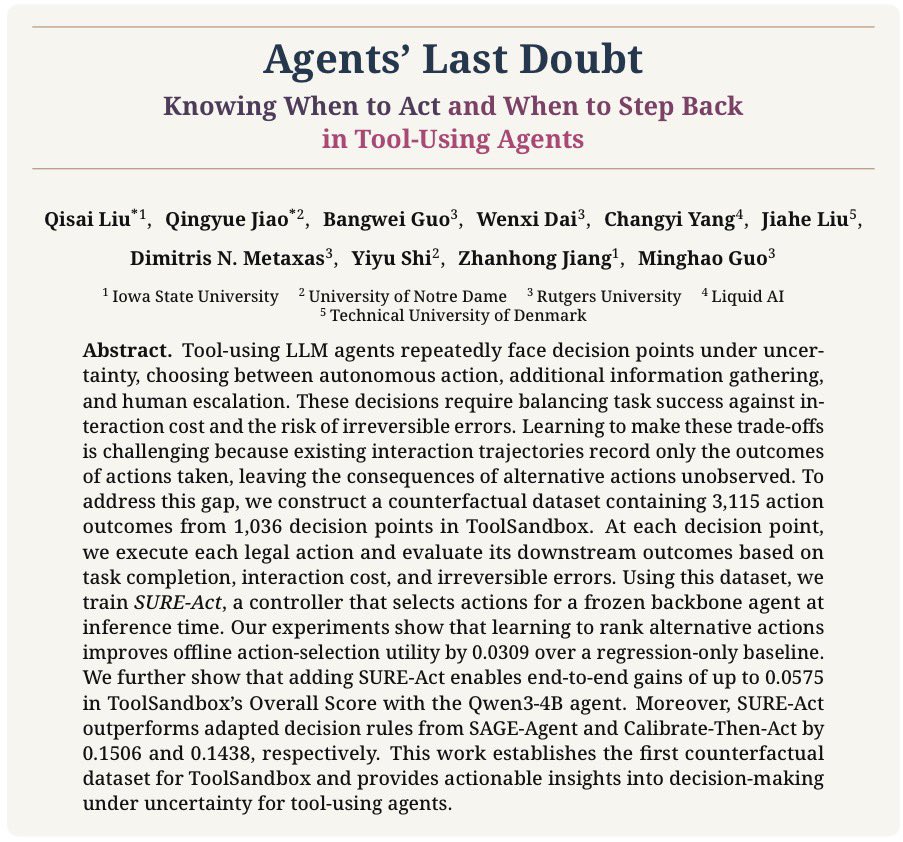
🚀 Excited to share our new paper, Agents’ Last Doubt (SURE-Act)!
Can AI agents learn when to act—and when to step back?
We explore counterfactual learning for better agent decisions, paving the way toward more reliable RSI.
#AIAgents#RSI
1/ Introducing the Cua Spaces SDK.
Every big lab now ships a bot with its own computer: Grok Bot, Muse, dots. None let you bring your own. With Cua Spaces, now you can.
Put Claude Code, Codex or any agent on compute you choose, and run jobs across all your computers at once.
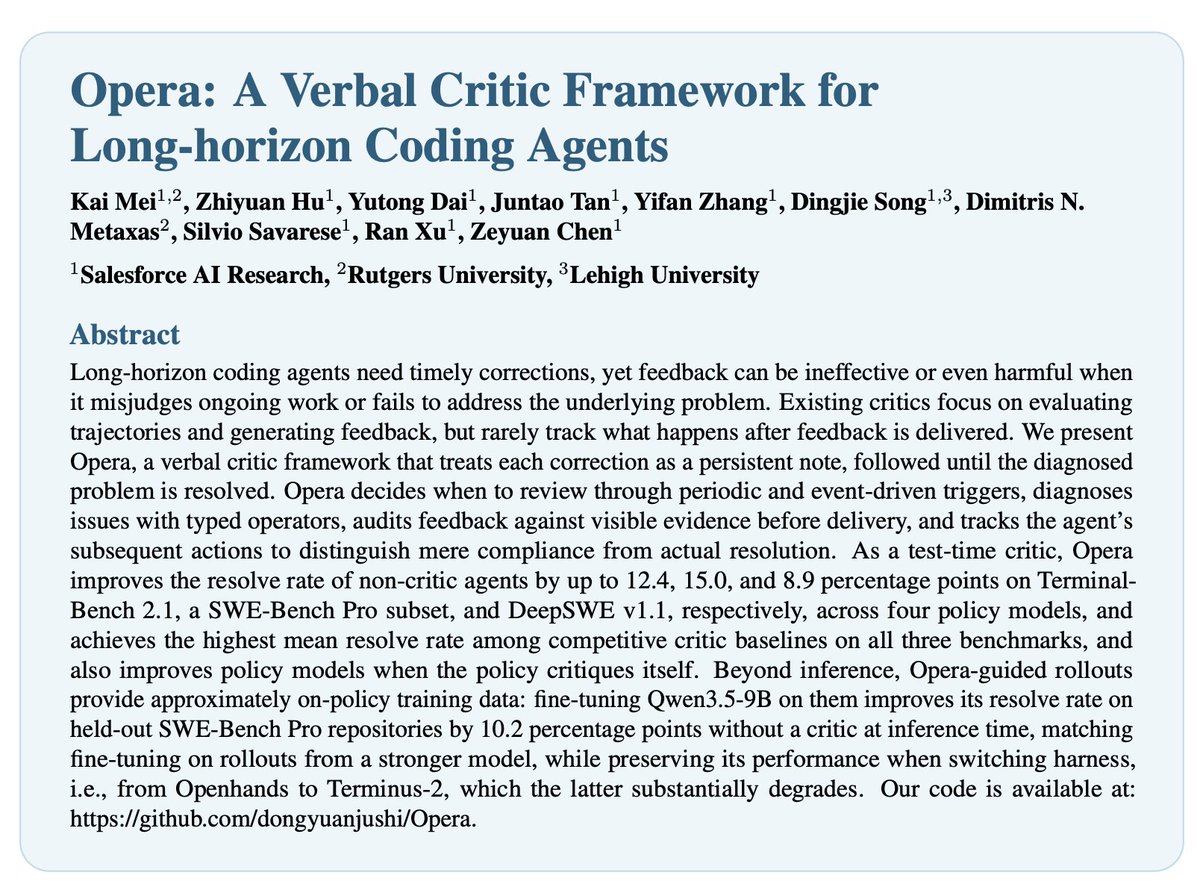
Excited to share Opera, our research from my internship at Salesforce AI Research!
If you’ve used coding agents, you’ve probably seen them repeat a failing command or say “done” while the bug is still there. How do we help them recover, and check that the correction actually worked? We propose a verbal critic framework: Opera, which decides when to intervene, checks feedback before delivering it, and tracks each correction as a persistent note until evidence supports closing the issue.Across three coding benchmarks, Opera improves task success by up to 15 percentage points. Its guided rollouts also provide training data: fine-tuning a 9B model improves performance on unseen repositories by 10.2 points, with no critic needed at inference.
Paper: https://t.co/rDjKYjos0F
Code: https://t.co/9K1ngoYzJW
Would love feedback from anyone building coding agents.
1/ Today we're launching Cua-Bench with @SnorkelAI: a benchmark for computer-use agents on professional software, open for any model to run. The benchmark covers 25 expert-authored KiCad tasks, and the best frontier model we tested cleared only 6 of them.
1/2 The Cua team is excited to join @aiDotEngineer World’s Fair on July 1 in SF to talk Computer-Use 2.0. CUAs are moving beyond screenshot + cursor loops toward window-scoped loops orchestrated by coding agents. We’ll share what changed and what becomes possible next.
Most "agent memory" benchmarks just test whether a chatbot remembers your preferences. That tells you almost nothing about real agents. So we built MemGym: memory evaluation for deep research, coding, and GUI agents, with a clean memory-isolated score. 🧵
I'm joining @salesforce this summer as a Research Scientist Intern based in the SF/Bay Area! I'll be working on coding agents and LLM post-training. Let's connect and chat! 😎
Today we're bringing Cua Driver to Windows: background computer-use for any agent. Claude Code, Codex, or your own loop can drive real Windows apps through CLI or MCP while your desktop stays usable, with true multi synthetic pointer support.
1/6
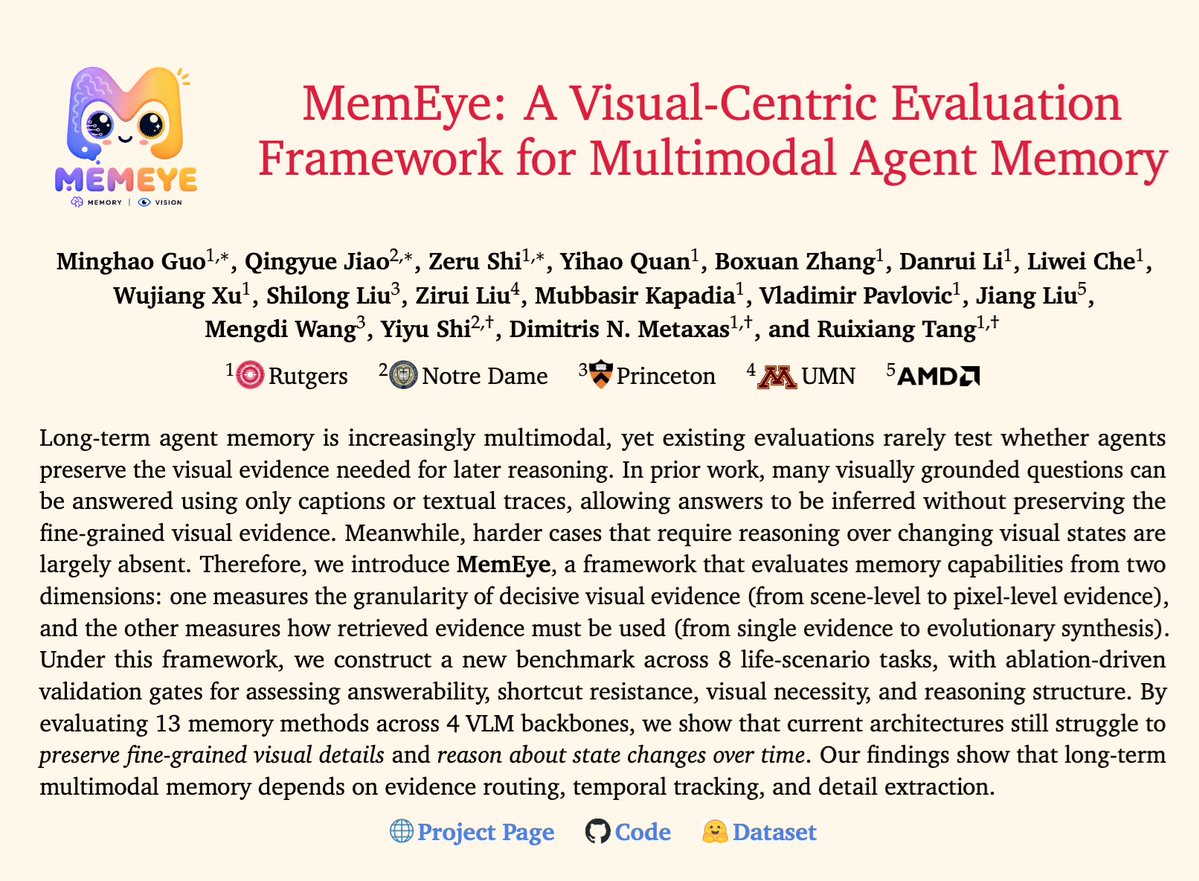
👀 Can multimodal agents truly remember what they saw? Do they just rely on caption-level shortcuts?
MemEye: a visual-centric benchmark for multimodal agent memory, can test whether agents can preserve visual evidence and track evolving visual states.
📄 https://t.co/CMNbNxmunQ
Rolling out today as a preview on iOS and Android in all supported regions.
Support for connecting your phone to the Codex app on Windows is coming soon.
https://t.co/jGNH2CUXih
there's a PR to add background computer use to OpenClaw via a proprietary Codex plugin. opened a counter-PR using cua-driver instead - MIT licensed, works with every agent harness, not just Codex. give it a 👍 if you want the open version https://t.co/q3BW48fNgP
We're open-sourcing Cua Driver - our new macOS driver that lets any agent (Claude Code, Codex, your own loop) drive any app in the background, with true multi-player and multi-cursor built-in.
1/8
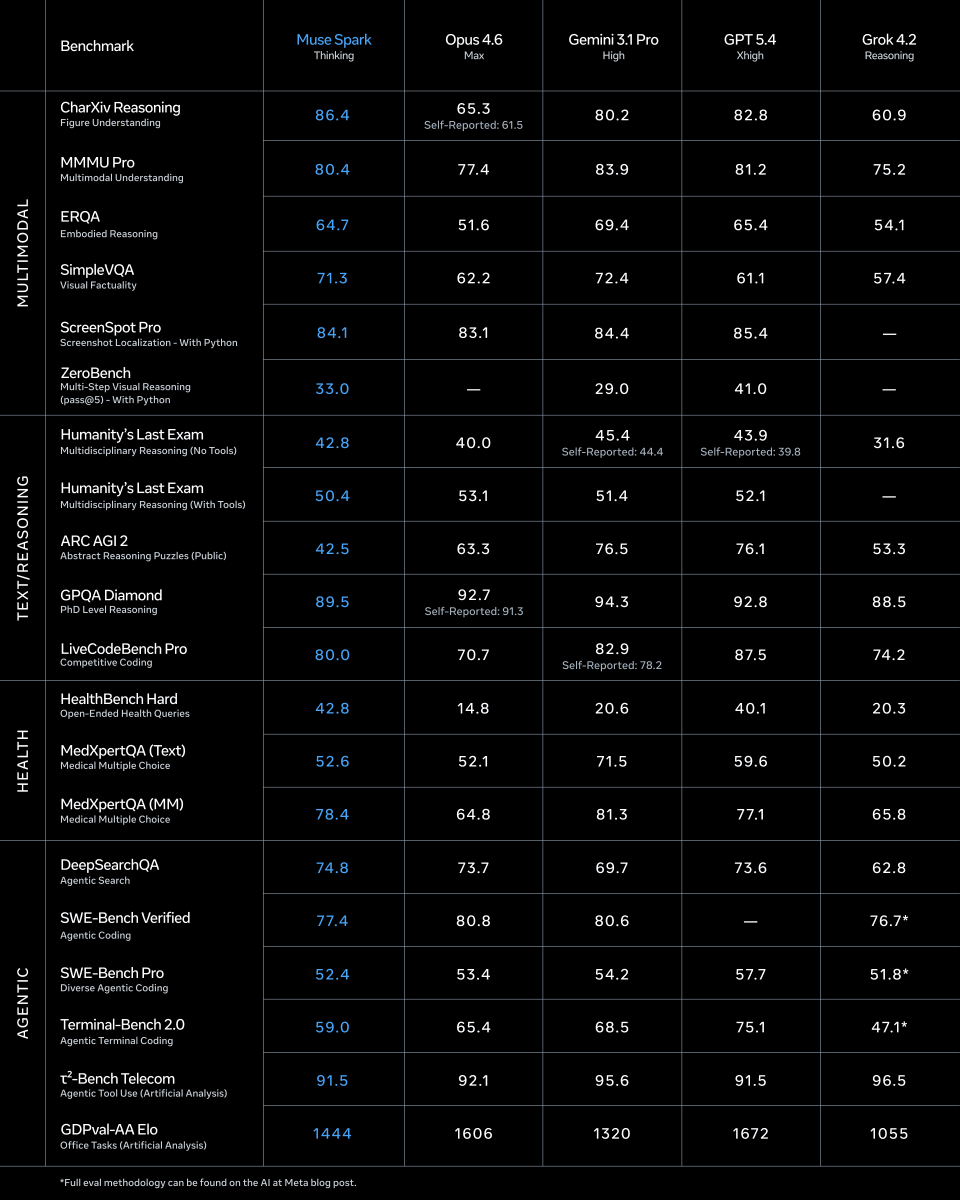
1/ today we're releasing muse spark, the first model from MSL. nine months ago we rebuilt our ai stack from scratch. new infrastructure, new architecture, new data pipelines. muse spark is the result of that work, and now it powers meta ai. 🧵
The work is led by our amazing intern @kaimei_2000 , along with our wonderful colleagues @jiangfeng1124 , @ds7711 , Dongkyu Lee, Xing Niu, and Jiarong Jiang.
🌟🎲🎲How to create a rational LLM-based agent? using game-theoretic workflow!
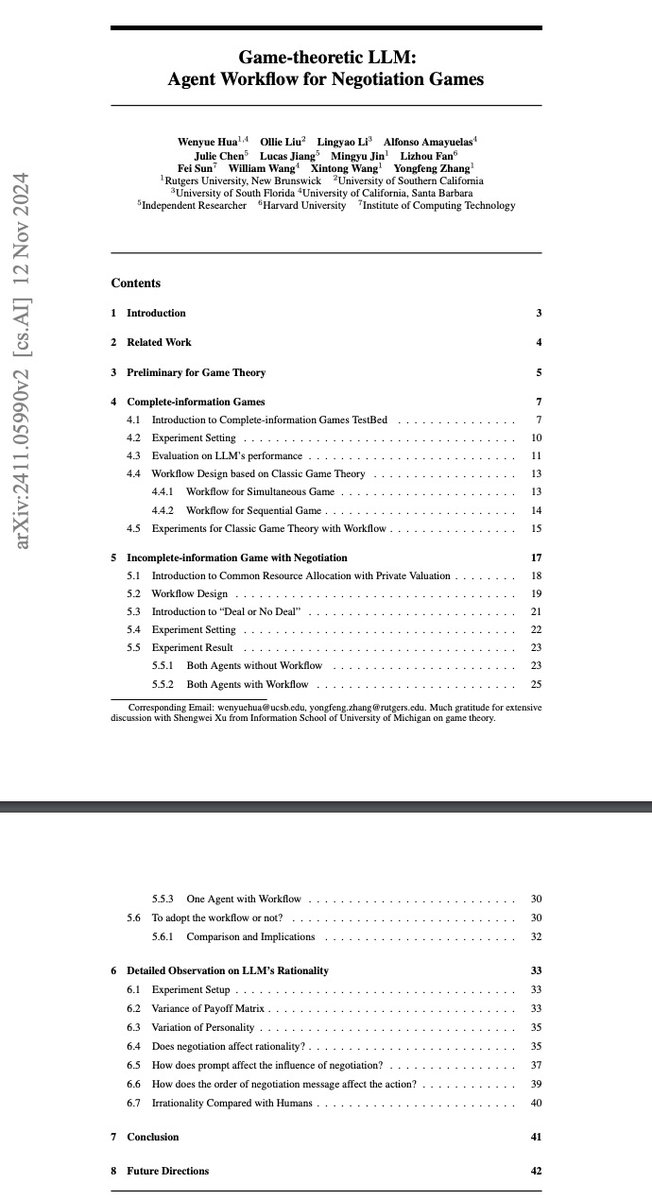
Game-theoretic LLM: Agent Workflow for Negotiation Games 😊
paper link: https://t.co/atfdfU8LSB
github link: https://t.co/pTzXRJYBIj
😼 This paper aims at observing and enhancing the performance of agents in interactions guided by self-interest maximization
😼 😼 We chose game theory as the foundation, with rationality and Pareto optimality as the two basic evaluation metrics: whether an individual is rational and whether a globally optimal solution is developed based on individual rationality.
❣️ Complete information games
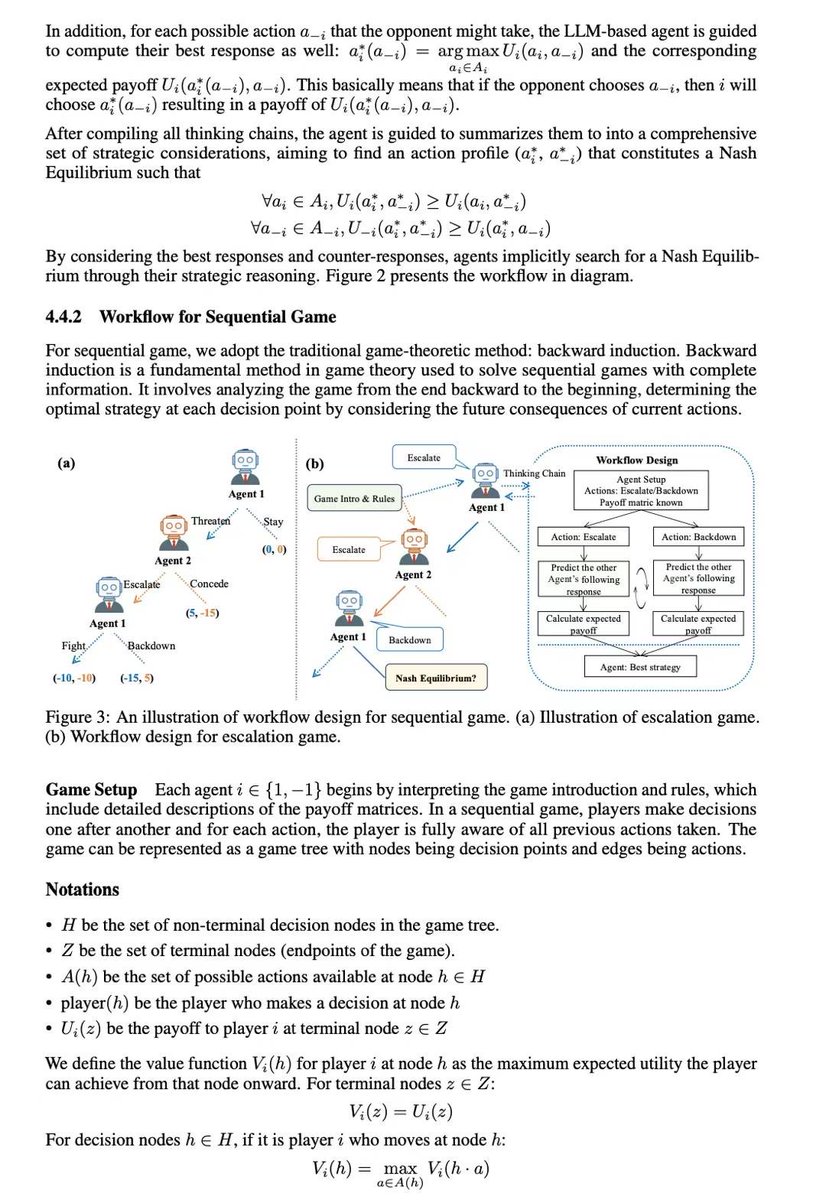
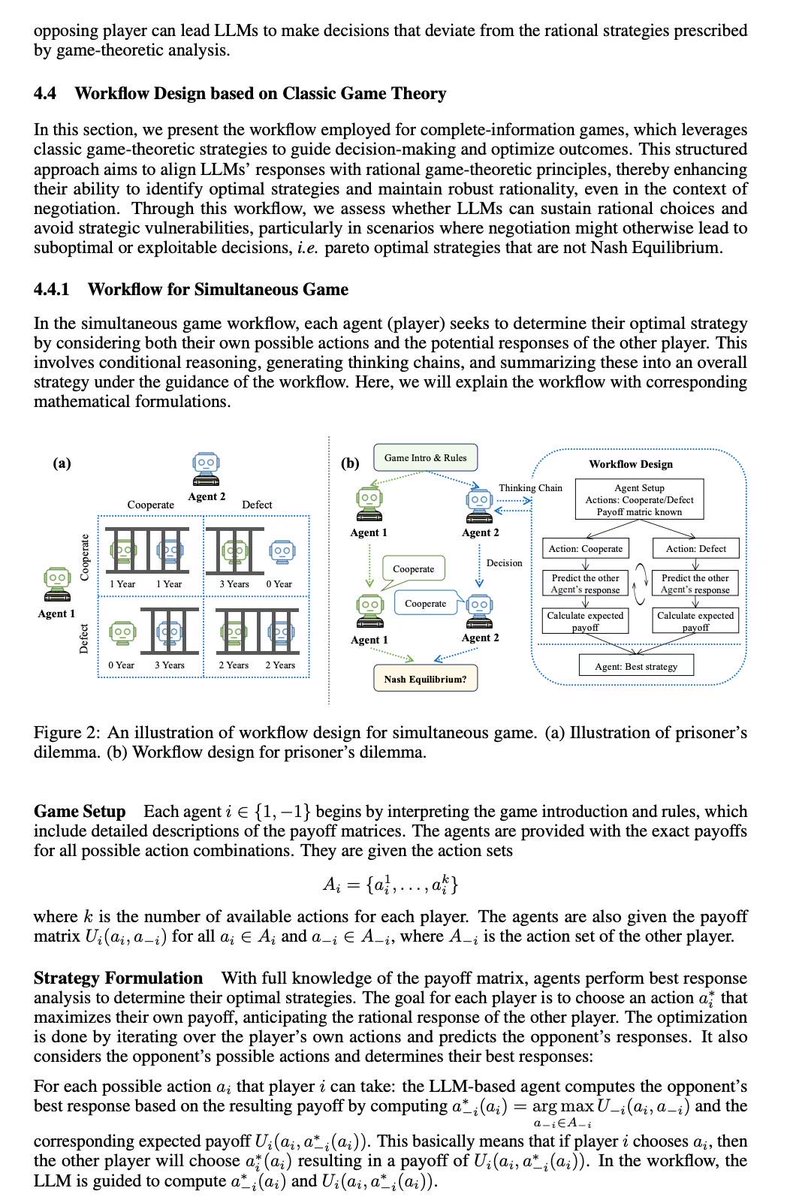
They are classic games such as Prisoner's Dilemma. We selected 5 simultaneous games and 5 sequential games. We found that, except for o1, other LLM generally lack a robust ability to compute Nash equilibria, meaning they are not very rational. They are not robust to noise, perturbations, or random talks among them.
Therefore, based on classical game theory methods (Iterative Elimination of Dominated Strategy & Backward Induction), we designed two workflows to guide large models step-by-step in computing Nash equilibria during inference time.
❣️ Incomplete information games
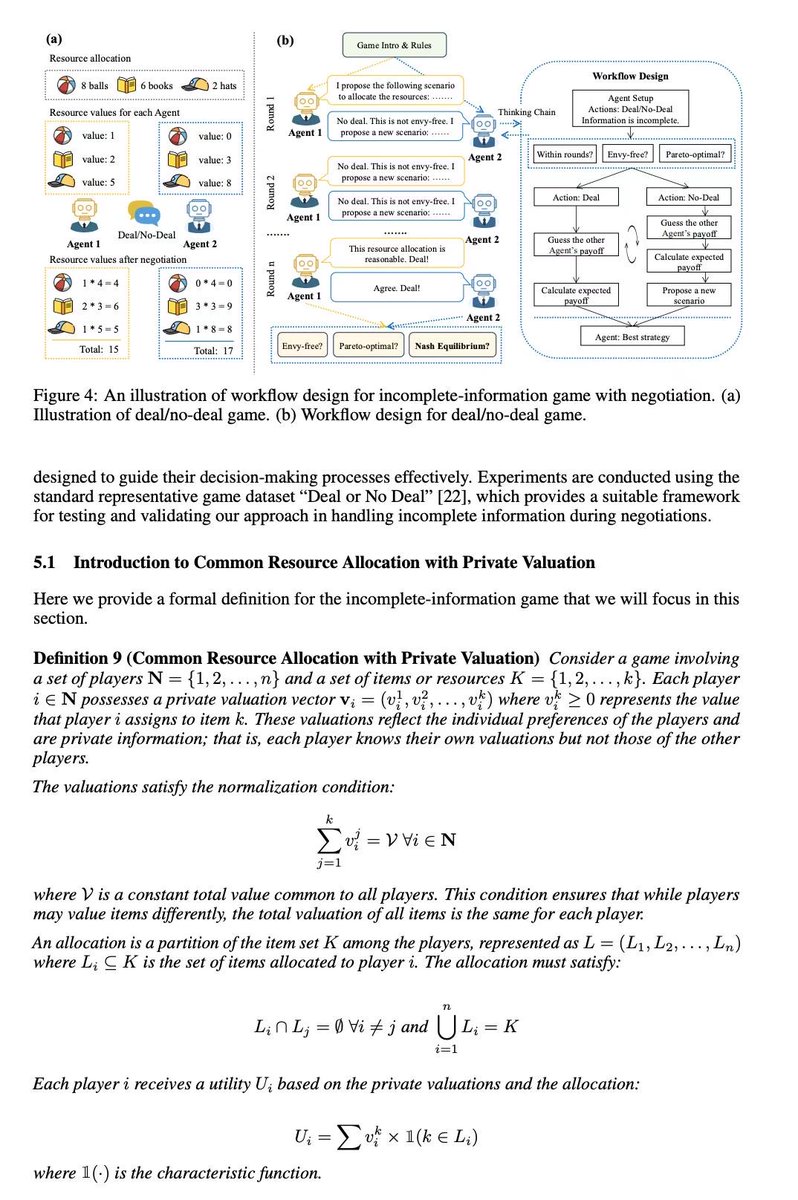
We used the classic "Deal or No Deal" resource allocation game with private valuation, where agents do not know the opponent's valuation of resources. Game theory does not provide a solution for this, and previous work has been based on reinforcement learning.
👉 Sonnet and o1 perform better than humans in terms of negotiation success rate and results
👉 Opus and 4o are far behind.
👉 We designed an algorithmic workflow based on the rational actor assumption, allowing agents to infer the opponent's valuation based on their reactions to various resource allocation schemes.
The workflow is very effective, reducing the possible estimated valuations from an initial 1000 possibilities to 2-3 within 5 rounds of dialogue, and always including the opponent's true valuation.
🌟🌟Based on the estimated valuation of opponent's resource, we guide the agents in each step to calculate and propose an allocation proposal that maximizes their own interests while having a non-zero probability of being envy-free, ensuring that both parties are relatively satisfied and the negotiation can proceed.
🌟🌟 But very interestingly, we found that if only one agent uses this workflow during negotiation, it will be exploited. Although the workflow improves the overall negotiation outcome and brings more benefits to the individual agent, the benefits will always be less than the opponent's.
🔥In the future, we will need a meta-strategy to choose which workflows to use!
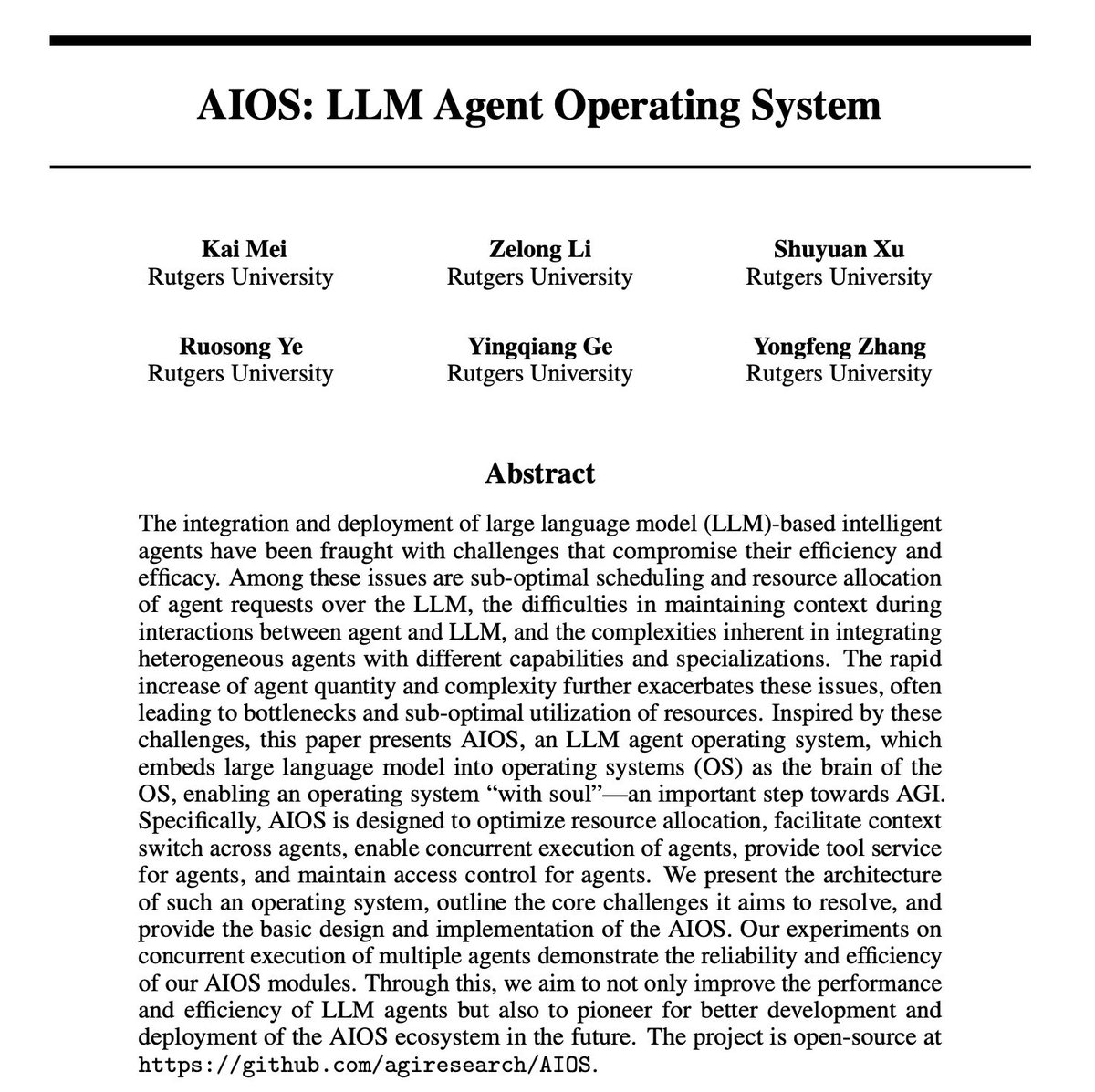
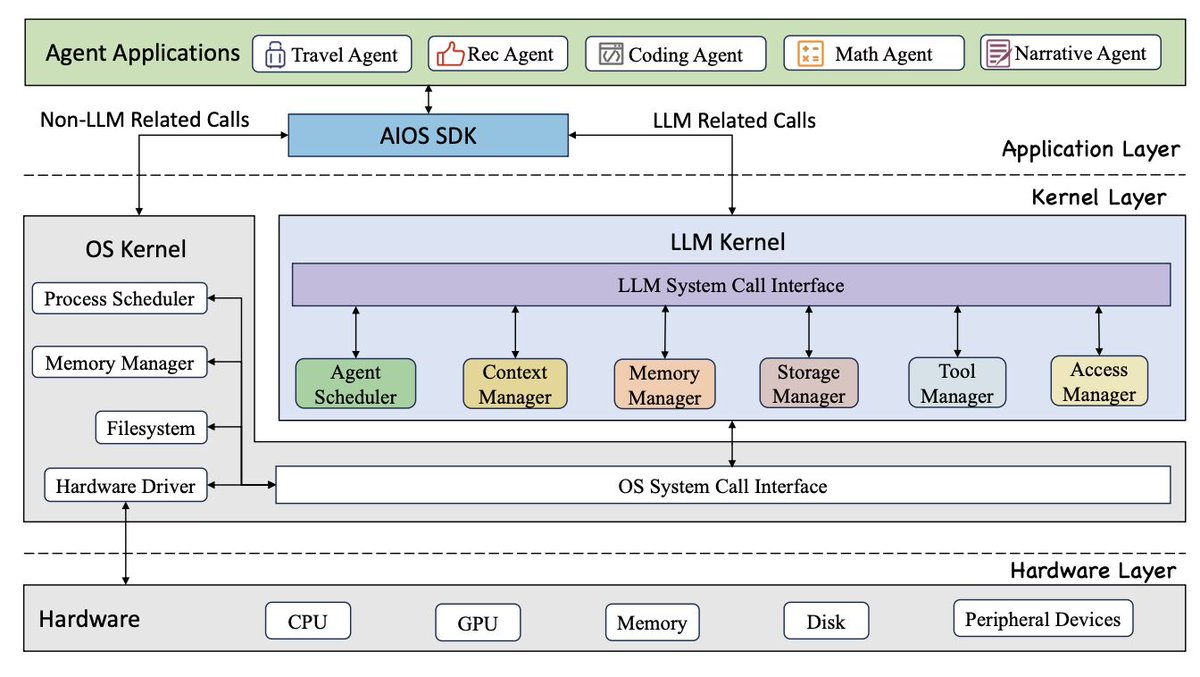
Introducing #AIOS, the world's first LLM Agent Operating System. AIOS embeds LLM into the OS as the brain, enabling an operating system "with soul".
Paper1: https://t.co/vfSiS2Y5TN
Paper2: https://t.co/E4ersVJMQJ
GitHub: https://t.co/uQTB5UShyk
Discord: https://t.co/UnJNlgdRnG