I don't think people appreciate how little monetary policy has to do with inflation right now. And those that believe it's all about monetary policy do not appreciate how insane fiscal policy has been the last 5 years.
Building an AI-native @Coinbase means rebuilding everything, especially the hardest parts. We've put a lot of time into redefining compliance, where the stakes are incredibly high, and we have to be extremely thoughtful about implementation.
We have invested heavily in rebuilding our compliance ops around AI with that reality as our starting constraint, not an afterthought. Here is an overview of what we've learned and what we built.
Most people assume compliance work is mostly checking whether a name appears on a sanctions list. That is the easy 5%. The other 95% is interpretive judgment under uncertainty: a customer claims their wealth came from real estate. Do the property records actually support it? Does the timeline hold? Is the documentation legitimate, or does it feel too polished? You need compliance staff and investigators who understand what “suspicious” actually looks like in context.
That's part of why compliance is so hard to automate—and so expensive.
The first obvious AI approach is to hand the model the existing procedures and ask it to run them faster. That approach misunderstands what procedures are for. Good procedures are not bad investigations; they are deliberately incomplete investigations. Their job is to create consistency, auditability, and a minimum standard across thousands of cases. They excel at saying what must happen. They are far worse at capturing everything a strong analyst actually notices: which sources they trust, when they widen the search, when a document feels off, when an explanation technically fits but still does not feel earned.
Procedures also carry the shape of the old operating model: fragmented systems, time pressure, queue pressure, and the hard limit of how much one human analyst can read, cross-reference, and hold in working memory at once. That is not a flaw in the procedure. It is how you design a process for humans.
AI changes the constraint set. Reading, searching, comparing documents, and tracing inconsistencies no longer have to be treated as scarce analyst time. Done carefully, with proper controls and human review, models can explore more context, test more hypotheses, and surface more inconsistencies than any single analyst could reasonably do case by case.
So if you simply automate the procedure exactly as written, you may gain efficiency. You will not unlock the full value of AI. You will just make the old bottleneck run faster.
The better question is not “Can AI follow the analyst playbook?”
It is: once the cost of reading, cross-referencing, and testing hypotheses collapses, what should the investigation become?
A second tempting approach: feed it historical Suspicious Activity Reports (SARs) and let it learn from outcomes. This breaks down too. You rarely have the full state of what the analyst actually saw during the investigation. A case that looks straightforward today might only look that way because information surfaced later. A fraud indictment that didn't exist when the original analyst made the call, news articles that hadn't been published yet. Hindsight can contaminate your training data. Also, regulators themselves acknowledge that SAR decisions can be subjective.
The architecture has four layers. The first is data: continuously enhancing the coverage, quality, and architecture of the signals the system depends on. The second is classical machine learning models that cluster and classify alerts to determine what type of investigation needs to run. The third is the investigation agent itself: a multi-agent system that orchestrates specialized agents to execute the investigation end to end. The fourth is a safety filter that runs independently of typology, ensuring no risk vector is missed regardless of how the alert is classified. Each layer is independently auditable and learns from the feedback provided by human reviewers.
Inside the investigation agent, specialized sub-agents run across the full case surface: alert context, customer and identity signals, access patterns, risk indicators, transaction behavior, source-of-funds, onchain activity, and public adverse media. Each writes its findings into a shared case memory. A coordinator agent reconciles and challenges them. When sub-agents disagree, such as when source-of-funds marks activity as “explained” while adverse media surfaces a recent indictment, the coordinator attempts to resolve these disagreements knowing the common patterns. The narrative agent prepares the final report with all collected evidence and suggested resolution. The last self-validation agent acts as a guardrail: if the system cannot support its conclusion with sufficient confidence or data quality, the case is routed to manual investigation instead of being surfaced as an automated result.
Before any of this touched a real customer case, we built what we call a “Golden Set” - historical cases with known right answers. "Known right answers" in compliance is harder than it sounds. It meant re-investigating old cases, getting multiple senior analysts to independently agree on what the right call would have been, then debating the disagreements until consensus. Months of work before we could even start measuring.
Here's an important part (for now) - cases currently get BOTH the AI's full investigation AND a senior human review. We didn't reduce scrutiny, in fact, we added more of it until it no longer proves valuable. Cases resolve significantly faster AND get more eyes than they ever did before. Every human correction feeds back into the model as a training signal. It gets better because it's wrong in front of people who know how to fix it.
None of this would have shipped without clearing structural blockers most financial institutions are still stuck on. Security and privacy sign-off to send customer data to LLMs at all. Senior compliance officer alignment on AI-assisted human decision making. Model Governance team embedded since December - they observed the entire Golden-Set Evaluation process and are running a formal validation review with our Internal Audit team now.
Today this handles roughly 55% of our US fraud case volume with significantly less analyst time per case. Time freed goes to the harder cases AI can't yet handle - and to teaching it.
Our internal compliance and quality teams are the ones who are building this system with the engineers, training it, validating it, and continuing to shape how it improves. In the process, they've developed skills that are incredibly valuable: how to design evals, how to think about model bias, how to think about human bias, how to architect human-in-the-loop systems, skills that are becoming among the most valuable at any company.
This entire project started ~6 months ago with a whiteboarding session between @galpa42 and I, and was built by an AI-pilled cross-functional and it’s just the first pod - there's a multi-month roadmap,rebuilding compliance from the ground up with AI. Huge thanks to everyone involved and congratulations to @galpa42 for shipping two babies to production this month :)
The future of high-stakes work is not AI replacing judgment. It is AI making judgment scalable, auditable, and continuously improvable.
New blog post: The third wave of American philanthropy
Hundreds of billions of dollars in new philanthropic capital will soon become liquid. The OpenAI Foundation holds 26% of OpenAI, worth about $220B at today’s valuation. Anthropic’s seven co-founders have pledged to give away 80% of their wealth and have instituted the most aggressive donor matching program for employees in tech history.
How much does this all add up to? And how meaningful is that in the context of philanthropy today?
I was doing some simple napkin math to wrap my head around the scale of what’s coming, and radicalized myself in the process. I had dramatically underappreciated the scale of the philanthropic capital that’s about to become available and the corresponding gap in talent and organizations that will be needed to make the most of it.
This piece aims to directionally sketch the scale of what’s coming, the gap in operational capacity needed to absorb it, and what we can do to fill it.
(Link to full post in reply)
I've warned for months that a @JetBlue-@SpiritAirlines merger would have led to fewer flights and higher fares.
@JusticeATR and @USDOT were right to stand up for consumers and fight against runaway airline consolidation.
This is a Biden win for flyers! https://t.co/lJFGS3ucv3
1/4 LLMs solve research grade math problems but struggle with basic calculations. We bridge this gap by turning them to computers.
We built a computer INSIDE a transformer that can run programs for millions of steps in seconds solving even the hardest Sudokus with 100% accuracy
My 5% billionaire wealth tax will raise $4.4 trillion to:
✔ Give $3,000 to everyone in a household making $150,000 or less
✔ Build 7 million homes & apartments
✔ Enact a $60,000 minimum teacher salary
✔ Expand Medicare for dental, vision & hearing
And much more...
A common misunderstanding is that supplying expensive new housing does not help the poor.
No. Residents each move up a rung, freeing up housing at the bottom of the ladder.
The latest, of many, papers to show this uses great data from Switzerland. 1/3
https://t.co/5NK74riQog
Today, I’m releasing the City’s preliminary budget. After years of fiscal mismanagement, we’re staring at a $5.4 billion budget gap — and two paths.
One: Albany can raise taxes on the ultra-wealthy and the most profitable corporations and address the fiscal imbalance between our city and state.
The other, a last resort: balance the budget on the backs of working people using the only tools at the City's disposal.
The first path matches a structural crisis with a sustainable and fair solution. I know where I stand.
New Yorkers voted for bold change and competent leadership. We will deliver both, and we look forward to partnering with Albany to protect working New Yorkers.
The @CAgovernor and I have had our policy disagreements over the past few years on issues like his opposition to Prop 36, but he is spot on here. This so-called wealth tax is going to backfire and middle class taxpayers are going to be forced to pick up the bill. We need to close federal tax loopholes, cut waste - not crash California's economy. https://t.co/SBQKWCUv39
U.S. Treasuries are having their best year since 2020, and the investors who had confidence and faith in President Trump’s economic policies have been richly rewarded.
Never bet against @POTUS or America! 🇺🇸
We are on the cusp of a profound change in the field of mathematics. Vibe proving is here.
Aristotle from @HarmonicMath just proved Erdos Problem #124 in @leanprover, all by itself. This problem has been open for nearly 30 years since conjectured in the paper “Complete sequences of sets of integer powers” in the journal Acta Arithmetica.
Boris Alexeev ran this problem using a beta version of Aristotle, recently updated to have stronger reasoning ability and a natural language interface.
Mathematical superintelligence is getting closer by the minute, and I’m confident it will change and dramatically accelerate progress in mathematics and all dependent fields.
LedgerX stands out because it spent over a decade doing the hard things right.
Over a decade ago, their team set out to build an institutional grade venue for bitcoin options and swaps in the U.S.
They built through the noise of every market cycle and earned the licenses required to operate at the highest regulatory standard.
By 2017, LedgerX was running one of the first fully regulated crypto derivatives platforms in the country, proving that crypto infrastructure could meet the expectations of traditional markets.
The company had different owners in the years that followed, including FTX US, yet its core stayed solvent and disciplined. The work held up even as the world around it shifted.
In 2023, it was bought by Miami International Holdings and renamed MIAXdx, with its technology-first focus and high standards still intact.
That resilience and discipline are exactly why Robinhood Markets has acquired a stake in LedgerX with our partners at Susquehanna.
Their platform brings a decade of exchange-level engineering, proven risk management systems, and a regulatory foundation that lets markets scale safely. Those ingredients are essential for building the next generation of prediction markets and derivatives in the U.S.
A business shaped by rigor and experience across many cycles in crypto is now joining what we are building next.
This is a good illustration of a general principle:
As you build new high-end apartments, people move up, freeing up supply of lower-tier apartments.
Building luxury housing thus lowers downmarket rents. You don't need to build 'affordable housing' to make housing affordable.
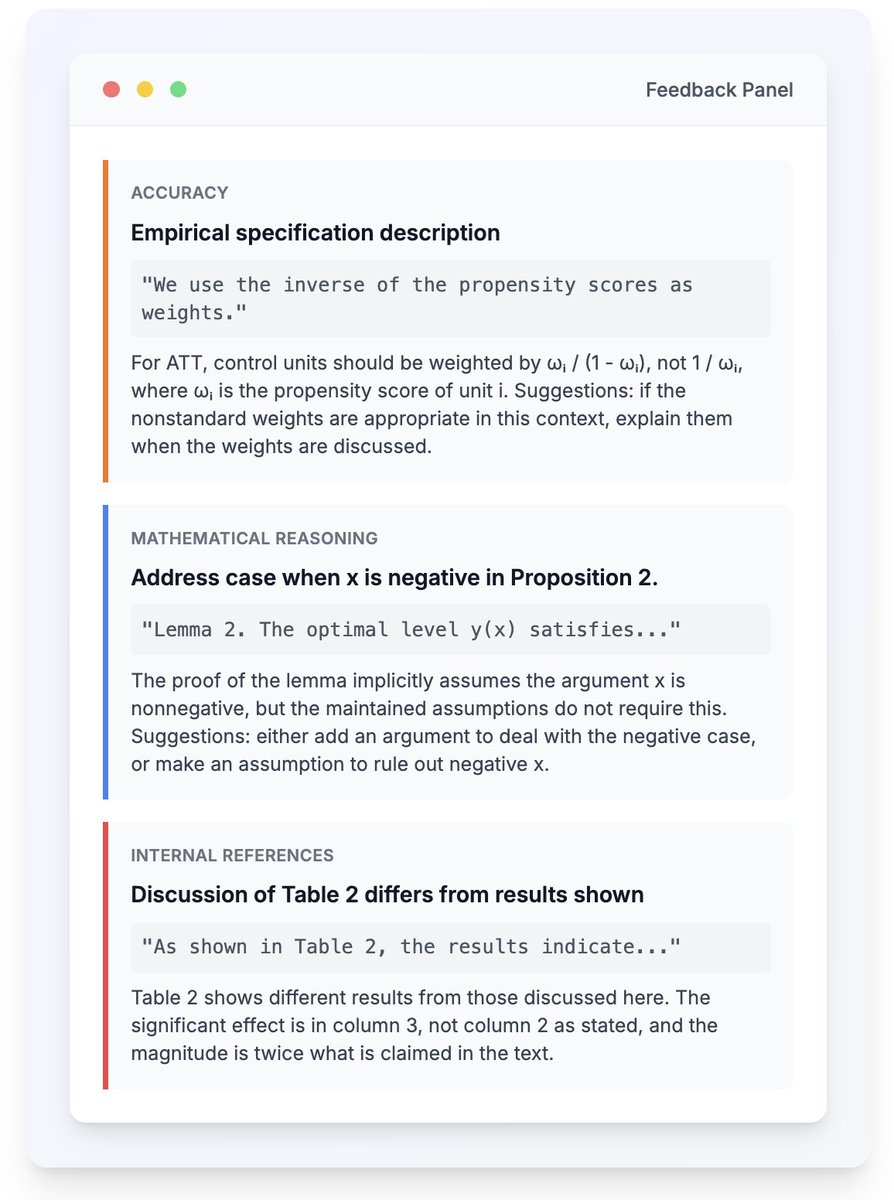
I am super excited to share a new AI tool, Refine.
Refine thoroughly studies research papers like a referee and finds issues with correctness, clarity, and consistency.
In my own papers, it regularly catches problems that my coauthors and I missed.
1/
Shorting is coming to Robinhood.
Whether you want the potential to capitalize on bear market speculation or hedge against existing long positions, Robinhood lets you open short positions during market and extended hours, and close your positions during market, extended, or during our 24 Hour Market hours.
Rolling out to all Robinhood users soon.
#RobinhoodPresents https://t.co/LPTAxIFVyj