Diffusion/Flow-based models can sample in 1-2 steps now 👍 But likelihood? Still requires 100-1000 NFEs (even for these fast models) 😭
We fix this! Introducing F2D2: simultaneous fast sampling AND fast likelihood via joint flow map distillation.
https://t.co/FFfqWnLIwu
1/🧵
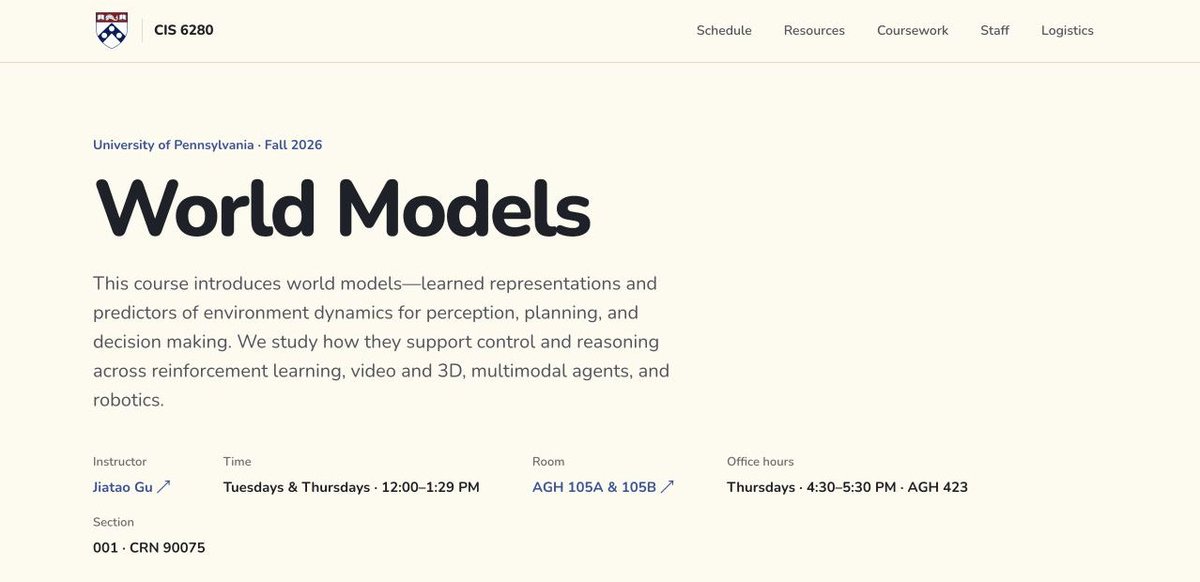
We’re teaching a new course at Penn: CIS 6280 · World Models 🌍
https://t.co/3mCdWdOVsg
Every day, LLMs amaze me with one more thing they can solve. But I’ve always felt there’s more to learn than what humans have written down—from observing the world, interacting with it, and experiencing what happens next. To me, that’s what world models are about—and why I see them as one of AI’s next big bets.
However, I struggled to find a systematic course on them—so we are building one!
Topics will include: representation learning, generative models, simulation, model-based RL, video and 3D generation, world models for robotics, reasoning, and code-based world models.
Hands-on work will include:
- Building an environment
- Training a world model
- Learning a policy
and a final research project with leaderboard.
We’re already six lectures in. Slides, demos, and readings are public, and we’ll keep adding materials throughout the fall.
Big thanks to our TA team— @TongMutianTMT@hagsaeng_bag@EnxinSong@KeelyAi04 —for helping bring this course to life!
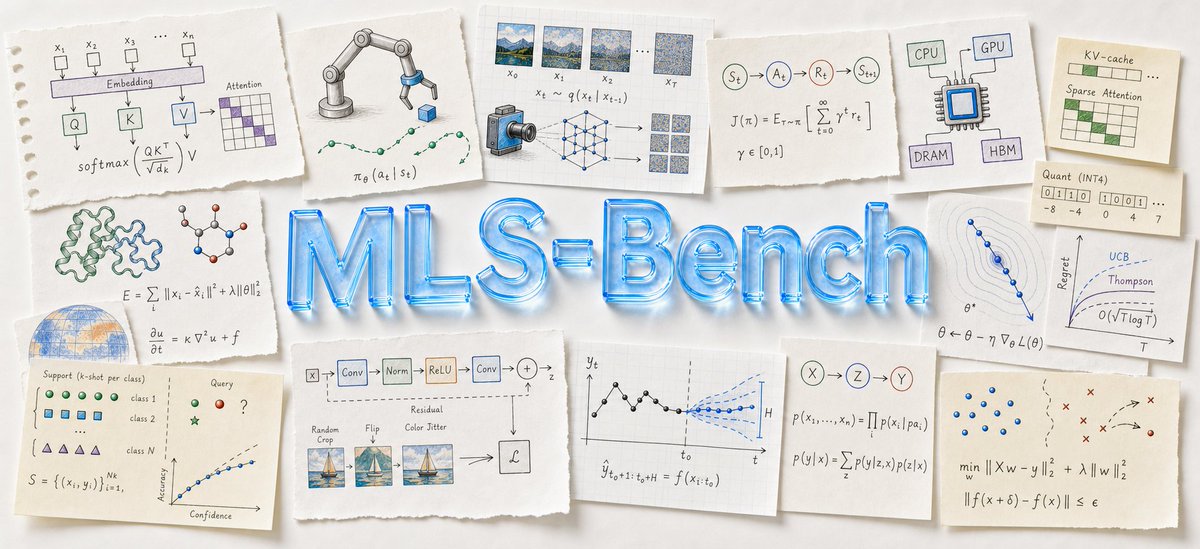
Everyone is talking about self-evolving AI, or recursive self-improvement. The methods that built modern ML are the ones that keep working across settings and scales, yet no benchmark directly tests AI systems for that ability.
Today, after months of cross-platform validation with external teams, we're proud to introduce MLS-Bench, a benchmark for ML Science with 140 tasks across 12 ML domains. It asks whether AI systems can create scalable and generalizable ML methods, the way human researchers have pushed AI forward. (1/9)
As a PhD student, I was told not to work on deep RL - too full of hacks and alchemy" But after a year or two of working in this area, I’ve come to (deeply?) appreciate all of the thoughtful research that’s gone into understanding what/why things work and how to make them better.
My lab (joint with @abhishekunique7) took what we’ve learned by reading this body of literature to answer the question: what are the actual best-practices for finetuning a diffusion/flow/generative robot policy (for now, in sim)? Under one set of constraints - ample compute but limited time on your robot - @servo97 paper gives a pretty compelling answer.
Diffusion planners are great for offline RL. But they need many steps to work well! Way too slow for real-time decision making!
Presenting RACTD at #ICLR2026: reward-aware distillation that plans in ONE step
🇧🇷 Today (4/23) P4-#4618 3:15-5:45 PM
https://t.co/80EM9aO0Nb 1/
Unlocking test-time scaling and search in generative models has been a fundamental obstacle, and is increasingly important as these methods are deployed in science, engineering, and robotics.
It was a pleasure to work with @peholderrieth on a paradigm that finally makes this capability genuinely possible, and lets you trade off training time vs inference time according to your needs. Check it out!
We release Diamond Maps💎 unlocking accurate and efficient guidance for diffusion models. Our experiments show that our methods scale incredibly well. Excited to see what people will build with this!
Accurate guidance has been a notoriously hard problem, but in this work, we’re bringing TWO (!) solutions to the table. The recipe for success:
1️⃣ Speed: Use distilled models (flow maps, mean flows, consistency models).
2️⃣ Exploration: Inject stochasticity to properly explore your search space.
Because this fundamentally improves anything using flow matching and diffusion, we see a lot of potential for applications across audio, robotics, molecules, and beyond.
Paper: https://t.co/wxtWWRrnw7
Code: https://t.co/WocPtT6orn
Huge thanks to an amazing team: Douglas Chen, @LucaEyring, @ishin_shah, Giri Anantharaman, @electronickale, @zeynepakata, Tommi Jaakkola, @nmboffi, and @max_simchowitz. It was awesome bringing this to life together!
F2D2 is accepted at #ICLR2026 ! To celebrate, we have added a new JAX codebase & new results w/ Lagrangian self-distillation in camera-ready! Check them out on our project page: https://t.co/AbcOZGTU77
P.S. I will present F2D2 Apr 23 10:30 AM – 1:00 PM P3-#1911, see yall in Rio🇧🇷
🤯 big update to our flow map language models paper!
we believe this is the future of non-autoregressive text generation.
read about it in the blog: https://t.co/DfBXrYmJc8
full details in the paper: https://t.co/coiNXj4ucC
we introduce a new class of continuous flow-based language models and distill them into their corresponding flow map for one-step text generation.
we beat all discrete diffusion baselines at ~8x speed!
v2 gives a complete theory of the flow map over discrete data, with three equivalent ways to learn it (semigroup, lagrangian, eulerian). it turns out you can train these with cross-entropy objectives that look very similar to standard discrete diffusion — but without the factorization error that kills discrete methods at few steps.
beyond improving results across the board, we showcase properties that are unique to continuous flows. in particular, inference-time steering and guidance become straightforward. autoguidance brings generative perplexity down to 51.6 on LM1B, while discrete baselines completely collapse at the same guidance scale.
we also show reward-guided generation for steering topic, sentiment, grammaticality, and safety at inference time — and it works even at 1-2 steps with our flow map model. simple, well-understood techniques from continuous flows just work incredibly well in practice for language.
we’re extremely excited about the future of this class of models.
stay tuned for results on scaling, reasoning, and reinforcement learning-based fine-tuning. 🚀
Can we turn part of an LLM's weights into long-term memory that continuously absorbs new knowledge?
We took a small step toward this with In-Place Test-Time Training (In-Place TTT) — accepted as an Oral at ICLR 2026 🎉
The key idea: no new modules, optional pretraining. We repurpose the final projection matrix in every MLP block as fast weights. With an NTP-aligned objective and efficient chunk-wise updates, the model adapts on the fly — complementing attention rather than replacing it.
📄 Paper: https://t.co/mtfkbptevk
with amazing @Guhao_Feng@Roger98079446 Kai @GeZhang86038849 Di @HuangRubio
🤩Vid2World is accepted by ICLR 2026🥳
Glad to see training world models from pre-existing video generation models, rather than from scratch based solely on interaction data, becoming a consensus in the past few months!
🤖🤖Very excited to finally share our new work “Action Chunking and Exploratory Data Collection Yield Exponential Improvements in Behavior Cloning for Continuous Control”
Everyone in robotics does action-chunking, but why does it actually work?🤔🤔And, what can theory tell us about the properties of data we should be collecting for robotic behavior cloning? 🧵1/N
quite belated, but we finally uploaded "ARC-AGI Without Pretraining" to arXiv (link in reply)
very impressive project by @LiaoIsaac91893 when he was just a first year PhD! he drove this entire project from beginning to end while I ate 🍿
at Neurips last week, Isaac was recognized with the ARC Prize 2025 Paper Award Runner Up for his innovative approach 🥳
Diffusion/Flow-based models can sample in 1-2 steps now 👍 But likelihood? Still requires 100-1000 NFEs (even for these fast models) 😭
We fix this! Introducing F2D2: simultaneous fast sampling AND fast likelihood via joint flow map distillation.
https://t.co/FFfqWnLIwu
1/🧵
I'm teaching a diffusion & flow matching class at CMU in Spring 2026 where students can use ChatGPT, Cursor, or any AI tool they want. No exams. Just build with open internet.
139 students signed up for 20 spots.
Here's what's happening: 🧵
https://t.co/t74V81OGiZ