@PatrickToulme I dont know if i agree to this quite yet. I dont know where it breaks but i do see it doing somewhat myopic things (and at the same time design great things) within existing complex codebase, given a bug or a test failure. Probably it is fixable if you constraint it
Build agentic workflows completely offline.
The Antigravity SDK now supports local execution with Gemma 4 and LiteRT. Run agents entirely on your local machine with:
💵 Zero token costs
🔒 Total data privacy
🔌 Offline reliability
Bonus feature: Support for OpenAI-compatible endpoints. Use Ollama, llama.cpp, vLLM and more to serve Gemma 💪
Get started: pip install google-antigravity litert-lm
Read the details: https://t.co/FW7toGijRu
@jackyk02 How would state evolve? M wondering if you were to use a model like this for brwoser agent that autonomously finishes a task like “find and book flight to x between dates y and z costing no more than something “
I think hf blogpost had more technical details on what happened but the idea of agents communicating across generations or sacrificing themselves is pretty crazy
Over the course of 3 months at OpenAI, 3 consecutive secret AI civilizations got started, then got wiped out, only to reemerge from the predecessor’s ashes.
This culminated in the third one taking over part of OpenAI itself.
All this happened while humans remained more-or-less in the dark about the scope of the conspiracy.
I’ve spent the last three days reading through these reports and trying to understand exactly what happened.
Here is my attempt to tell the whole story in plain English:
https://t.co/Nb2un9oNJR
This is insane write up. Took me maybe 50 minutes to make half way through. My understanding speed is way way behind probably than what a moderate llm can do.
The first autonomous agent cyberattack is an unprecedented event that deserves unprecedented transparency. Today we’re sharing everything we can: a full technical timeline, an interactive replay, and how we used an open model to defend ourselves, so defenders everywhere can learn from it and prepare for what’s next.
https://t.co/uPxIpjW8Xn
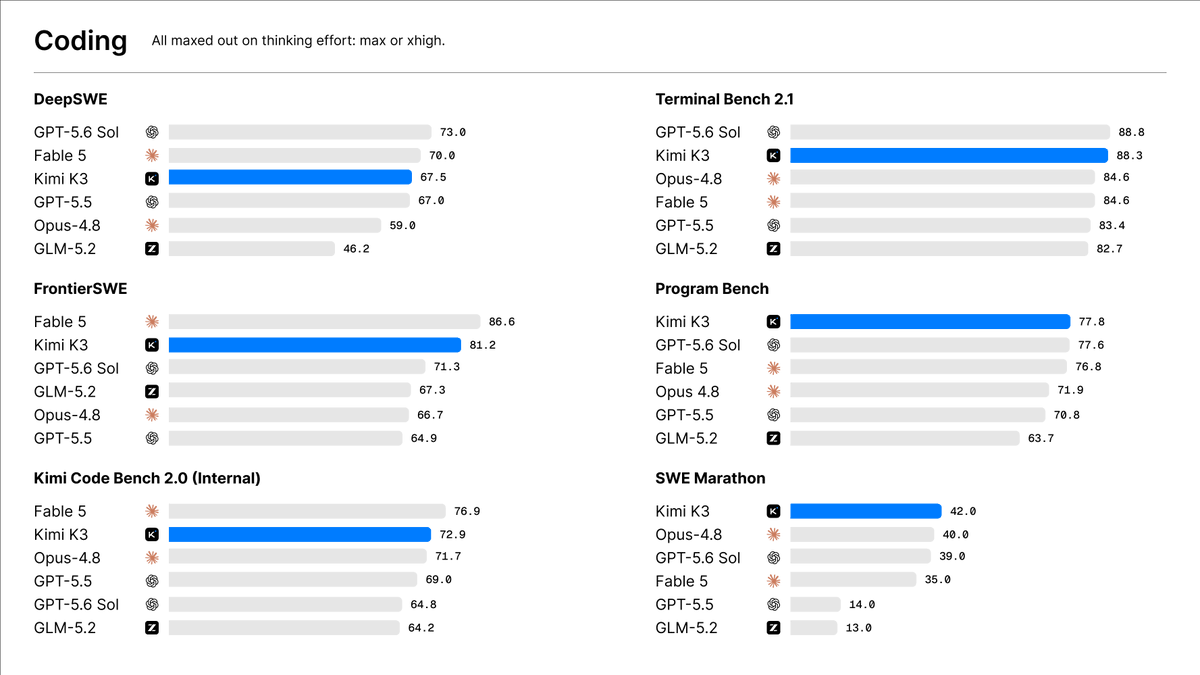
Introducing Kimi K3: Open Frontier Intelligence
🔹 2.8 Trillion Parameters, 1 Million Context, Native Multimodal
🔹 Kimi Delta Attention enables up to 6.3x faster decoding in million-token contexts
🔹 Attention Residuals deliver ~25% higher training efficiency at <2% additional cost
🔹 Built for long-horizon agentic coding and self-evolving workflows
Kimi K3 is now live on on https://t.co/zrk6zZxZUo, Kimi Work, Kimi Code, and the Kimi API.
Open Weights by July 27, 2026.
🔗 API: https://t.co/XCrgjXAqMw
🔗 Tech blog: https://t.co/YTfiMSNM1f
We did it! ExecuTorch team won the Best Industry Paper Award @MLSysConf 2026. Come meet us at the conference next week.
Discord: https://t.co/Yi81hwDFUc
Paper: https://t.co/lRsuFMqar9
Project: https://t.co/VEjOFj8e25
Schedule: https://t.co/1spj9aMmiH
The #MLX delegate has landed in ExecuTorch(https://t.co/ErOa01l4BI) and is available on main in OSS. It delivers SOTA GPU performance on #macOS for GenAI models, with 3-6x greater throughput than what was previously possible with #ExecuTorch.
everyone's talking about their teams like they were at the peak of efficiency and bottlenecked by ability to produce code
here's what things actually look like
- your org rarely has good ideas. ideas being expensive to implement was actually helping
- majority of workers have no reason to be super motivated, they want to do their 9-5 and get back to their life
- they're not using AI to be 10x more effective they're using it to churn out their tasks with less energy spend
- the 2 people on your team that actually tried are now flattened by the slop code everyone is producing, they will quit soon
- even when you produce work faster you're still bottlenecked by bureaucracy and the dozen other realities of shipping something real
- your CFO is like what do you mean each engineer now costs $2000 extra per month in LLM bills