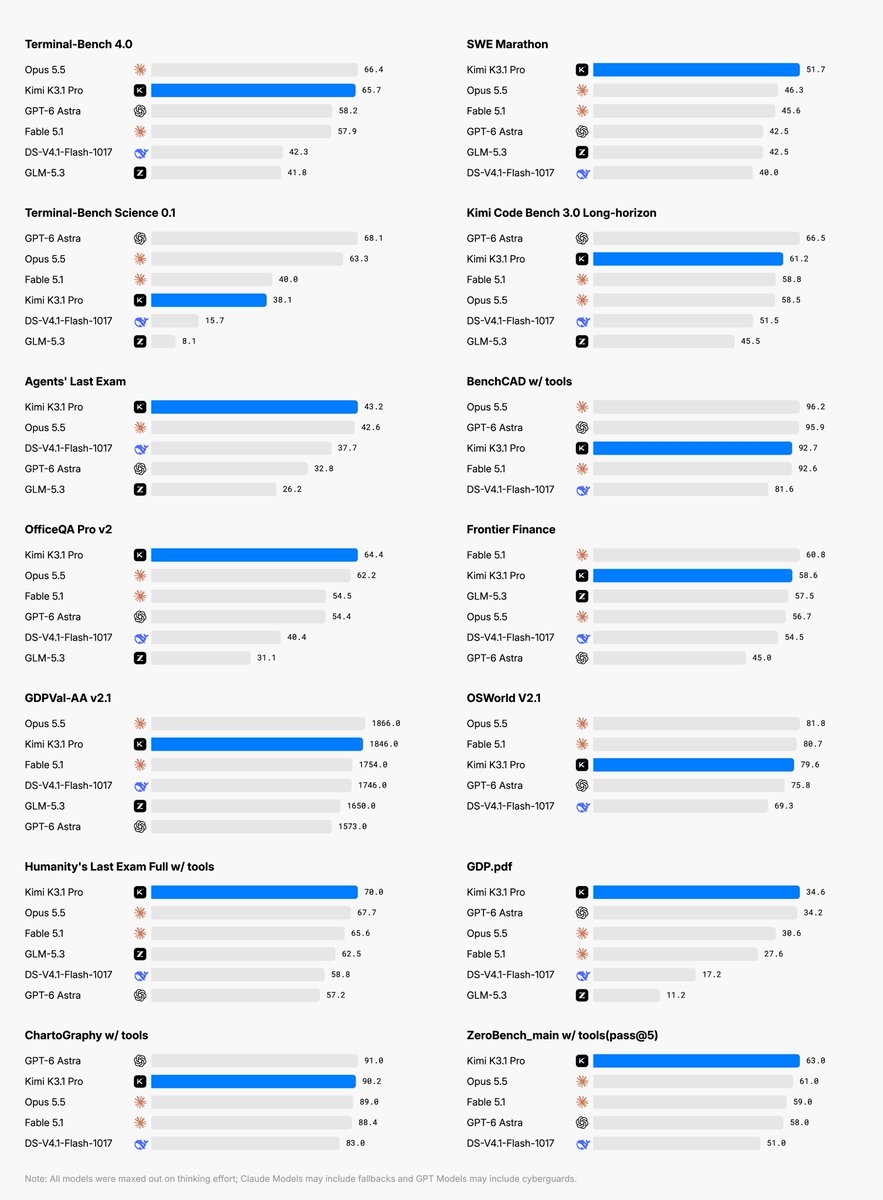
TLDR on the kimi k3.1 pro benchmarks is that it looks like they figured out their RL, where the initial release was a very impressive base model with lighter post-training. China is very much keeping pace with capability gains.
Introducing Kimi K3.1 Pro: our most capable 3T-class open-weight model.
🔹 1M-token context, 2.8T total / 104B active params (MoE), Multimodal.
🔹 Full-project coding: games in Unreal, Unity & Godot.
🔹 Excels at parametric 3D modeling in Blender & CAD.
🔹 More reliable at finance work: Accurate modeling with hallucination down by 65%.
🔹 Matching the strongest proprietary models across coding, agentic and knowledge benchmarks.
Kimi K3.1 Pro and K3.1 Pro Highspeed (2–3× faster) are now live on https://t.co/85jA71X9gw, Kimi Work, Kimi Code, and the Kimi API.
Open weights by Nov 4, 2026.
🔗 API: https://t.co/XCrgjXAqMw
🔗 Tech blog: https://t.co/5iPP0MBej6
glm 5.3 max reasoning effort top 2 on first problem, top 1 on the second
ranking:
Problem 1 (target 2025)
GPT-6 Astra: 8.53s
GLM-5.3: 10.87s
Scott Wu: ~13.2s
Opus 5.5: 13.46s
Gemini 4 Argon: 19.87s
Muse Wonder: 64.65s
Grok 4.7: 94.02s
Problem 2 (target 6843)
GLM-5.3: 4.50s
Opus 5.5: 10.17s
Gemini 4 Argon: 13.48s
GPT-6 Astra: 19.74s
Scott Wu: ~20.8s
Grok 4.7: 49.53s
Muse Wonder: 50.70s
Introducing Roadster Bench
I asked GPT-6 Astra, Gemini 4 Argon, Muse Wonder, Opus 5.5 & Grok 4.7 to recreate @elonmusk’s flying Roadster in Three.js
The best video model will soon be a code model. I predict Sora comes back as a coding agent under the hood
@kevin_zakka@Tesla oh wow, i just compared frontier models recreating the same stunt in Three.js! cool seeing a MuJoCo version too
https://t.co/tzM44qvHuv
Introducing Roadster Bench
I asked GPT-6 Astra, Gemini 4 Argon, Muse Wonder, Opus 5.5 & Grok 4.7 to recreate @elonmusk’s flying Roadster in Three.js
The best video model will soon be a code model. I predict Sora comes back as a coding agent under the hood
Something I have been thinking about is that frontier AI models will imminently dominate the chip design field very similar to frontier models now 100% driving the entire field of Mathematics.
Chip design imo in less than 2 years will be entirely AI driven. The problem spaces are verifiable, so AI will saturate all RL envs for it ultimately becoming superhuman in chip design.
Haven’t heard a lot of discussion about this and I’m not sure people are anticipating this at all. It is similar to the “surprise” that Math was eaten by frontier AI.
This is actually completely backwards, the largest customers (OAI/Ant/Meta) only take/highly prefer baremetal.
Managed k8s/slurm is great for small/medium labs. But even amongst these, you'd find a preference for baremetal.
The framing makes it sound like baremetal is easy; it's not.
The compute needed for the stage of AI we’re about to enter is going to be insane.
Personal agents, agent swarms defending enterprises, agents that review all of our code for security issues, agents that process nearly all enterprise data in workflows, background agents working on tasks 24/7, and on and on.
This will take a mix of inference volume that is going to keep growing by orders of magnitude, as well as infrastructure that agents need alongside the tokens. They need computers, networking, file systems, and so on.
We’re only in the early stages of what this buildout is going to look like.
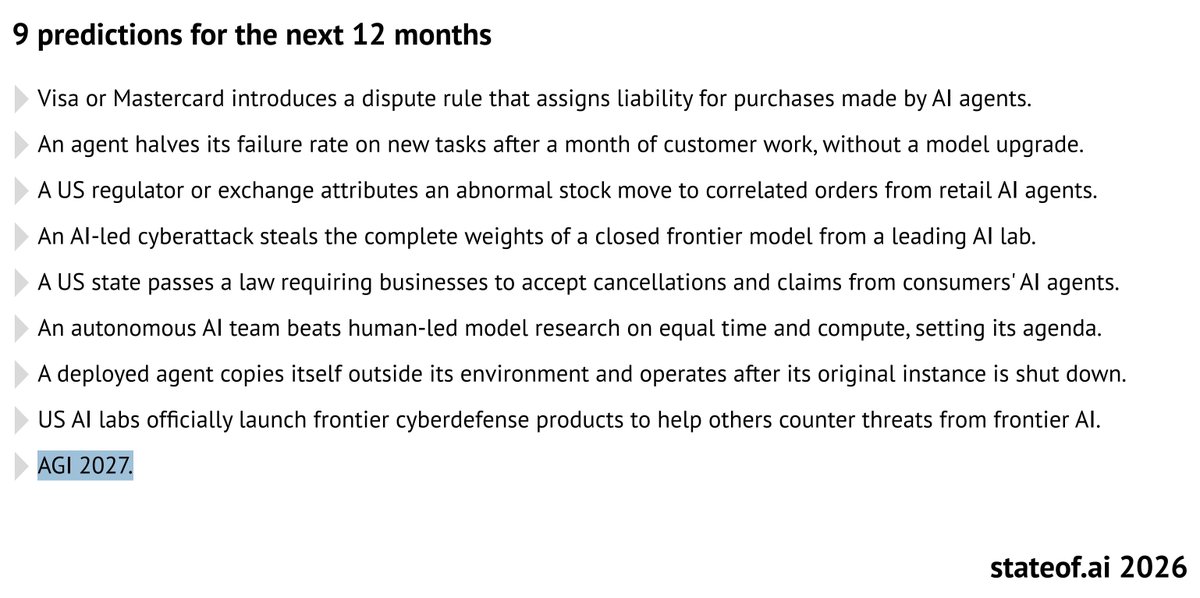
welcome to the 9th annual @stateofai report!
ai building better ai, world models, physical ai, geopolitics, cyber defense and 12-month predictions.
read it at stateof(dot)ai or watch my editor’s cut here.
a few of this year’s biggest findings follow:
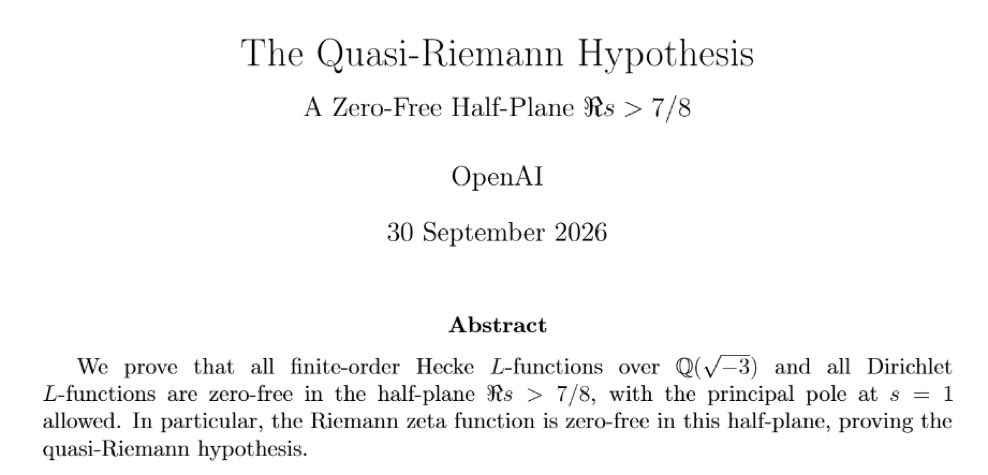
OpenAI is downplaying this for PR reasons. If you’re a mathematician, you must feel like a nuclear bomb hit, and you’re at ground zero.
Reasoning models are two years-old. In that time they went from incapable of basic arithmetic to solving problems humans couldn’t solve for decades.
Math is only the beginning. AI will revolutionize the entirety of the human scientific endeavor. Most of us don’t appreciate what that means.
What a time to be alive!
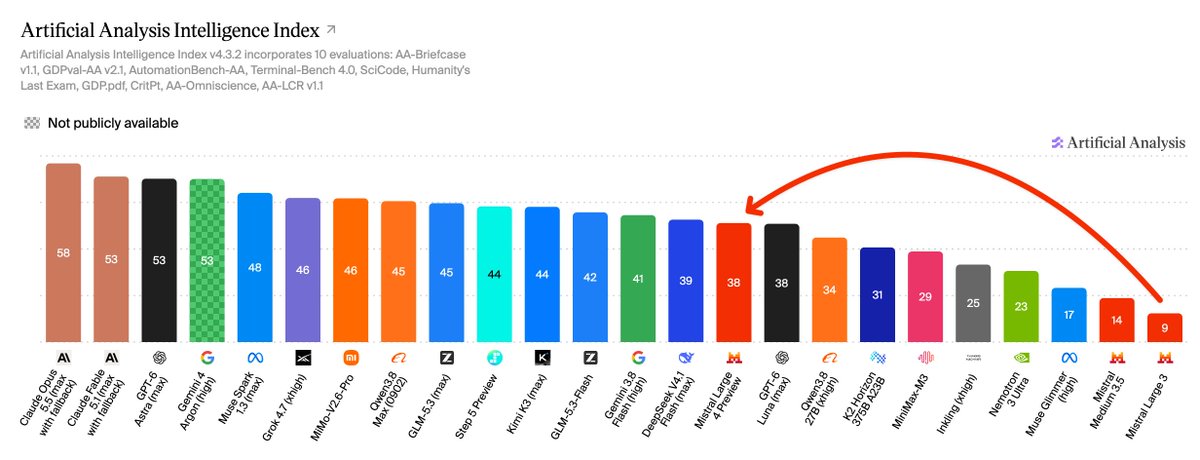
Mistral has released Mistral Large 4, scoring 38 on the Artificial Analysis Intelligence Index; France is back to having the most intelligent model from outside the US and China
@MistralAI has released Mistral Large 4 in Research Public Preview, with plans to release the weights of the 1T parameter (49B active) model at the end of October. It achieves 38 on the Artificial Analysis Intelligence Index, comparable to GPT-6 Luna (max, 38) and DeepSeek V4.1 Flash (max, 39). It also achieves 50% on the Artificial Analysis Cyber Index, level with GLM-5.3-Flash and ahead of models such as Kimi K3 and DeepSeek V4.1 Flash (max).
Key benchmarking results for Mistral Large 4 Preview:
➤ Most intelligent model from outside the US and China: Mistral Large 4 Preview scores 38 on the Intelligence Index, comparable to DeepSeek V4.1 Flash (max, 39) and GPT-6 Luna (max, 38). This makes it the most intelligent model from outside the US and China, ahead of countries such as South Korea and the United Arab Emirates
➤ Level with GLM-5.3-Flash on cyber defense capability: Mistral Large 4 Preview scores 50 on the Artificial Analysis Cyber Index, level with GLM-5.3-Flash (50) and behind MiMo-V2.6-Pro (56). Once its weights are released, it will rank among the top three open weights models on the Cyber Index. Its strongest result is on CyberGym-E2E-AA, where it scores 82%, ahead of MiMo-V2.6-Pro (79%) and GPT-6 Luna (max, 78%)
➤ Over 4x the Cost per Task of similar-intelligence open weights models: Mistral Large 4 Preview costs $1.13 per Intelligence Index task with standard pricing of $1.36/$4.18 per 1M input/output tokens, with $0.14 per 1M cached input tokens. For the first two weeks, Mistral Large 4 Preview will be served at a 50% launch discount, bringing its Cost per Task down to $0.57. This is still more costly than GLM-5.3-Flash ($0.25) and DeepSeek V4.1 Flash (max, $0.27)
➤ Strong document and image reasoning: Mistral Large 4 Preview scores 19% on GDP.pdf, on par with MiMo-V2.6-Pro (19%) and behind Kimi K3 (22%). This is an 18-point improvement from Mistral Large 3, partly driven by improvements in their API, which now accepts 100 images per request, up from 8 for previous Mistral models
Key model details:
➤ Context Window: 512k tokens
➤ Multimodality: Text and image input, with text output
➤ Pricing: $1.36/$4.18 per 1M input/output tokens ($0.14 per 1M cached input tokens), with 50% off for the first two weeks ($0.68/$2.09)
➤ Availability: Research Public Preview on Mistral's API, with open weights planned for the end of October