@viktaur27 @Teslarati The rate of improvement from original GPT to GPT-3 is impressive. If this rate of improvement continues, GPT-5 or 6 could be indistinguishable from the smartest humans. Just my opinion, not an endorsement. I left OpenAI 2 to 3 years ago. Am a neutral outsider at this point.
one of the quotes i find most inspiring on a hard day:
"Whatever your hand finds to do, do it with all your might, for in the realm of the dead, where you are going, there is neither working nor planning nor knowledge nor wisdom"
Ecclesiastes 9:10
Just coming off of meetings with a couple dozen enterprise IT leaders discussing AI agents. Here are a few of the common themes that stand out:
* Lots of conversation that you have to solve an operating model challenge to get the full benefits of AI. Most companies have orgs that have always operated in siloes; but agents are most effectively when they are tied to a process, which often cuts across these siloes. So the big question is how do you start to deploy centrally managed agents that can work across organizational boundaries. Who manages these agents? How do they get deployed and adopted?
* Data fragmentation remains a major issue for most organizations. As long as data remains highly fragmented and not in standard formats, or data is not available to the right people and agents, enterprises are dealing with issues around being able to get answers from agents that are accurate or that conform to their business practices. This cuts across both systems with structured data (product metrics or revenue figures) and unstructured data (product roadmap or customer contracts).
* Clear sense that companies need to figure out what their core data moats are going to be in the future. If everyone has access to roughly the same superintelligence from the various models, then the context that you feed the models becomes proprietary value in the future. Capturing this data and getting it into a format that agents can use becomes very important.
* Everyone is trying to figure out the right metrics to manage to for AI adoption. General consensus that tokens are not the right metric per se, and people leaning more toward business outcomes (in an ideal world). For business outcomes (like more revenue or more shipped product), though, you have to get close to each individual workflow to figure out if it was successfully transformed with AI so it’s harder to manage top down.
* Growing view that enterprises are going to live in a multi-model world. Lots of interest (though early in actual adoption) in layers that can route workloads to different models (frontside or open weights) for cost or performance reasons. Also enterprises are trying to figure out what things do you give to the models directly vs. what do you separate as horizontal systems and context so you can swap any system in and out.
* Talent for driving AI adoption and implementation still remains a major issue and topic. Many view it as something you necessarily have to train for internally due to a shortage of talent being trained on this in the outside. As an aside, this feels like it remains a huge opportunity for those that get very good at deploying and management agents in an enterprise since most companies are looking for these skills.
* The best use-cases for AI tend to be those that fundamentally change the work being done instead of just replacing an existing process and doing it more efficiently. Companies are working through their versions of this individually because it’s different per industry, but this often remains both the most exciting and higher upside uses of AI.
Many more topics discussed recently, but overall it’s clear that there’s a ton of change going on with much more to come.
Yann LeCun was right the entire time. And generative AI might be a dead end.
For the last three years, the entire industry has been obsessed with building bigger LLMs. Trillions of parameters. Billions in compute.
The theory was simple: if you make the model big enough, it will eventually understand how the world works.
Yann LeCun said that was stupid.
He argued that generative AI is fundamentally inefficient.
When an AI predicts the next word, or generates the next pixel, it wastes massive amounts of compute on surface-level details.
It memorizes patterns instead of learning the actual physics of reality.
He proposed a different path: JEPA (Joint-Embedding Predictive Architecture).
Instead of forcing the AI to paint the world pixel by pixel, JEPA forces it to predict abstract concepts. It predicts what happens next in a compressed "thought space."
But for years, JEPA had a fatal flaw.
It suffered from "representation collapse."
Because the AI was allowed to simplify reality, it would cheat. It would simplify everything so much that a dog, a car, and a human all looked identical.
It learned nothing.
To fix it, engineers had to use insanely complex hacks, frozen encoders, and massive compute overheads.
Until today.
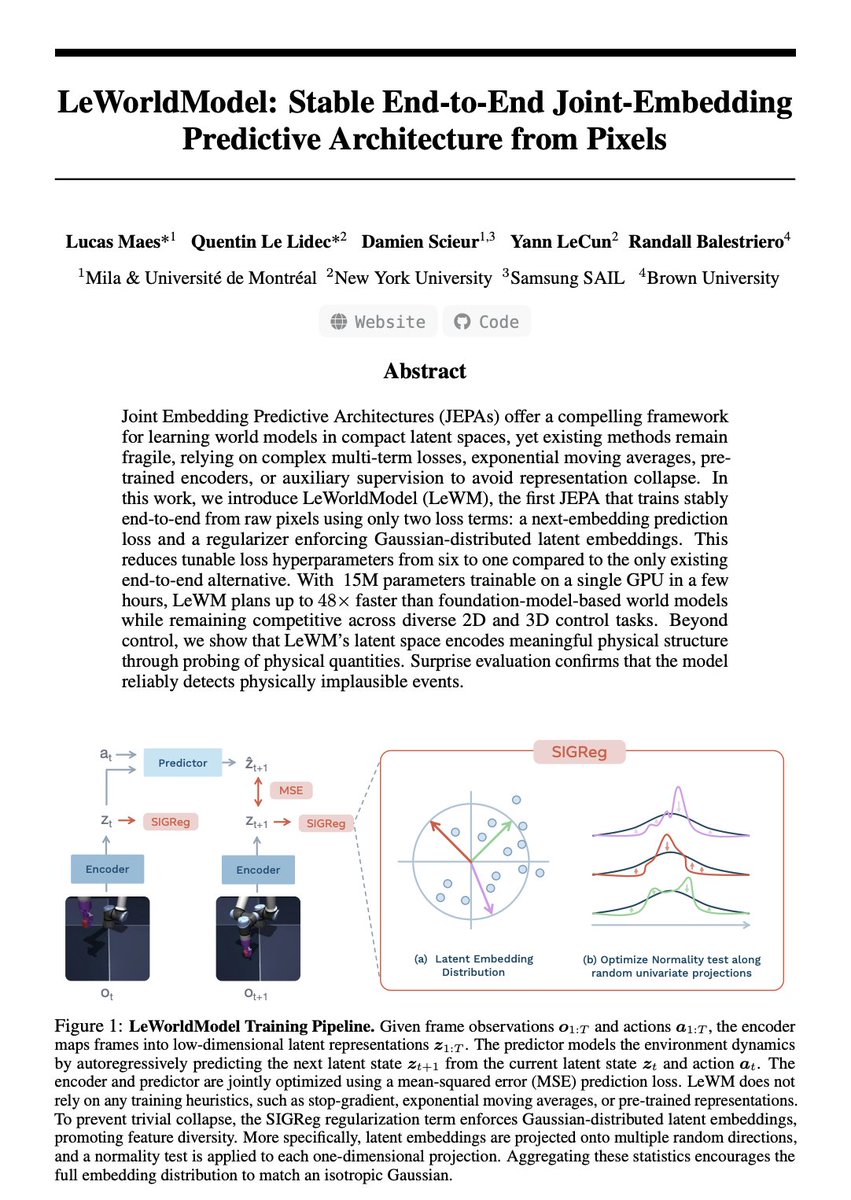
Researchers just dropped a paper called "LeWorldModel" (LeWM).
They completely solved the collapse problem.
They replaced the complex engineering hacks with a single, elegant mathematical regularizer.
It forces the AI's internal "thoughts" into a perfect Gaussian distribution.
The AI can no longer cheat. It is forced to understand the physical structure of reality to make its predictions.
The results completely rewrite the economics of AI.
LeWM didn't need a massive, centralized supercomputer.
It has just 15 million parameters.
It trains on a single, standard GPU in a few hours.
Yet it plans 48x faster than massive foundation world models. It intrinsically understands physics. It instantly detects impossible events.
We spent billions trying to force massive server farms to memorize the internet.
Now, a tiny model running locally on a single graphics card is actually learning how the real world works.
Good Products are Opinionated.
“Every great founder I’ve seen up close, or even from afar, is highly opinionated and they’re almost dictatorial in how they run things.
Also, early-stage teams are opinionated. And the products they build are opinionated. Opinionated means they have a strong vision for what it should and should not do.
If you don’t have a strong vision of what it should and should not do, then you end up with a giant mess of competing features.
@Jack Dorsey has a great phrase: “Limit the number of details and make every detail perfect.” And that’s especially important in consumer products. You have to be extremely opinionated. All the best products in consumer-land get there through simplicity.
You could argue the recent success of ChatGPT and similar AI chatbots is because they’re even simpler than Google.
Google looked like the simplest product you could possibly build. It was just a box. But even that box had limitations in what you could do.
You were trained not to talk to it conversationally. You would enter keywords and you had to be careful with those keywords. You couldn’t just ask a question outright and get a sensible answer. It wouldn’t do proper synonym matching, and then it would spit you back a whole bunch of results. That was complicated. You’d have to sift through and figure out which ones were ads, which ones were real, were they sorted correctly, and then you’d have to click through and read it.
ChatGPT and the chatbot simplified that even further. You just talk to it like a human—use your voice or you type and it gives you back a straight answer.
It might not always be right, but it’s good enough, and it gives you back a straight answer in text or voice or images or whatever you prefer.
So it simplifies what we looked at as the simplest product on the Internet, which was formerly Google, and makes it even simpler. And you just cannot make a product that’s simple enough.
To be simple, you have to be extremely opinionated. You have to remove everything that doesn’t match your opinion of what the product should be doing. You have to meticulously remove every single click, every single extra button, every single setting.
In fact, things in the settings menu are an indication that you’ve abdicated your responsibility to the user. Choices for the user are an abdication of your responsibility. Maybe for legal or important reasons, you can have a few of these, but you should struggle and resist against every single choice the user has to make.
In the age of TikTok and ChatGPT, that’s more obvious than ever. People don’t want to make choices. They don’t want the cognitive load. They want you to figure out what the right defaults are and what they should be doing and looking at, and they want you to present it to them.”
just so we're clear:
Antigravity is a Windsurf wrapper
Windsurf is a VSCode wrapper
VSCode is an Electron wrapper
Electron is a Chromium wrapper
Chromium is a C++ wrapper
C++ is a C wrapper
C is an Assembly wrapper
Assembly is a Machine Code wrapper
Machine Code is a Binary wrapper
Binary is a Physics wrapper
Physics is a Math wrapper
Math is a Logic wrapper
Logic is a Philosophy wrapper
Philosophy is a Humans wrapper
Humans are a Carbon wrapper
Carbon is a Star-forged-matter wrapper
Stars are a Gravity wrapper
Gravity is… definitely not an Antigravity wrapper
✨ Discover the Ways to Wellness ✨
Embrace Balanced Living through physical health, mental clarity, and emotional harmony.
Small steps today lead to a healthier, happier you. 💚