@GrowingUpRetro Crock pot full of white beans slow-cooked all day with a big chunk of ham by Mom, along with a batch of fried cornbread that Dad made (cornbread but fried like pancakes instead of baked)
Sunrise, sunset 🏜️
To mark Curiosity’s 5,000th Martian day on the Red Planet, the rover’s team created this postcard. It combines two panoramas, with blue colors representing images taken in the morning, and yellow colors for the images taken at dusk. 1/2
@JamieAdStories Yes, I like to read to music, but it must be instrumental. Lyrics are distracting. But usually I am reading to purring because Reading Cat insists that I cannot read without a certified Reading Cat present.
Eines Morgens riechst du den Herbst. Es ist noch nicht kalt; es ist nicht windig; es hat sich eigentlich gar nichts geändert – und doch alles.
🍁 Kurt Tucholsky 🍂
@DisrespectedThe I drive through that area every once in a while. Thankfully I have never personally seen the ramp used. I really hope the trucker driver is ok.
He didn’t invent SQL. He invented why SQL works.
Edgar “Ted” Codd sat at IBM in San Jose, watching people hunt records through pointer mazes. He wanted something cleaner: tables as mathematical relations, questions as algebra.
In 1970 he gave data its operators:
- σ selects the rows that fit a condition,
- π keeps only the columns you need,
- ⋈ joins tables where meaning overlaps.
He wasn’t trying to make the math look pretty. He was tired of people having to know the machine’s private wiring just to ask a simple question. That was the point of data independence: you should be able to reach for the rows, the columns, the connections, and leave the storage headaches to someone else. IBM dragged its feet. The rest of the field did not. And those three marks are still sitting under almost every query we write.
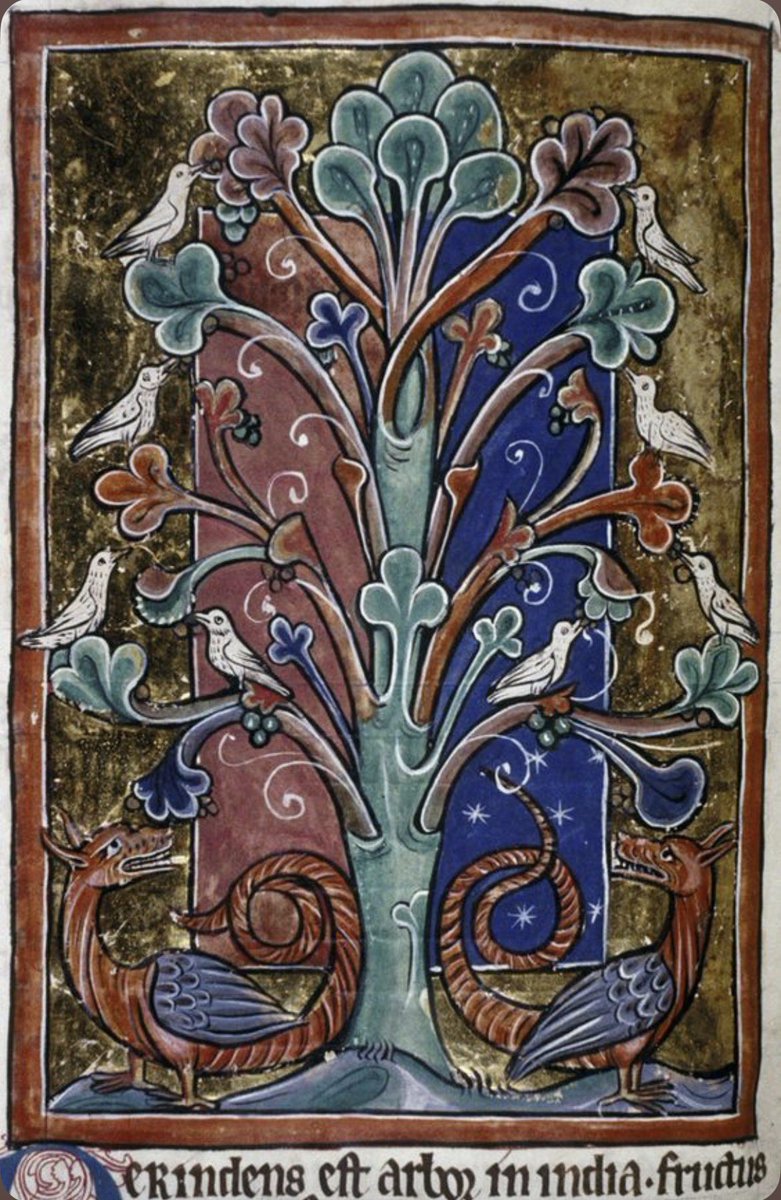
The Peridexion tree, depicted in a 13th-century bestiary. Doves shelter beneath its branches while dragons lurk beyond its protective shadow—a medieval allegory of the Church as a refuge from temptation.
Voyager hit a 90,000°F wall at the solar system’s edge.
NASA’s Voyager 1 spacecraft crossed one of the most dramatic frontiers in the cosmos: the heliopause, the tenuous boundary where the Sun’s influence finally gives way to interstellar space. What the probe discovered there was astonishing, a turbulent zone of superheated plasma with temperatures soaring between 30,000 and 90,000 °F (roughly 17,000–50,000 °C).
This wasn’t a physical wall or barrier, but a dynamic transition region where the outward-flowing solar wind abruptly slows, compresses, and piles up against the incoming pressure of interstellar material. That compression converts kinetic energy into thermal energy, driving the plasma to extreme heat levels far beyond anything found inside the heliosphere.
Remarkably, despite the blistering temperatures, this “wall of fire” would pose no danger to a hypothetical astronaut. The plasma is extraordinarily diffuse, far less dense than the best vacuums achievable in Earth laboratories, so there are simply too few particles to transfer meaningful heat. The region is hot in temperature but cold in practical effect.
Voyager’s instruments captured clear signatures of the crossing: a sudden plunge in solar wind particles, a sharp rise in galactic cosmic rays, and faint plasma oscillations that revealed the density and temperature of this exotic boundary layer for the first time. These vibrations, analogous to ripples on an unseen sea, provided direct measurements of conditions in a realm previously known only through theory.
The heliopause itself serves as a vital shield. The entire heliosphere, the vast bubble carved by the Sun, deflects most of the galaxy’s high-energy cosmic radiation, helping protect life on Earth from constant bombardment. Beyond this protective envelope lies the harsher, unfiltered radiation environment of the interstellar medium.
Today, more than 15 billion miles (24 billion kilometers) from home, Voyager 1 remains the farthest human-made object ever sent into space. Still operational and transmitting precious data, it continues to reveal the secrets of this distant frontier.
At the outer limit of our solar system, space is neither empty nor serene. It is a violent, glowing threshold: and humanity has only begun to map its mysteries.
Three minutes before the first moon landing, the computer inside the lunar module started throwing an alarm nobody in the cockpit recognised.
Neil Armstrong read out the code. 1202. Then it fired again. Five alarms in four minutes, while they were descending toward the surface with the fuel running down.
The computer was overloaded. A radar switch was flooding it with data it had not been asked for, and it had more jobs than it could finish in the time available.
It did not crash. It threw work away.
The software had been written to expect this. Every job on that computer had a priority number, and when the machine ran out of capacity it dropped the lowest-priority tasks, restarted cleanly, and kept the landing calculations running. That is why Houston told Armstrong to continue.
Margaret Hamilton was 32 and led the team at MIT that wrote it. She had spent years arguing that software deserved the same seriousness as the hardware. The phrase software engineering is one she coined, partly to make that argument.
Her design assumption was that the operator would make mistakes, the hardware would misbehave, and both would happen at the worst possible moment. So she wrote code that survived it.
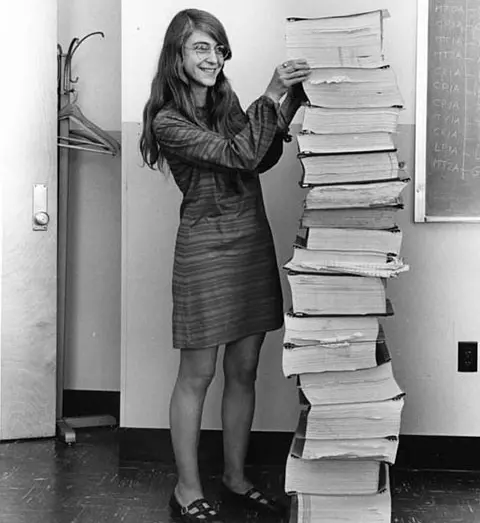
Armstrong landed with about 25 seconds of fuel left. There is a photograph of her from that year standing beside the printed listings of the Apollo code, a stack of paper taller than she is. She wrote the instructions that told a machine what to abandon when it could not do everything.
https://t.co/U5hOVkOpXN
Anton Seder’s The Animal in Decorative Art (1896) — an Art Nouveau reference book full of elaborate ornamentation: winged dragons, chiseled hieroglyphs, warring sea creatures, and more... https://t.co/6GknoAT7yp
He thought. Therefore he plotted.
René Descartes (1596–1650) didn’t just give us “I think, therefore I am.” After vivid dreams in 1619, the French philosopher found a way to unite algebra and geometry - two worlds that had always been separate.
In 1637 he published La Géométrie and gave every point two numbers: x and y. The Cartesian plane was born. Suddenly a curve wasn’t just a shape you drew; it was an equation you could calculate.
Legend says it started with a fly walking across his ceiling. True or not, the idea changed everything. Every graph, every map, every GPS coordinate and every video game still lives on the grid he invented.
One man stayed in bed till 11. The universe got coordinates.