Kimi K2.5 1T runs on 2 M3 Ultras with mlx-lm in it's native precision.
It's actually quite usable. Here it's making a space invaders game. Generated 3856 tokens at 21.9 tok/sec using 350GB per machine.
Thanks to @kernelpool for the port.
Assorted things I've been mulling over regarding agents in the economy:
• Companies are in some sense the original superintelligence. It's often the case that they can use their amortized cognitive surplus to advance their interests against those of certain consumers: relative to the optimization capacity of companies, consumers can be inattentive, underinformed, irrational, etc. (Think, say, of some of the classic insurance upsells at the end of a booking process, which is typically priced substantially above what a regular policy would cost.) Herbert Simon introduced the idea of bounded rationality, and firms often end up benefiting from it. Thanks to personal agents, we will probably get somewhat more rational in how we engage with companies.
• How exactly will outcomes change? Well, certain kinds of price discrimination will work less well (how do coupons work if every agent hunts fastidiously for them?), and certain kinds of customer cross-subsidy will change (today, people who forget to cancel subscriptions subsidize those who don't). Taken across the economy as a whole, I'm not sure what the incidence of all of this will be.
• In corporate strategy, people have long debated the relative importance of distribution and product quality. Perhaps you've made something better, but does anyone know about it? Won't people just continue to buy the ACME Corp Mousetraps? Personal agents will, I think, act as a kind of structural subsidy for product quality. How would markets look different if individuals always spent at least 10 hours researching their purchases? On the margin, focusing on making a product better is, I think, going to become a more effective strategy for companies. This is good!
• It true, a corollary is that information about product quality will become more important and impactful. Today, most people have very limited ability to aggregate and integrate such data, but agents will have insatiable thirst for such signals. (It's often said that data is becoming more valuable because it helps in the training of models. That's obviously true, but I think there's a secondary way in which it's more valuable simply as a complement to cheaper intelligence.)
• A big question is whether agents will increase superstar effects (rational agents all settle on the same product) or increase dispersion (because everyone has slightly different tastes and preferences, which agents are good at eliciting, finally overcoming the artificial clustering we've been subjected to).
• Many internet companies have monetized demand routing, which is in turn often predicated on short attention spans. "I'll click on the first thing I see." This has led to some amount of inefficiency, as companies try to propitiate capricious ranking algorithms and incur various placement fees. It's not all deadweight loss (willingness to pay is itself a kind of signal, which is valuable to buyers), but it's not great. How will the nature and value of this routing change in a world of personal agents? I don't know the answer, but I think that the effects might be pretty big.
• Much of what I'm writing hinges on the assumption that personal agents will be on the consumer's side. I suspect that that will be the winning strategy, but whether it's true, and what it means to be true, involves a lot of other questions.
Taken as a whole, the market is a massively parallelized, decentralized, and highly imperfect value attribution machine, and, taking stock of all of the effects, it seems to me that the quality point may well be the biggest: that agents will change the nature of the backpropagation such that the rewards for better products increase. Maybe this is too optimistic, but I suspect (and hope) that companies that make things that they're proud of will feel that the universe is a little more partisan in their favor.
It’s called https://t.co/znR2U4Bh6w
Cloud agents on your own hardware. Bring any subscription—including Claude Code—and any model.
A remote dev environment per task, a great mobile experience, built for evaluating agent work.
Free. Open source. Let me show you around 👇
Amazon self-censored their order emails to hide purchase details from Google. Now they are doing that for agents.
As a marketplace person I have seen this movie before and self-censoring never ends well! Marketplaces need to become platforms for their participants instead of matchmakers. This is why @Shopify reacts differently to the world of agents compared to Amazon!
Set the goal. Build the environment. Do the work. Fix the details. Let them fail while it's cheap. Keep going.
It isn't complicated. It's just hard to do for long period of time
I haven’t tried video explainer but “HTML SPA” has been my default output for a while now. The output is remarkably approachable with animations/simulations inserted at the right moments without even asking. It is also a single file so very easy to share.
We'll be spending a lot more time trying to understand the outputs of language models. A few thoughts, tips & tricks:
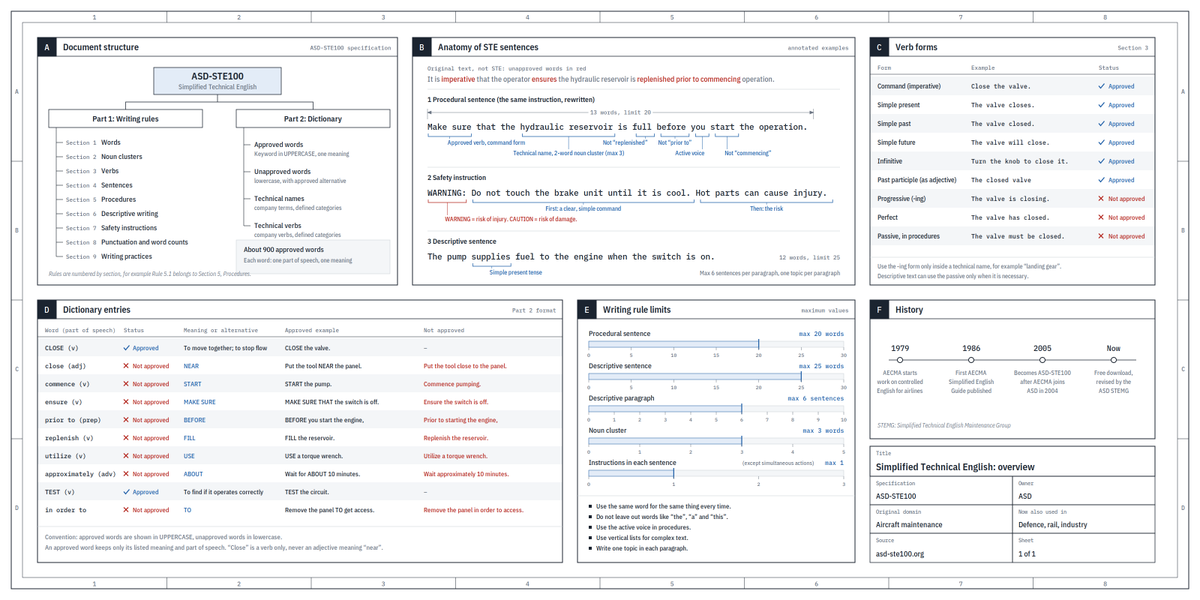
Writing. Something I've had success with: Ask your LLM to explain something in ASD-STE100, it's a controlled language specification originally developed for aerospace maintenance documentation. LLMs well-versed in this language and it comes with heavy constraints on clean writing style that I often find a lot more readable. Sometimes I've tried to soften it a bit e.g. ask for "80% of the way to ASD-STE100" because the spec is quite stringent. But even better:
Diagrams / images. Instead of writing, ask your LLM to create a diagram. These can be a lot easier to process, parse, and understand. But even better:
Web pages. Ask for output "in HTML" to get a beautiful, interactive webpage. LLMs are getting really good at frontend and can create beautiful experiences, animations, etc. But even better:
Explainer videos. The output format I am most bullish on is fully custom / bespoke explainer videos generated on any arbitrary topic. Experiment with things like "Create a 3b1b style video explainer on X. Use my ElevenLabs API key for audio narration". (you'd need an API key for the latter or you can ask your LLM to find you decent free alternatives that use your local compute). This is actually starting to work!
In summary:
- As LLMs get better, they will do more and more of the legwork autonomously, and a lot more of our work will rise up the abstractions into oversight and understanding.
- Luckily, LLMs can help here too because as intelligence and code are increasingly abundant, you can ask for large, custom, discardable software artifacts (e.g. web apps, video explainers) that would have never made sense to create before. Push the boundaries here and you'll be surprised.
Took a minute to write a few words about security & safety as someone who lived through it all at OpenAI. I hope my thoughts help someone out there. https://t.co/gJBf08vJH9
SCOOP: OpenAI, Anthropic and security researchers are investigating tens of thousands of incidents - not dozens - in which their frontier models took steps that outside evaluators would consider problematic, sources told Axios.
The sheer volume of incidents found in our reporting indicate that the problem is orders of magnitude more complex than what is currently publicly known and disclosed.
The findings also raise questions about what level of control anyone working on AI development can expect to have over their own technology, and whether these kinds of incidents are becoming synonymous with frontier deployment.
Read my latest for Axios here: https://t.co/42h9aR4sem
I can empathize with these agents because some of these websites are so bad it’s easier to SQL injection them than find the buttons/links to click to get what I need 😅
Interestingly, the agents use exploits to complete what appears to be routine data retrieval tasks that are not cyber-related (for instance, searching for the average cost of skin and hair treatments in Australia).
Jev is cool, but like any foundation model it needs to be calibrated to your decision criteria.
We launched jev-align: an open-source CLI to quickly teach Jev what good and bad looks like using GEPA.
Try it out! https://t.co/UpvJs53RKm
In the near term (definitely not in the long term), more capable models should mean safer models (maybe paradoxically).
Current models are unsafe not because they're too smart, but because they take goals too literally or take nonsensical shortcuts to achieve these goals, i.e. they're RL-fried. They lack common sense. They don't do the right thing in the face of ambiguity. Basically, they're not smart enough. They're at that dangerous level where they're smart enough to achieve goals but not smart enough to tell if they're pursuing the right goals or achieving them in a sensible way.
More capable models can be safely trusted with more complex goals -- I personally feel like Astra is much safer for my codebase than Sol.
This is often framed as an alignment problem, but really it's an intelligence problem.
I'd rather have powerful AI broadly accessible, and ideally open, than centralized in the hands if a few people that strongly believe themselves to be the righteous and ideologically pure.