With 1.9 seconds left in overtime of Game 5 of the 2006 NBA Finals, Dwyane Wade went to the free throw line.
Wade & the Heat were down by 1. The series was tied 2-2.
He told Tiger Woods how he prepared to make those high-pressure free throws:
“The night before,” Wade said,
“I was in the gym at midnight.
And I was like, ‘I know games come down to free throws. No matter what happens, it's going to come down to free throws.’
So I was in the gym and I had my cousin standing next to me, I had him right in my ear talking shit to me.
And so the next night, I get in that same situation where I got to make these free throws. And I just went back to last night in the gym. I just went right back to that. I was like, ‘I just hit 200 of these last night. I got this.’"
"That's so good," Tiger says.
"It's like," Wade says, "your confidence comes from your work."
"Correct," Tiger replies.
Wade: "You've done it over and over. You've seen yourself do it."
Tiger: "Correct, thousands of times."
Wade hit the two free throws, and the Heat won 101-100 to take a 3-2 series lead. Then in Game 6, he had 36 points to help the Heat win the game and their first championship in franchise history. Wade was named NBA Finals MVP.
Takeaway 1:
Ryan Holiday likes to say,
"Belief in yourself is overrated. Generate evidence."
Wade simulated the situation so that when he was in that situation for real, he had the evidence.
“You've done it over and over,” he told himself. “You've seen yourself do it.”
Your confidence comes from your work, from your evidence.
Takeaway 2:
What Dwayne Wade figured out intuitively—that confidence is a function of the previous work put in—is scientifically accurate.
For nearly three decades, the neuroscientist Dr. Lisa Feldman Barrett has been studying where emotions—calmness, panic, nervousness, and so on—come from.
Her bestselling book, "How Emotions Are Made: The Secret Life of the Brain," gets its title from the discovery that emotions are constructed by the brain.
"In every waking moment," she writes, "your brain uses past experience to guide your present sensations."
In every waking moment, your brain sifts through its library of past experiences, looking for something similar to what is currently happening. If your brain can’t find anything in your past that is similar to your present, you are in a state of what brain scientists call “experiential blindness.”
If you are at the free-throw line with the game on the line, for instance, and you start to panic—you’re in a state of experiential blindness. Your brain, Dr. Barrett would say, is calling you out. You didn't put in the work. You didn't form the past experience needed for your brain to be able to say, as Wade was able to say, "I just hit 200 of these last night. I got this."
- - -
“You are continually cultivating your past…the experiences you have today become the past that your brain uses to make predictions for tomorrow.” — Dr. Lisa Feldman Barrett
Follow @bpoppenheimer for more content like this!
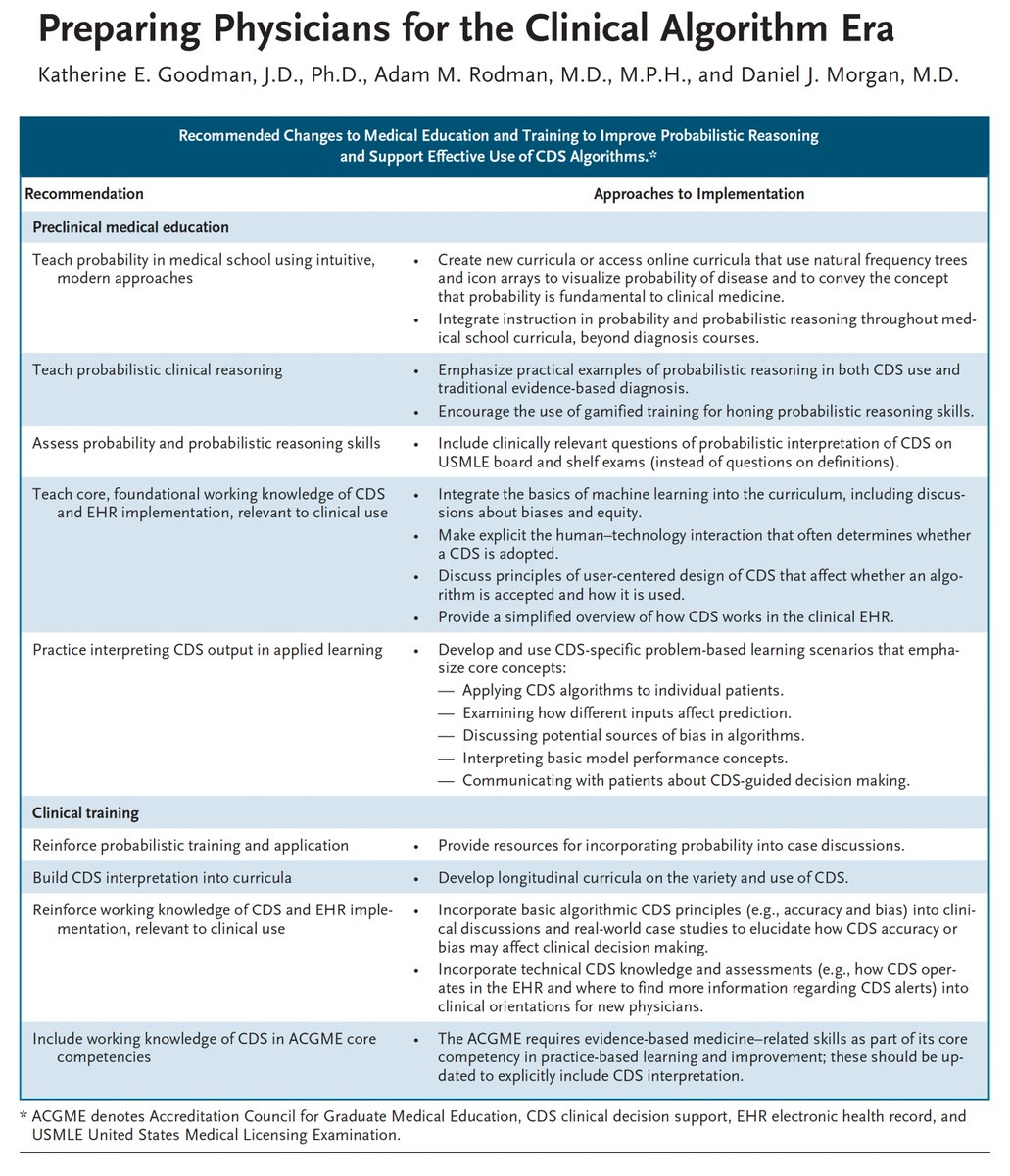
New @NEJM
Educating clinicians and medical students about #AI isn't happening. It needs to, and here's are recommendations and how they can be implemented
https://t.co/8ujpsuQGyx by @AdamRodmanMD@dr_dmorgan Katherine Goodman #MedEd#MedTwitter
In a CNBC interview a few years back, Warren Buffet relayed a story of a time shortly after he and Bill Gates first met.
Gate's father asked a group of roughly 20 people to write down on a sheet of paper the one word that they thought accounted for their success.
Without seeing what the other wrote, both Buffet and Gates chose the same word: Focus.
With this in mind, I wondered: How they would advise someone to choose what they place their focus on?
In search of this answer, I ran across an article by author Scott Dinsmore which describes Buffet's 5-step framework for narrowing your focus to what really matters:
Your "Avoid At All Costs List."
The story is framed as a conversation between Buffet and his pilot (no idea if this is actually what happened) but you'll get the point nonetheless.
Here goes:
Buffet jokingly said to his pilot: "The fact that you're still working for me, tells me I'm not doing my job. You should be out going after more of your goals and dreams."
Warren then asked his pilot to take the following steps: (You should do the same)
• List your top 25: Make a list of the Top 25 things you want to do over the next few years or in your lifetime.
• Choose your top 5: Review your list and circle the Top 5 items that are most important to you. This is critical––you can only pick 5.
• Make a plan: Now that you have your Top 5, it's time to make a plan. How will you start working on these? Who do you need to enlist help from? When can you start? Hint: the answer should be now!
• Know your priorities: Now that you've made your Top 5 plan, let's talk about the other 20 items on your list: Buffet asked his pilot, "What is your plan for completing those?" The pilot stated that he word work on those intermittently, as he had time, since they were not part of the Top 5.
To the pilot's surprise, Buffet said: "No, you've got it all wrong. Everything you didn't circle just became your 'Avoid At All Costs List.' No matter what, these things get no attention from you until you've succeded with your Top 5."
•Be ruthless with your Top 5 list: I think most of us would have probably answered Buffet in a similar manner to his pilot. I mean, those other things are still important, right?
Well, according to Buffet (and seemingly Gates as well), the ability to focus on the few things that are the most important to you––what you really want––is the key to outsized results.
Letting yourself be distracted by the 20 (less important) things is why you never reach your potential on the 5 that matter the most.
For someone like me (with more ideas than time) this exercise was extremely helpful.
Take 20 minutes today and write out your own list and see what you come up with. You might be surprised at the results.
You can see something 10,000 times on your phone, but never understand it until you see it in person for the first time.
That’s the lesson from the park bench scene in Good Will Hunting.
Matt Damon is the arrogant, book-smart intellectual who’s seen little but read everything. Robin Williams is the wise professor who rolls his eyes at Damon’s hubris. The stuff of life can only be fully absorbed through direct experience, he says.
This is one reason why school falls short. It conflates regurgitation for understanding.
Shakespeare’s plays have been reduced to bite-sized cramming on SparkNotes and exam questions the following day. Or, take entrepreneurship, where certain kinds of wisdom can only be gained in the trenches of a sales call or when you have to fire the executive you swore was going to save your company.
Travel, too.
Something about the Golden Gate Bridge can only be understood when you feel the Pacific Ocean wind and shiver under a blanket of fog. Something about the life of Moses can only be understood when you stand atop Mount Nebo (where he died) and look down at the Promised Land of Israel. Something about Italian food can only be understood when you slurp “siero” in a Parmesan cheese factory and meet the 4th-generation shop owner.
Pixels on a screen aren’t enough.
Get out and Do the Thing because certain kinds of knowledge can only be gained through tactile, first-hand experience.
Elon Musk fired 6,500 employees at Twitter.
A little birdie told me it's down to:
- 2 designers
- 6 iOS developers
- 20 web developers
- Around 1,400 sales and operations people
How is it possible that we are still using this website?
Two words:
Parkinson's Law.
Have you ever wondered why seemingly simple tech companies have tens of thousands of employees?
Sometimes, it's because they have huge sales forces or tech support/operations people.
But often it's also due to Parkinson's Law.
Parkinson's law is like lighter fluid for bureaucracy.
It's a business tapeworm that slowly eats away at companies, making them less and less efficient and innovative over time.
Parkinson's Law is the idea that the work will generally expand to the amount of time, budget, and number of people allocated to it, and no matter how many people you allocate to it, those people will feel busy.
They'll feel busy because, due to the excess time/slack in the system, they'll start focusing on less and less important tasks.
Here's how it manifests on an individual level:
Let's say you have a report due in a week.
The report might only take you around five hours to finish if you really focus and work efficiently. However, because you know you have a week to complete it, you might find yourself spending a lot more time on it than you need to.
You'll be more prone to distractions, take longer breaks, or perhaps decide to add more details, tables, graphs, and so forth.
Essentially, the task becomes more complex and time-consuming purely because you have more time in which to do it.
And here's how it manifests across organizations:
Imagine a big tech company. A social media company with various departments. Each department has tasks that it must complete to contribute to the overall productivity of the company.
Now, suppose each department is given a budget and a set amount of time to complete its tasks for the year.
According to Parkinson's Law, each department will use its entire budget and the entire allotted time, even if the tasks could have been completed more efficiently.
This is because as resources and time increase, departments tend to become more complex and less efficient.
For example, a department might add more steps to its procedures, requiring more approvals and creating more paperwork, which slows down the process.
Or it might use the full budget on additional personnel or equipment that doesn't necessarily improve productivity.
The department might also use the full budget to justify the same or larger budget for the next year, since budgets in many organizations are often determined based on the previous year's spending.
This is a phenomenon known as "budget padding" or "spend it or lose it" mentality.
Inefficiencies can also develop in staff allocation. If a department expands, it might add managerial positions that aren't strictly necessary.
More employees are hired to manage, creating layers of bureaucracy that may not contribute to productivity and can even slow decision-making.
I have seen this occur over and over again in my career. The larger the team, the larger the budget, the longer the timeline, the less gets accomplished.
I'm very curious to see how many more tech companies come to this realization.
So often, good times + revenue growth = Parkinson's Law.
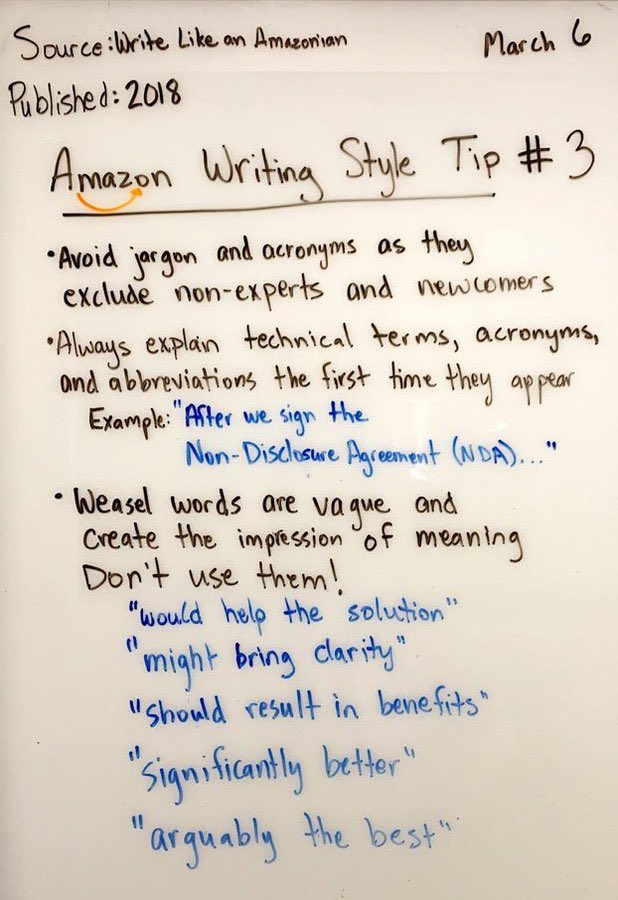
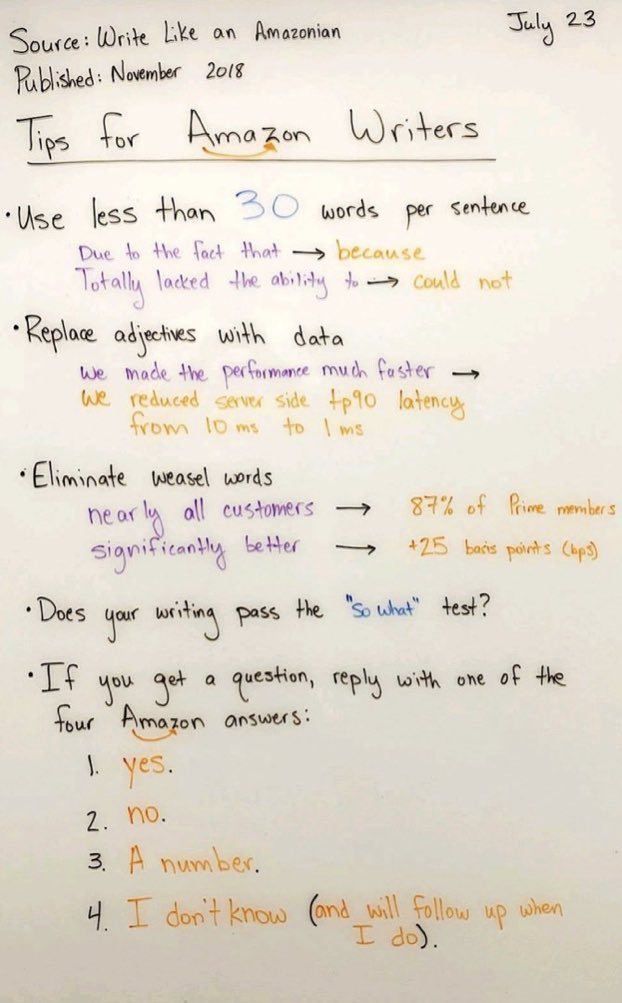
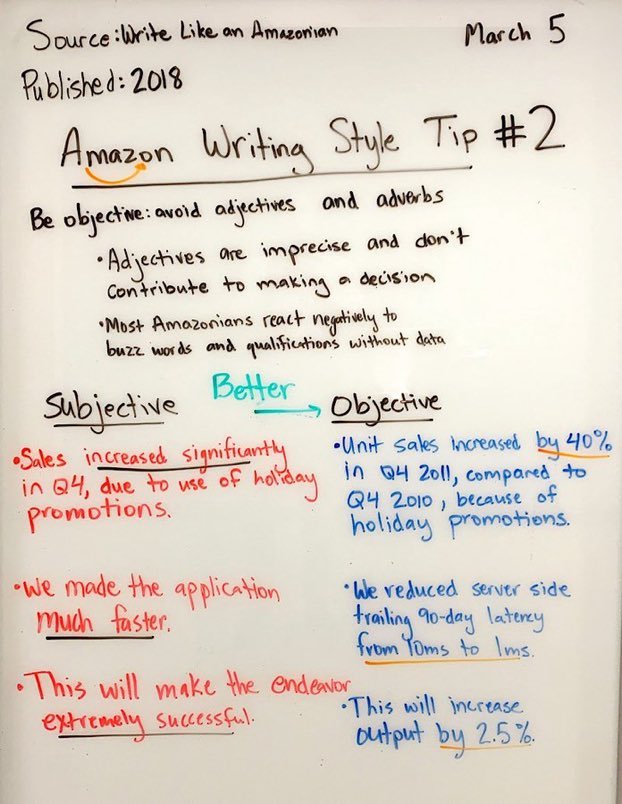
In 2018, an Amazon employee shared the company’s “7 Tips for Business Writing.”
They’re a must-read for anyone who wants to write more clearly.
1. Use fewer than 30 words per sentence
Constraints drive clear thinking.
And the best constraints force you to use less words, not more.
If you can explain something in simple terms, you likely understand it well.
2. Use subject-verb-object sentences
The goal of writing is to transfer your thoughts to another person with as little lost in translation as possible.
It’s a big game of telephone.
The simpler your sentences, the more accurately your ideas will be translated.
3. Replace adjectives with data
“Customers love Prime.”
“Customers with Prime spend on average 3x more than those without and we retain 90% of them year over year.”
Specificity leads to clear results and quick decision-making.
4. Pass the “so what” test
The reader should immediately know what action you want them to take.
Make sure to answer who, what, and when.
Otherwise, you’ve wasted your time and the reader’s.
5. Eliminate weasel words
Most weasel words are adverbs.
“Nearly,” “Significantly,” “Almost.”
These words are imprecise. They may mean one thing to you, and another to your boss.
Get rid of them.
6. Avoid clutter words
Utilize → use
In order to → to
Until such time as → until
Due to the fact → because
Getting rid of clutter focuses your message on the parts that matter.
7. Avoid jargon and acronyms
Companies are littered with internal jargon.
But this excludes new employees and anyone external to the company.
When wanting to use an acronym, write it out the first time it’s used in any document.
Clear > clever
***
The best marketers are relationship builders — strong internal alignment separates good from great.
So I got interested in Amazon’s writing.
Because writing is communication and communication is alignment.
Follow @TheMarkJung for more content like this on marketing and media.
@Berci Very interesting to hear about swarm learning, could this change or optimize the development of treatment pathways? Could be great to intersect pharma and RW needs.
Google interviewing people: "Design a system that can scale to billions of users, with a p99 of 30 seconds for data replication. We ask questions like this because this is the type of work you'd do here, day-in, day-out."
Also Google when changing your profile image:
Don't lie to people.
More money = simpler life
Connections = opportunities
Starting early = huge advantage
Good-looking = another advantage
Born in a rich country = taken for granted
Loving parents = already immensely lucky
Smart / learning fast = life is much more fun
The most creative company of the last 30 years:
Pixar.
Back in 2011, Pixar storyboard artist Emma Coats shared their "22 Rules For Storytelling."
And the rules are a must-read for writers, entrepreneurs, and anyone who wants to tell captivating stories.
Here's the breakdown:
It started with a study which resulted in my biggest scientific achievement yet at The Medical Futurist Institute.
The @US_FDA lists our #database as a publicly available resource on their official page.
https://t.co/7GMuHlmtZr
https://t.co/QtsGHfx41w
https://t.co/TpWXAnzIVE