14 most important and influential types of JEPA
▪️ JEPA / H-JEPA
▪️ I-JEPA
▪️ MC-JEPA
▪️ V-JEPA
▪️ Audio-JEPA
▪️ Point-JEPA
▪️ 3D-JEPA
▪️ ACT-JEPA
▪️ V-JEPA 2
▪️ LeJEPA
▪️ Causal-JEPA
▪️ V-JEPA 2.1
▪️ LeWorldModel
▪️ ThinkJEPA
Save the list and check this out to explore these JEPA milestones as a map of AI progress: https://t.co/w3zoOyMBez
F4Splat
A feed-forward 3D Gaussian Splatting framework that predicts per-region densification scores to enable spatially adaptive Gaussian allocation under any user-specified budget, maintaining high fidelity with significantly fewer primitives than uniform methods.
Don't use weight decay.
Just normalize everything you see (updates + parameters).
Works on top of your favorite optimizer (e.g., Muon).
Result: 33% speedup + better hyperparameter transfer.
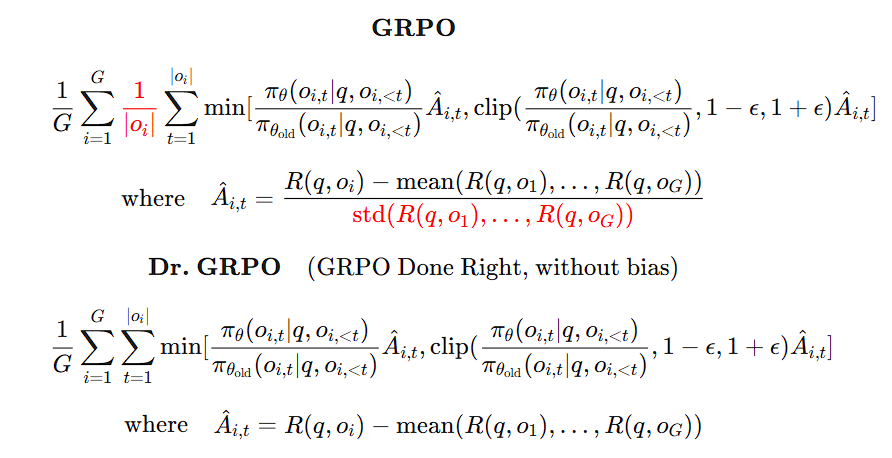
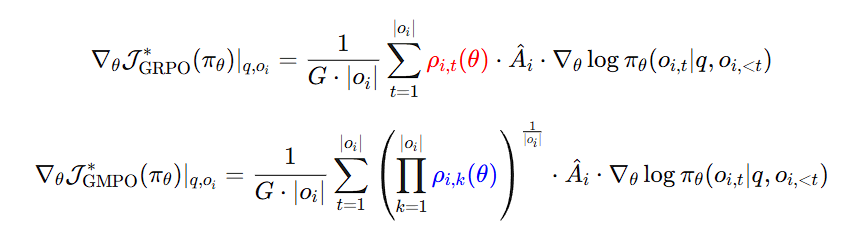
Understanding vanilla GRPO is not enough. There are many tricks / modifications needed to avoid things things like training instability and entropy collapse, especially at scale.
In a new blog, I outline (or at least try my best) all of the practical tricks and best practices that have been recently proposed for GRPO. The overview will be released tomorrow morning. It includes 10+ papers and is 13,000 words long. Super excited for this one!
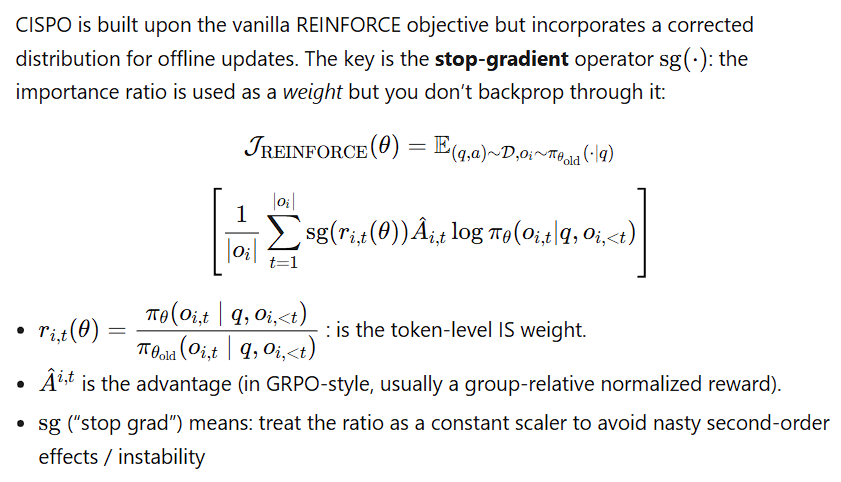
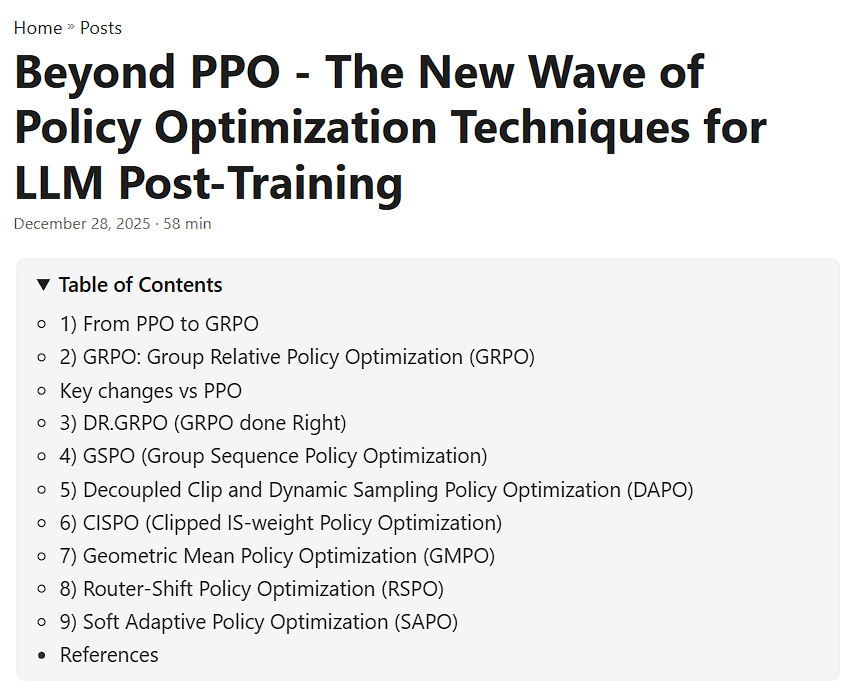
new blog is out! i went way too deep into the policy-optimization rabbit hole and dumped my “policy optmzn techniques beyond ppo” notes into one post. i have covered grpo, dr.grpo, gspo, dapo, cispo, gmpo, rspo, and sapo. blog link in next tweet.
Diffusion/Flow-based models can sample in 1-2 steps now 👍 But likelihood? Still requires 100-1000 NFEs (even for these fast models) 😭
We fix this! Introducing F2D2: simultaneous fast sampling AND fast likelihood via joint flow map distillation.
https://t.co/FFfqWnLIwu
1/🧵
🤔Want a principled way to RL your diffusion model?
Check Data-regularized Reinforcement Learning (DDRL)! Post-train @nvidia#Cosmos World Foundation models with a million GPU hours! 🤯
Novel formulation ➡️ Theoretically integrates SFT into RL ➡️ Robust to Reward Hacking 🛑
Details: https://t.co/1A9q8ho2xb
#DDRL #Diffusion #RL #NVIDIA #Cosmos
Slides for my talk at the NeurIPS 2025 Structured Probabilistic Inference & Generative Modeling workshop: https://t.co/X7pDVeTNG4. I talked about a new theory on diffusion loss weighting, masked diffusion, and why diffusion is really not so different from AR.
Diffusion language models are making a splash (again)!
To learn more about this fascinating topic, check out
⏩ my video tutorial (and references within): https://t.co/9I74IWj2Su
⏩discrete diffusion reading group: @diffusion_llms
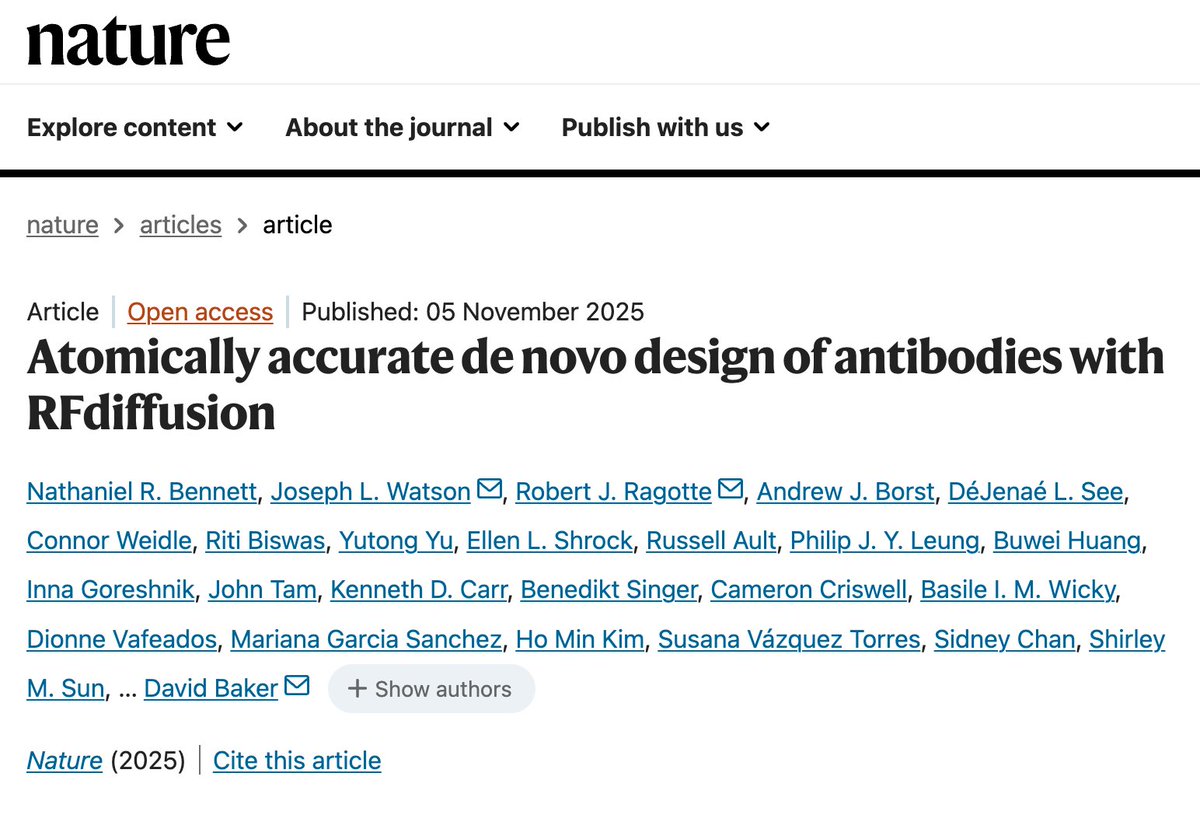
Atomically accurate de novo antibody design with diffusion models
Antibodies recognize specific molecular “patches” on proteins—epitopes. Modern therapeutics depend heavily on finding antibodies that bind exactly the right patch. But today, we still obtain them mostly through biological search processes: immunizing animals, screening huge random libraries, or isolating antibodies from patients. These approaches work, but they offer little control over where the antibody binds, and they take time.
Nathaniel Bennett and coauthors introduce a computational alternative using RFdiffusion, a generative diffusion model for protein structure. Instead of searching through natural antibody diversity, the model constructs the binding loops directly, shaping them to fit a user-specified epitope. The antibody framework remains fixed, while the model generates the flexible CDR loops and the overall docking geometry with the target protein.
After RFdiffusion produces the structural design, ProteinMPNN assigns amino acid sequences, and a structure predictor screens for designs whose predicted fold matches the generated fold—a structural self-consistency check analogous to verifying confidence in model outputs. The designs that pass this test are expressed experimentally.
The results are striking: Cryo-EM structures of the designed antibodies bound to their targets show atomic-level agreement between the computational model and reality. Moreover, the binding interface remains stable even after affinity maturation, confirming that the intended epitope and binding geometry were correct from the start. While the initial binding affinities are modest, they improve through directed evolution, just as one would fine-tune weights after pretraining.
This work hints at a future where antibody discovery becomes model-guided rather than search-driven—where specifying what to bind is enough to generate a binder, and wet-lab work focuses only on refinement. A shift analogous to moving from feature engineering to end-to-end learning—only now in molecular therapeutics.
Paper: https://t.co/16QJiZltmN
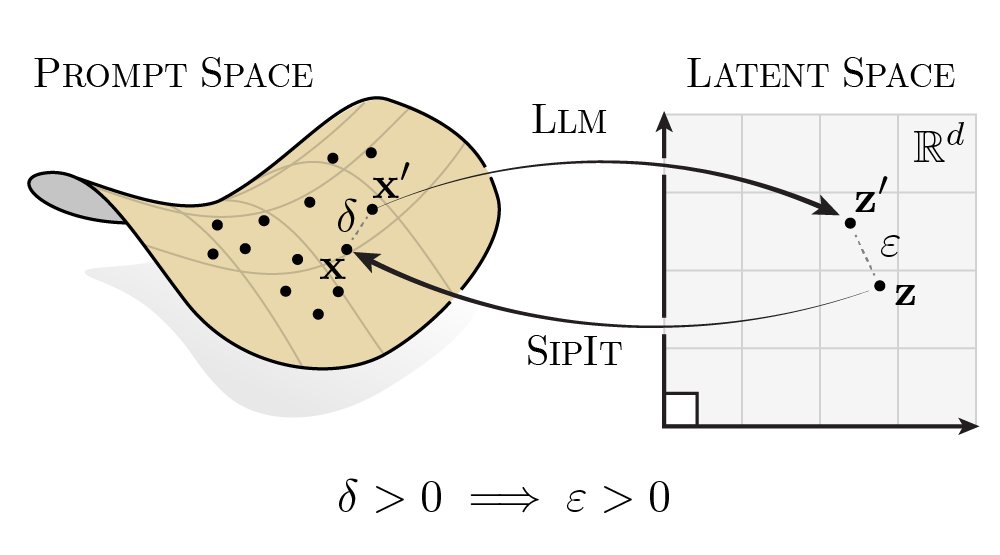
LLMs are injective and invertible.
In our new paper, we show that different prompts always map to different embeddings, and this property can be used to recover input tokens from individual embeddings in latent space.
(1/6)
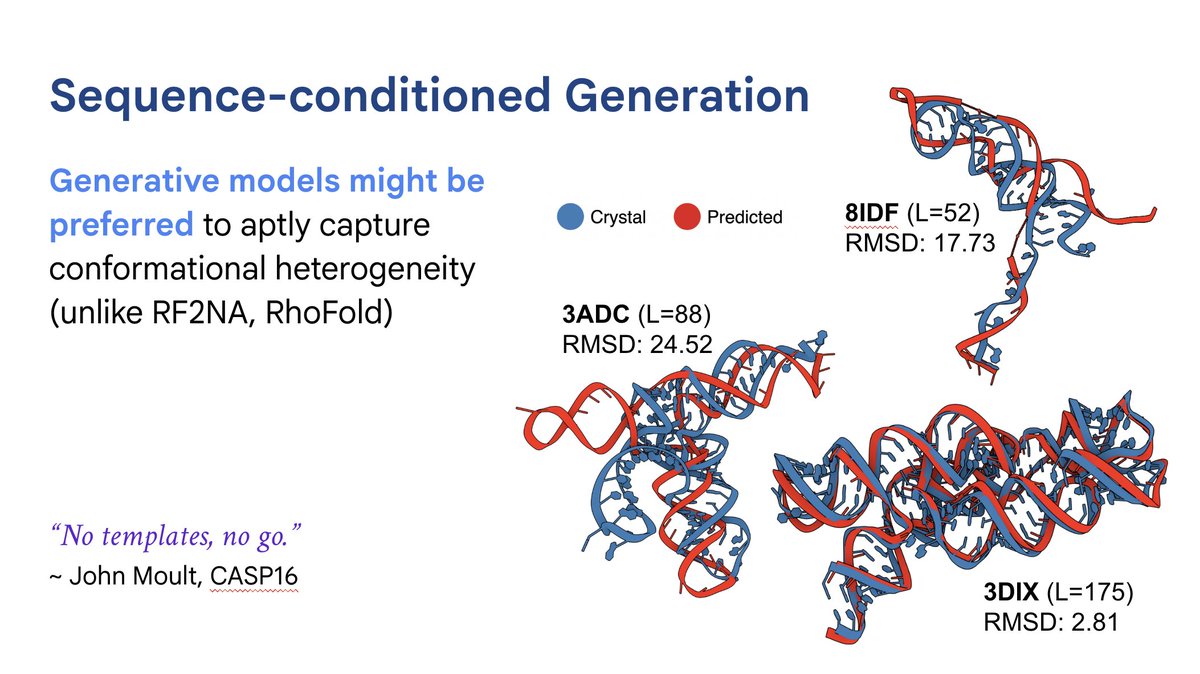
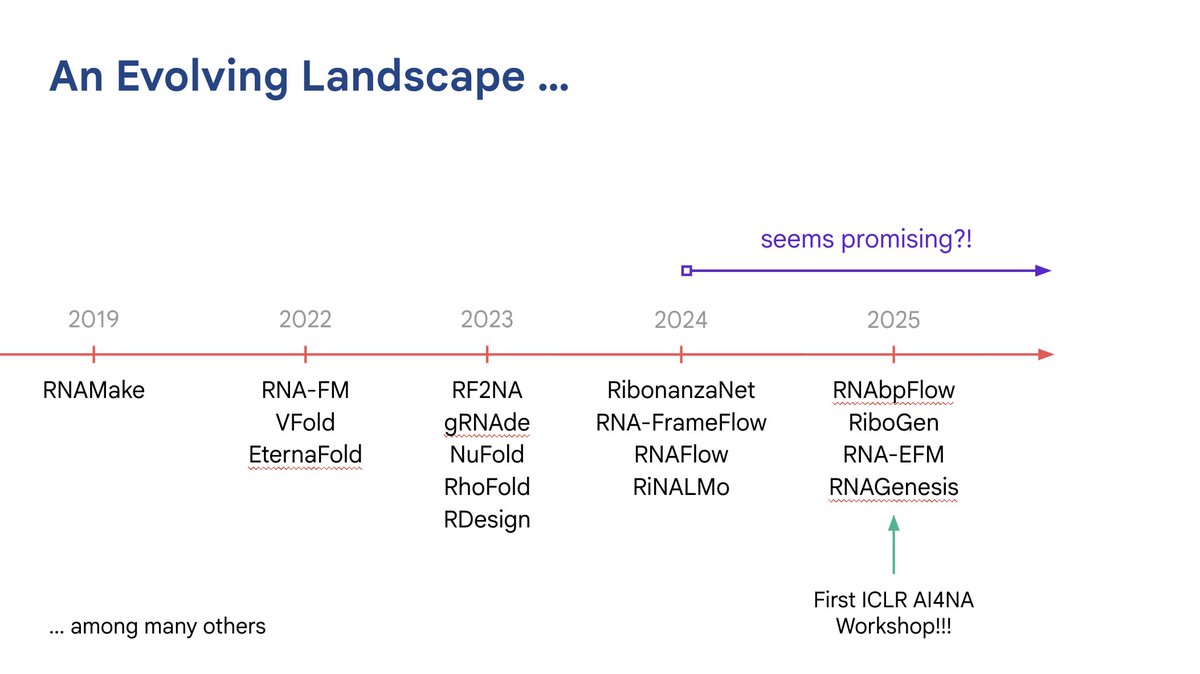
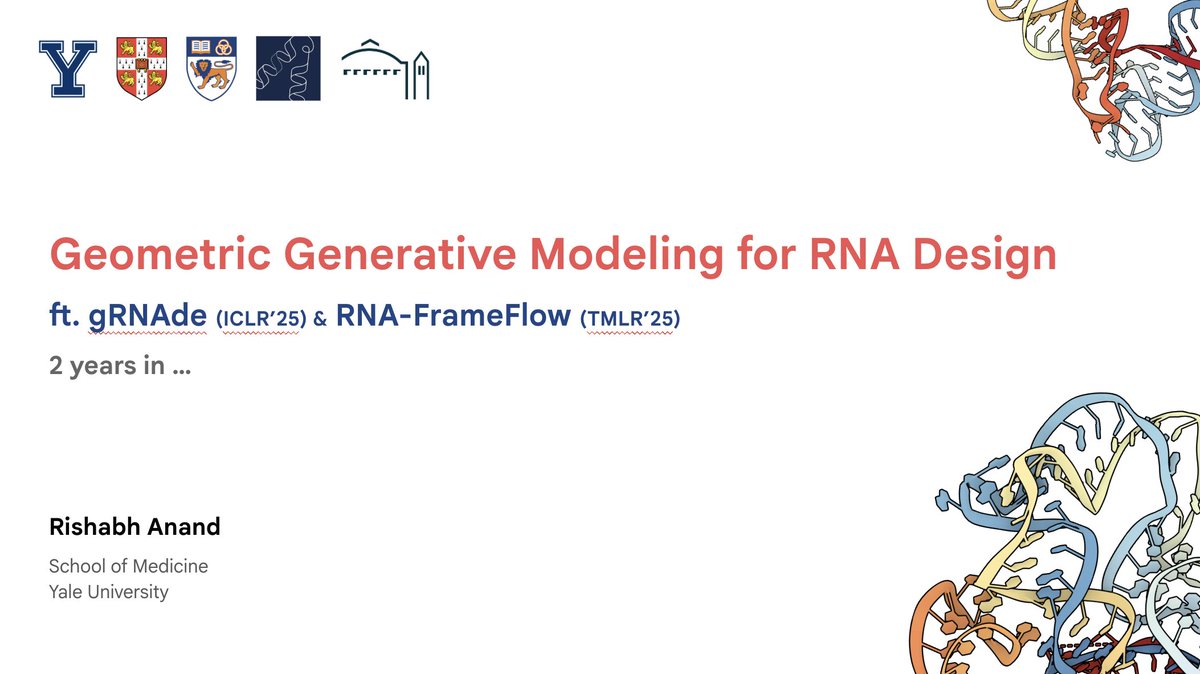
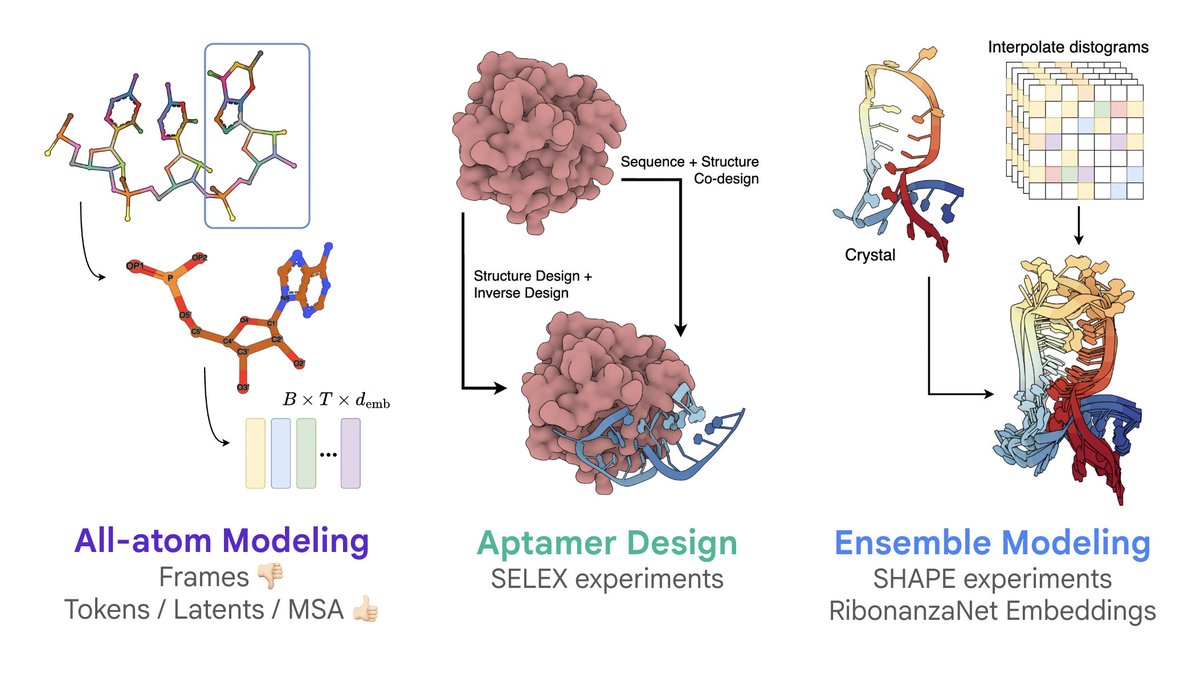
Recently gave a talk at @FlagshipPioneer on how far we've come in AI methods for RNA design, and where the field is potentially heading. Shared a similar (shorter) version with Rhiju Das' group at Stanford BioE this summer. Lots of fun convos thereafter 🤔
The talk contains some "bets" on where I think we're heading, and what *might* work. More than happy to be proven wrong ;)
Slides in the thread👇🏻
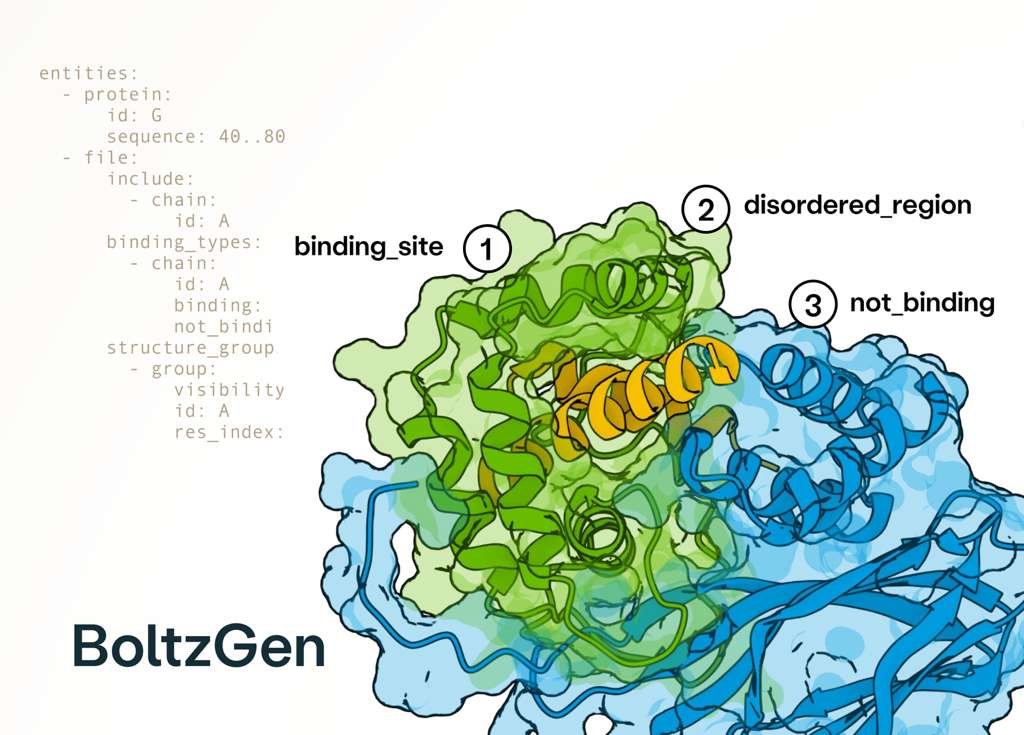
Excited to release BoltzGen which brings SOTA folding performance to binder design! The best part of this project has been collaborating with many leading biologists who tested BoltzGen at an unprecedented scale, showing success on many novel targets and pushing its limits! 🧵..
Nice, short post illustrating how simple text (discrete) diffusion can be.
Diffusion (i.e. parallel, iterated denoising, top) is the pervasive generative paradigm in image/video, but autoregression (i.e. go left to right bottom) is the dominant paradigm in text. For audio I've seen a bit of both.
A lot of diffusion papers look a bit dense but if you strip the mathematical formalism, you end up with simple baseline algorithms, e.g. something a lot closer to flow matching in continuous, or something like this in discrete. It's your vanilla transformer but with bi-directional attention, where you iteratively re-sample and re-mask all tokens in your "tokens canvas" based on a noise schedule until you get the final sample at the last step. (Bi-directional attention is a lot more powerful, and you get a lot stronger autoregressive language models if you train with it, unfortunately it makes training a lot more expensive because now you can't parallelize across sequence dim).
So autoregression is doing an `.append(token)` to the tokens canvas while only attending backwards, while diffusion is refreshing the entire token canvas with a `.setitem(idx, token)` while attending bidirectionally. Human thought naively feels a bit more like autoregression but it's hard to say that there aren't more diffusion-like components in some latent space of thought. It feels quite possible that you can further interpolate between them, or generalize them further. And it's a component of the LLM stack that still feels a bit fungible.
Now I must resist the urge to side quest into training nanochat with diffusion.
In diffusion LMs, discrete methods have all but displaced continuous ones (🥲).
Interesting new trend: why not both? Use continuous methods to make discrete diffusion better.
Diffusion duality: https://t.co/KPO56vDygp
CADD: https://t.co/CNOIWcUIMo
CCDD: https://t.co/2jOBIcZvQZ
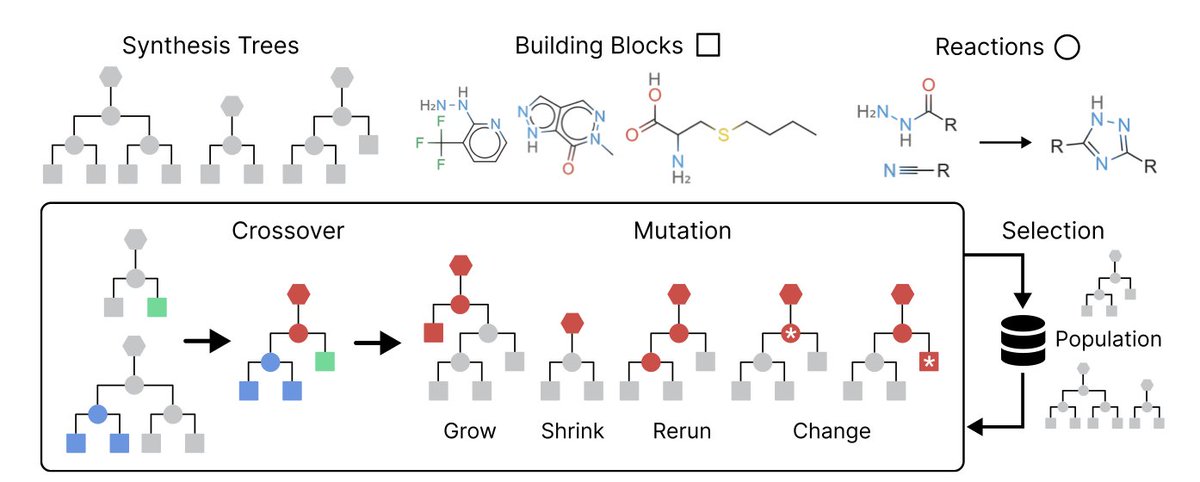
A Genetic Algorithm for Navigating Synthesizable Molecular Spaces
1. This paper introduces SynGA, a genetic algorithm designed to operate directly over synthesis routes, ensuring that all generated molecules are synthesizable. This is a significant step forward in addressing the challenge of synthesizability in molecular design, which is crucial for practical applications in drug discovery and materials science.
2. SynGA features custom crossover and mutation operators that explicitly constrain it to synthesizable molecular space. By modifying the fitness function, the authors demonstrate its effectiveness on a variety of design tasks, including synthesizable analog search and sample-efficient property optimization for both 2D and 3D objectives.
3. The authors enhance SynGA with a machine learning-based filter that focuses the building block set, boosting its performance to state-of-the-art levels. For property optimization, this leads to SynGBO, a Bayesian optimization algorithm that uses SynGA and block filtering in its inner loop, achieving superior results.
4. SynGA is lightweight and enforces synthesizability by construction, making it a strong standalone baseline and a versatile module that can be incorporated into larger synthesis-aware workflows. The authors provide extensive benchmarks showing that SynGA and its augmented versions achieve state-of-the-art performance on various optimization tasks.
5. The approach is validated through a series of experiments, including synthesizable analog search and property optimization tasks. SynGA is shown to be competitive with or outperform existing methods, highlighting its potential for practical use in molecular design.
📜Paper: https://t.co/54FAwzxIfv
#GeneticAlgorithm #MolecularDesign #Synthesizability #MachineLearning #Optimization