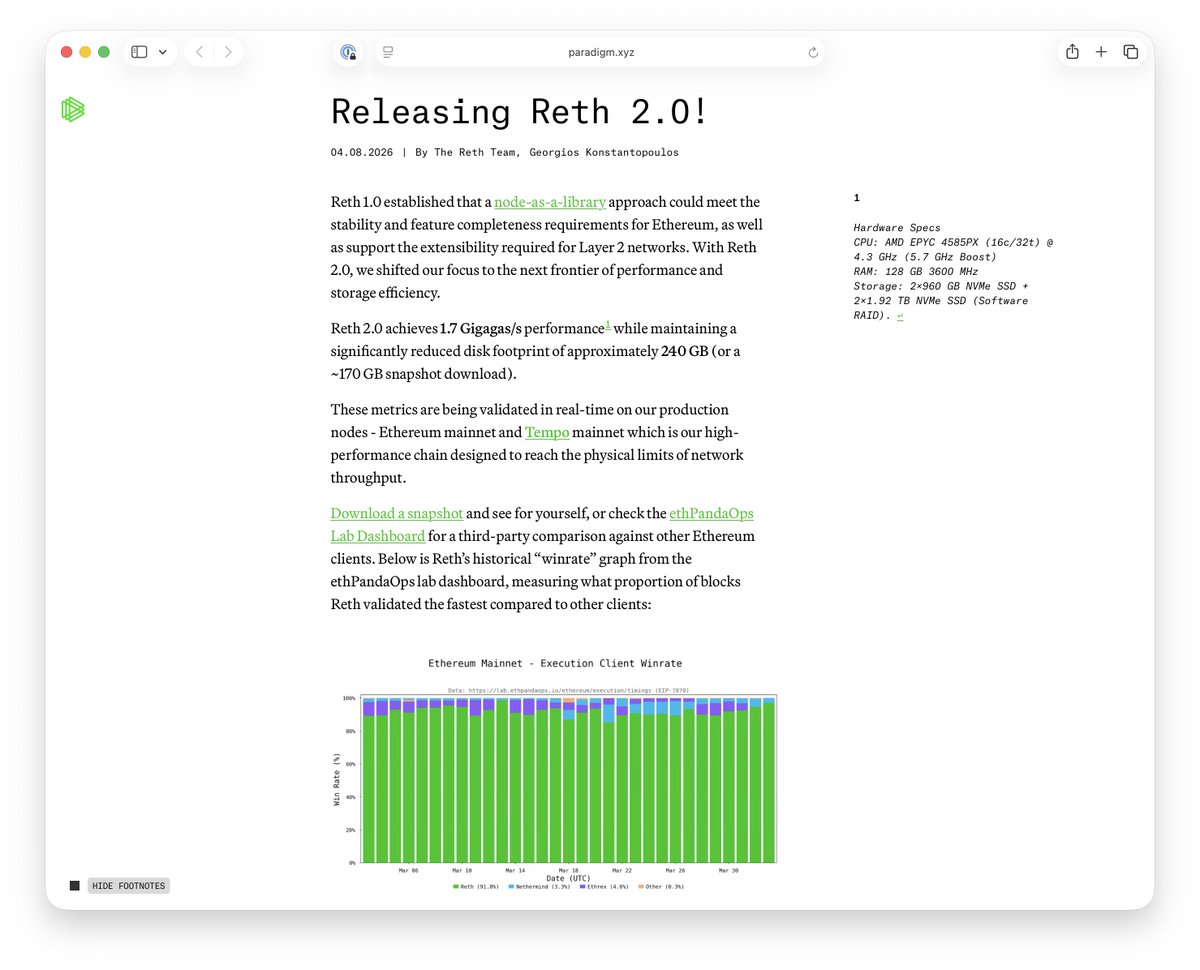
RELEASING RETH 2.0!
Reth is now faster, smaller, and ready for the future of crypto infrastructure.
Gigagas per second has not just been achieved, it's been blown out of the water.
We've put in a ton of work in this, and we're incredibly proud to be sharing this with everyone.
Tempo Mainnet is live! Starting today, anyone can build on Tempo through our public RPC endpoints.
Alongside mainnet, we’re introducing the Machine Payments Protocol, an open standard for machine payments.
I was sick of seeing all these crypto debit cards for wallets, we're supposed to be replacing TradFi not joining them! How hard could it be to do it crypto native anyway?
So I created this - FreePay - the worlds first open source, fee-free payment terminal.
Introducing the Porto Developer Preview!
What if passwords did not exist?
What if the web was built natively for payments?
Porto is the open-source Typescript library we've built @ithacaxyz that gives accounts the superpowers to answer these questions.
Learn more below 🧵
The Reth SDK vision is to be the #1 framework for building EVM-core blockchains (L1s and L2s) and peripheral infra (eg block builder), being as configurable as Cosmos SDK/Substrate with higher performance, less LoC to build a chain, efficient archive nodes and more.
Really excited for today's Ress release.
Ress is Stateless Reth and highlights how there's an "offense" angle to statelessness that is historically underdiscussed.
<4K LoC, built on Reth SDK.
🚀 Excited to release Ress - a fully validating stateless Ethereum node with just 14GB disk requirements, built on Reth!
Statelessness paves the way for scaling L1 gas limit, scaling optimistic L2s, and for implementing Native Rollups to improve the L2 ecosystem’s security & interoperability.
Maybe this is the right time to say: In my opinion, for-profit motives and positive impact do not have to be in tension with each other at all.
I am very glad Ethereum has Paradigm. When we look back and trace why Ethereum won, they will have played a meaningful part.
eth/acc.
Ethereum community,
I’ve been digesting a lot of what has been said from everyone these past couple of days/weeks, wanted to say a few words.
If you don’t know me, I’ve been a long time builder in Ethereum almost since inception. I built some of the first apps on Ethereum, some of the first tools, SDKs and the first stage-2 rollup Fuel V1.
Ethereum was and still is completely different from any other human project on planet earth. It took me three days to even understand what it was in the old days, I had to watch grainy videos of Vitalik in dark rooms explaining how it worked. At that point it was unintelligible even for most in the space.
What drew me to Ethereum was a few things:
- a love for building things in a decentralized way (getting rid of single points of failure and middle men)
- a desire for building a new internet
- a principled leader who didn’t seem like a grifter business guy
Vitalik was not a normal “leader” in any sense. Nerdy, unapproachable, and in his own head. But he had something most others didn’t, he was not in it for the money or business . He just loved the build and research. This is what made me pick Ethereum. It was the love for building things and changing the world. Yes, the power of capitalism makes the system run, but it’s a component of a larger whole. A flow that makes the turbines work, not the turbine itself.
Ethereum and the foundation was never run like a business. This was intentional for regulatory reasons at the time, but also spiritual, in the sense that corporate practices is what got us into the mess of needing Ethereum in the first place. Repeating those patterns always felt wrong.
The foundation was always designed to be somewhat removed from marketing, and even the build of many tools. The community had to do almost everything. Only Solditiy and client development was covered.
I loved and hated this. In one scene, it was more decentralized. In another, it held back development of things like the language and tooling for years. People who should not have been building tooling ended up doing it. It slowed the space and project down significantly. In retrospect, this should have been done by a single focused entity like a business.
What made Ethereum become the force of nature it was not the foundation but companies like Consensys. Joe, had a deep sense about institutions and marketing that the foundation lacked. At the time it gave Ethereum a more decentralized source of marketing. The foundation just had to focus on DevCon and other major events.
I think this relationship worked really well in the early days and drove Ethereum to the success we see today.
Of course now the world is different. Projects like Solana run things far more like a business, even at the foundation level (at least from my perspective), it’s basically American Ethereum. I don’t believe this is right for the EF to follow and it goes against the spirit of the project in the first place.
Many of the really good engineers were drawn to Ethereum specifically because it wasn’t run like an American company, but instead as a global project to change the world. Call it idealistic, but it’s true.
I’m really happy Solana exists to explore what that side of the field can produce, and I think it’s helped accelerate the space tremendously, but this vibe/approach is not the spirit of Ethereum for me.
Ethereum and its foundation needs to retain its ethos of being a neutral zone of blockchain research and development. It’s not a company, it’s not a product creator, it’s a lot more than all those things combined. That being said, the EF should listen to our new customers more: rollup teams (more blobs and fix bridging, then do fancy things later) and to market Ethereum to the masses.
I’m very proud of being a part of Ethereum in the small way I have over the years. Many do not have the context or the history to understand what it means for humanity and I’m very excited for its future despite what others say.
looking for a killer Rust engineer to join our team @ithacaxyz, focused on Reth. remote, full-time & long term. cash + equity.
will be working directly with me.
email: join at ithaca dot xyz, or dm me.
🚨 Action required: After >3yrs of heads-down development, Foundry is en route to our first stable release! Upgrade your installation of Foundryup! 🚨
2025 is looking to be an amazing year with faster and more secure EVM smart contracts!
Foundry is a critical part of the EVM development stack, empowering developers through their end to end development lifecycle, from quick builds to deep tests and rich debugging workflows.
More importantly, for the EVM to win, Foundry must remain a reliable building block for developers. For that, we must graduate to having stable releases, so we encourage all developers to upgrade their `foundryup` installations.
Upgrading is really simple, just run: `curl -L https://t.co/myqScjYfu3 | bash`.
❗Why upgrade?
Upgrading ensures your `foundryup` defaults to updating to the latest stable release instead of the latest nightly build. That build is hosted on Github under the `stable` tag: https://t.co/d5SBm6vmQo.
In the coming weeks, we'll be shipping our last few breaking changes to Foundry (e.g., turning off the optimizer by default, which was recently shipped). If you do not upgrade, you will continue to receive nightly builds by default, which may contain these breaking changes.
✨ Prefer nightly builds?
You are still able to receive the latest nightly builds by running `foundryup --install nightly`
Be cautious — nightly builds may include breaking changes that are difficult to debug without context.
🔄 Switching between versions?
Easily manage your installations with: `foundryup --use <version>`
e.g. `foundryup --use nightly`, `foundryup --use stable`
⚙️ And the CI?
The foundry-toolchain GitHub Action will use the latest stable release unless you specify the version to be different: https://t.co/hURV4C4633, via the `version` tag.
Huge kudos to legends @gndizzy@zerosnacks@YashAtreya@DaniPopes who have taken over the Foundry torch in the last year.