The organizations seeing the greatest impact are connecting #cloud, #data, and #AI strategies to measurable business outcomes while building the flexibility to adapt as needs evolve. 🔁
That's where long-term value takes shape. ☁️💡
Great deep dive from @DavidLinthicum. ⬇️
Cloud Success Isn’t About Migration—It’s About Maturity
After 15 years of enterprise cloud adoption, we should be past the illusion that simply moving workloads to the cloud creates transformation. It doesn’t. What it creates, too often, is a more expensive version of existing complexity.
That’s the hard truth many enterprises are now confronting. Lift-and-shift migrations may check a strategic box, but without modernization, governance, cost discipline, and architectural rigor, they rarely deliver the business value leaders were promised. The result is predictable: higher operating costs, limited agility, and growing frustration from both IT and the business.
What separates cloud success from cloud disappointment today is not access to technology. It’s execution. Enterprises that are getting real value from cloud are aligning cloud investments to specific business outcomes, modernizing applications where it matters, and building operational discipline around security, observability, performance, and cost optimization from the start.
This becomes even more important as AI and generative AI drive a new wave of cloud consumption. Many organizations are rushing into these opportunities without first addressing the fundamentals: data readiness, governance, architecture, and financial accountability. That’s a mistake. AI will amplify whatever foundation already exists, whether that foundation is strong or weak.
Cloud remains one of the most important enablers of innovation, but it is no longer enough to “move to the cloud.” Enterprises need to make smarter decisions about what to migrate, what to modernize, what to keep, and how to manage it all as a long-term operating model.
The future of cloud belongs to enterprises that treat it not as a destination, but as a discipline.
https://t.co/qB3d7eKAIV
#CloudComputing #CloudStrategy #EnterpriseIT #DigitalTransformation #FinOps #CloudNative #HybridCloud #GenerativeAI #AI #DataStrategy #EnterpriseArchitecture #CIO #CTO #Innovation
🏒 The Stanley Cup Finals are here at the @LenovoCenter, and the @Canes are battling for hockey’s biggest prize. 🏆
Behind the action on the ice, faster access to player and puck tracking data is helping transform game footage into smarter coaching decisions.
With @Lenovo ThinkAgile VX Integrated Systems, the Hurricanes tripled key analytics performance, delivering the speed and insights needed for the game’s biggest moments.
Read the full story and let’s go Canes! 🚨
https://t.co/7yUyE9pVYn
As #AI reshapes the way we work, success will come from combining powerful technology with human skills. 🤖🤝
Check out @BernardMarr's guide of the skills needed to thrive in this new environment. 👇
🚀 What skills will matter most in the age of AI?
In this video, I break down the five essential skills people need to thrive as artificial intelligence transforms business, work, and society. From understanding AI and using it effectively, to developing the deeply human capabilities that machines cannot replicate, these are the skills that will define success in the years ahead.
🔹 Why digital and AI literacy matter more than ever
🔹 How to use AI effectively, including better prompting and delegation
🔹 Why emotional intelligence and interpersonal skills still set humans apart
🔹 Why critical thinking is essential in a world flooded with AI-generated content
🔹 Why curiosity, adaptability, and continuous learning are now non-negotiable
If you want to understand future skills, AI literacy, prompt skills, critical thinking, emotional intelligence, adaptability, and the future of work, this video gives you a clear and practical guide.
🎥 On this channel, I explore the biggest trends in AI, business, leadership, and technology in a way that is easy to understand and useful in the real world.
#AI #FutureSkills #FutureOfWork #ArtificialIntelligence #CriticalThinking #EmotionalIntelligence #Leadership #Upskilling #DigitalLiteracy #TechTrends
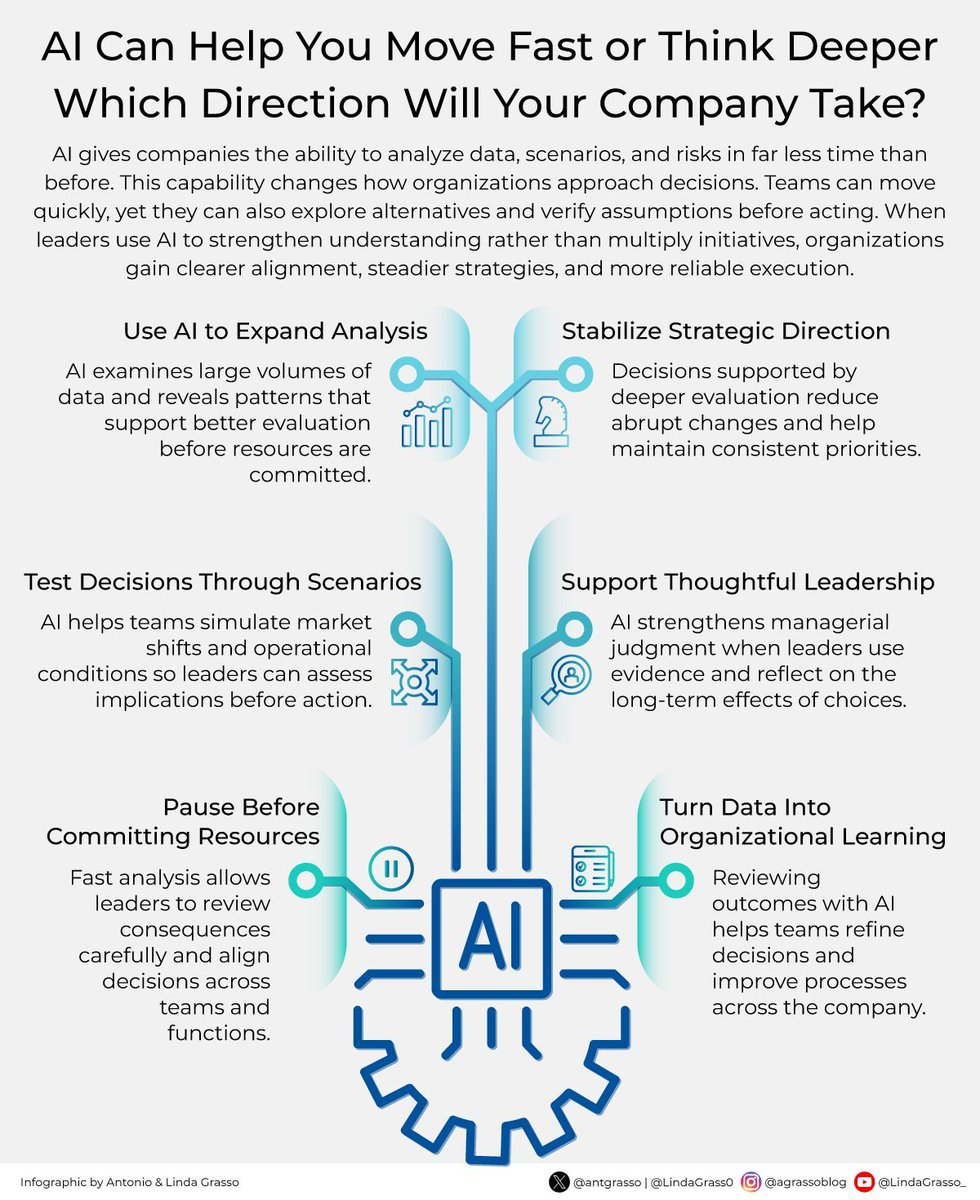
AI is accelerating how orgs evaluate insights and make key decisions. 🏎️💨
With better visibility into outcomes, leaders can move with confidence and execute with greater precision. At @Lenovo, we're helping unlock these opportunities through #SmarterAIForAll.
AI is reducing the time needed to evaluate scenarios and alternatives before decisions are executed.
Organizations that use this speed to improve judgment can limit costly direction changes and strengthen coordination.
Microblog by @antgrasso#ai#leadership
Behind every unforgettable match at the @FIFAcom World Cup 2026™ is infrastructure built to perform in real time. ⚽🏟️🌟
At the world’s biggest stage, @Lenovo ThinkSystem servers will help power AI driven broadcast delivery, live streaming, and tournament operations at unprecedented scale. From rapid issue detection to immersive fan experiences, Lenovo’s AI infrastructure is engineered to reduce latency and deliver performance when every second matters.
Read more about how Lenovo will deliver the tournament’s end-to-end technology backbone from AI to infrastructure: https://t.co/RxVRnCXv8Y
#LenovoFIFA #FIFAWorldCup
The world’s gone football - and it’s powered by Lenovo AI.
We’re proud to support @FIFAcom’s vision of using technology to elevate the game, enhance the fan experience worldwide, and foster innovation that levels the playing field. Our cutting-edge technology and AI are center stage in the upcoming tournaments, delivering personalized, immersive, and interactive experiences for the next generation of football fans.
The FIFA World Cup™ unites the world like no other, and Lenovo is honored to be part of that mission through Smarter AI for All. Bringing fans closer to the sport they love.
Countdown to FIFA World Cup 2026™ is on. AI and football are at the center of conversations around tables worldwide, and @Lenovo is leading the charge, on and off the field.
Learn more at https://t.co/EOG49wZzAf. #LenovoFIFA #FIFAWorldCup
Orgs don’t need to wait for 100% completion to see #DigitalTransformation impact.
When #infrastructure, #AI, & #data foundations begin reducing friction and improving decision-making, transformation shifts from roadmap to operational reality. 🗺️📍
Spot on, @thomas_dettling! 🎯
⬛️ #Blog4Managers | Why the First 50% Become the Turning Point of Transformation
Digital transformation is still treated in many organizations like a traditional rollout or implementation program. The prevailing assumption is that real value only emerges once everything is fully integrated, automated, and rolled out across the enterprise - in other words, at 100%. Only then is transformation considered “successful.”
🔹 But this mindset often causes companies to overlook the most important moment in the entire transformation journey: the point where transformation begins changing organizational behavior.
🔹 Because transformation does not start at the end of the journey. It starts much earlier. Not when everything is perfect, but when enough new capabilities are in place to fundamentally improve how people work. That is why the first 50% of a transformation should not be interpreted as “half finished.” Instead, it marks the moment when a critical threshold is reached. Information becomes more accessible. Processes become more efficient. Decision-making improves. Collaboration changes. Transparency increases. Organizations become less operationally reactive and more orchestrated in how they work.
📢 This is the real tipping point.
🔹 Many companies underestimate this phase because they evaluate transformation primarily through completeness. Yet momentum rarely emerges from perfection. It emerges from usability. People do not change behavior because an architecture is theoretically complete. They change behavior once they experience meaningful improvement in their daily work. This becomes especially visible in project management environments.
🔹 Even partially integrated data models, early automation of reporting processes, or AI-supported risk indicators can fundamentally change operational reality. Project teams spend less time consolidating information. Risks become visible earlier. Alignment becomes more focused. Decisions are made faster and on a more reliable data foundation. Of course, this does not mean transformation is complete. Not every system is integrated. Not every process is automated. Not every decision is data-driven. But the organization is already working differently.
📢 That is what matters.
🔹 Because the moment people experience faster access to information, clearer decisions, and less friction in daily operations, something fundamental begins to shift: expectations change. Leaders start asking different questions. Teams proactively identify improvement opportunities. Discussions become more forward-looking because less energy is wasted reconstructing the present. At that point, transformation stops being a 'program'. It becomes operational reality. The remaining 50% still matter enormously. That is where scale, resilience, governance, integration depth, and long-term optimization emerge.
🔹 But the second half builds on something that already exists: trust in the new way of working. And this is precisely why the first 50% are strategically more important than many organizations realize. They create the momentum that makes transformation sustainable. They generate acceptance not through presentations or vision statements, but through visible operational improvement.
📢 The key question changes from: “Do we really need this?” to: “What becomes possible if we continue?” That is the moment transformation starts reinforcing itself.
🔹 So perhaps the most important insight is not that 50% is enough. It is that transformation starts creating real impact long before 100% is reached. Not because the journey is complete - but because the organization has already begun thinking, deciding, and working differently - that is where real transformation begins.
✨ @Khulood_Almani@timo_vi@TamaraMcCleary@AkwyZ@MaryRich78@rwang0@drsharwood@DrHolzwarth@HelenBevan@phinifa@pierrecappelli@JimHarris@jenstirrup@GlenGilmore@subare@Ronald_vanLoon@enilev@Scobleizer@AndrewYNg@YuHelenYu@quepasachico
#DigitalTransformation #TransformationLeadership #BusinessTransformation #AI #OperationalExcellence #ChangeManagement #FutureOfWork #Innovation #DigitalStrategy #ProjectManagement #Leadership
Infographic by @thomas_Dettling | GPT 5.5
As organizations shift from AI experimentation to ➡️ AI operations, scalable #infrastructure becomes the foundation for real business impact.
@NVIDIA is helping power the next gen of enterprise #AI innovation to enable orgs to deploy, scale, and operationalize AI with ease. 🌏
Nvidia’s Singapore research hub shows where the next AI race is moving.
Embodied AI and robotics will require not only better models, but more efficient infrastructure and real-world testing.
Singapore understands the assignment, AI leadership is built through talent, compute, regulation and execution.
https://t.co/m3EQKePPPx @cnbc
Technology that helps save lives deserves infrastructure that never skips a beat. ♥️
Obras Sociais Irmã Dulce supports more than 3 million people annually across Brazil. To keep critical healthcare systems running efficiently, they modernized their data center with @Lenovo ThinkAgile HX & @Nutanix HCI.
Read the case study: https://t.co/suDf2UUAvW
Enterprises don’t need more disconnected #AI pilots. 🛑
They need AI that operates securely across workflows, devices, users, and #data, with governance built in from day one.
The control layer is becoming the foundation for scalable AI adoption. 🚀
AI maturity is no longer about how many copilots a company has deployed.
It is about whether AI can operate inside real workflows with:
🆔 Identity
🛡️ Policy
⚙️ Workflow
👁️ Audit
The market is moving from AI pilots to AI operations.
Governance is the scaling layer.
The key questions:
1️⃣ Which agents can act?
2️⃣ On which systems and data?
3️⃣ Under which policies?
4️⃣ How is every action audited?
AI adoption without observability creates noise.
AI adoption with governance creates leverage.
What is the bigger bottleneck in your organization: use cases or control layer?
#EnterpriseAI #AIAgents #Cybersecurity #DigitalTransformation
For manufacturers, downtime is not just inconvenient. It can disrupt the entire operation. ⚙️
@Lenovo VP, Anwar Ghuloum joined @TheSixFiveMedia to discuss why hybrid AI makes sense on the factory floor, bringing intelligence closer to production so teams can detect issues faster and keep operations moving.
Watch the full video: https://t.co/2wJfjHBXrm
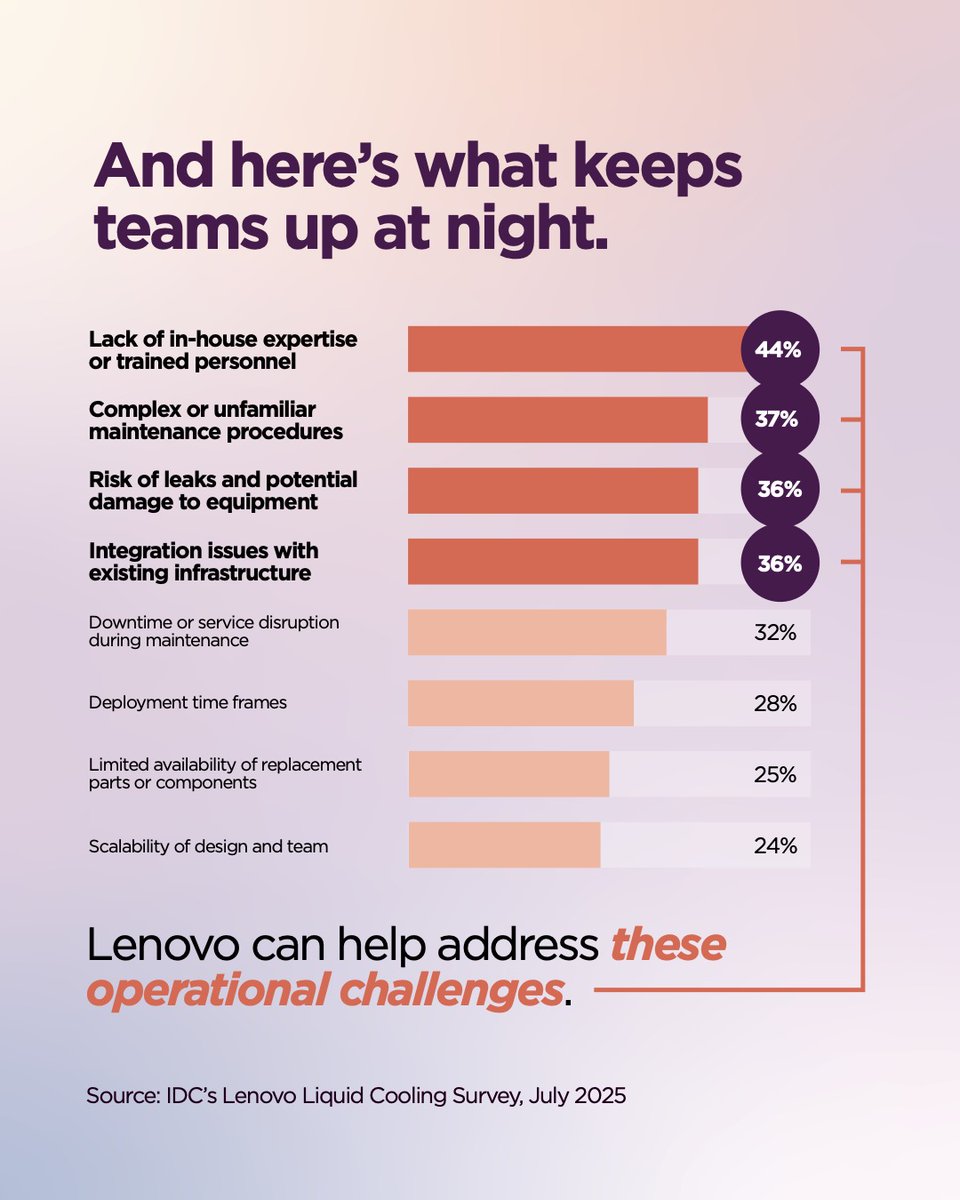
As AI workloads scale, the heat is on. 🔥
New @IDC research explores why liquid cooling is becoming critical as AI and HPC workloads move into production and place new demands on datacenter power, density, and efficiency.
With @Lenovo Neptune® liquid cooling and expert services, organizations can build AI-ready infrastructure designed for performance at scale.
Read the InfoBrief: https://t.co/V5ZPflONq3
Big results. Bigger momentum. 📈
Lenovo Infrastructure Solutions Group delivered record Q4 revenue, up 37% year over year, alongside our strongest performance to date, including a record annual revenue of 19.2 billion.
More exciting news from @Lenovo’s FY25/26 earnings https://t.co/cvyekgfhRi
The next wave of AI is not just about training models. It is about putting AI to work. ⚡
In conversation with @thesixfivemedia, @Lenovo CMO Flynn Maloy shares why businesses are increasingly focused on inferencing, where speed, scale, and real world deployment matter most.
Watch the full video: https://t.co/tM8KyXRJ7Q
Modern data demands storage built to keep up. ⚡
@Lenovo ThinkSystem Storage, ThinkAgile, and Lenovo @Infinidat solutions help organizations simplify data management, strengthen resilience, and unlock faster AI-driven insights.
https://t.co/WGHzbXhGPW
AI maturity is becoming less about experimentation and more about integration. 🤝🤖
If approvals, reporting structures, and decision-making stay the same, #AI often becomes an expensive assistant, and not a transformational tool.
Check out more insights from @sijlalhussain. ⬇️
📍 The AI problem is not lack of investment. It is the inability to translate experimentation into organizational value.
As Gartner highlights, 72% of CEOs see AI as a primary growth driver, yet only 11% of CFOs can concretely measure ROI from AI investments. The gap is not technological capability. It is execution architecture.
1️⃣ Execution Failure: Most organizations treat AI as a portfolio of pilots instead of an operating model redesign. Experiments scale faster than accountability structures.
2️⃣ Governance Gap: AI initiatives often sit between IT, business units, and strategy teams without clear ownership of value realization. Responsibility becomes distributed while outcomes remain unmeasured.
3️⃣ Structural Blind Spot: Organizations focus heavily on proof-of-concept activity but underinvest in workflow integration, decision-right redesign, and managerial adoption needed for sustained execution.
This is why many organizations report strong AI momentum while struggling to produce measurable enterprise impact.
The real challenge is not proving AI works. It is redesigning organizations so value creation survives beyond the pilot stage.
via Gartner
https://t.co/1ELyXdeceG
@faryus88@ILoveBooks786@MarcoAnibal@bygregorr@dinisguarda@timo_vi@MHcommunicate@BFleurot@michaeldacosta@Zeepoffine@drsharwood@Alovesublime@harbi_nh@ramonvidall@9SManagement@jameslhbartlett@ozsilverfox@beglen@YalaCoder@bociek191905@FrRonconi@ankitku_jaiswal@EduardoValenteI@TalentedLearn@sonu_monika@NathaliaLeHen@felice_ragone78
As digital learning accelerates, universities are rethinking how their IT environments keep up. 🎓
At Jangan University, that meant moving away from a fragmented setup toward a more unified, flexible foundation with @Lenovo & @Nutanix. The shift has made it easier to manage systems, maintain consistent performance, and support a more connected experience across campus.
Read the full story: https://t.co/p7JkHxH4nI
More data should not mean more friction. 💾
@Lenovo Data Storage Solutions help organizations keep up with AI driven demands, creating a secure, high performance foundation that scales as fast as the data itself.
For solutions, read here: https://t.co/Xpfr21mfDE
Not every company wants to send all their #data on a round trip to the #cloud. ✈️☁️
That’s where #EdgeComputing changes the game: faster insights, more control, and data that stays closer to home.
🌐 Is your data really under your control—or just stored somewhere else?
As businesses scale with AI and cloud, data sovereignty is becoming a strategic priority. And edge computing is part of the answer.
Follow @LindaGrass0 for more insights 💡
AI has entered its production phase. What matters now is not just how models are trained, but how they perform in the real world. ⚡
This new research from the Futurum Group explores why inferencing is becoming the true driver of business value and how infrastructure decisions today will shape AI outcomes for years to come.
Read the full report: https://t.co/igep3RPQ3Z