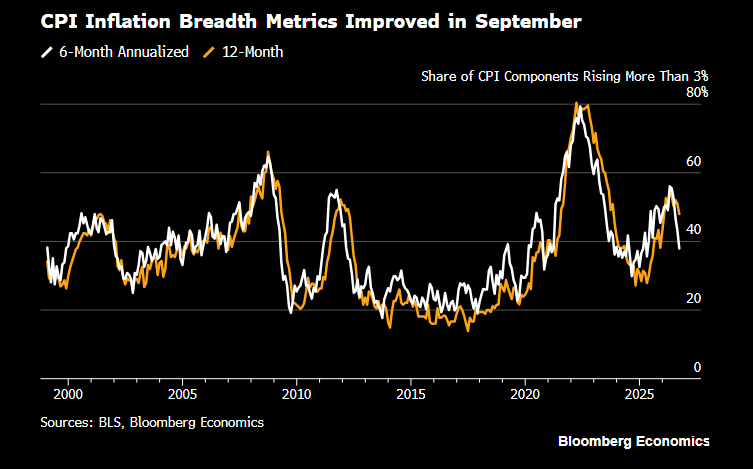
This is the diffusion of CPI inflation, measured similarly to Kevin Warsh's preferred PCE inflation diffusion metric.
It's down.
our full reaction @TheTerminal https://t.co/WGPEXDyOy6
Headline PCE: 3.4% YoY; Core: 3.0%
"Things are still not great." 👇
“Diesel is what powers this economy. And I don't just mean the American economy, I mean the global economy that has diesel as a major cost input. So, if it goes up, that will cause price increases throughout this entire economy and be shown in the index with core inflation heating up. That's what we're looking at in the months ahead.” @RealEJAntoni
"Energy and tariffs remain the principal upside risks, while cooling is being experienced in core and trimmed means, suggesting then the underlying price pressure is beginning to moderate. Our viewpoint is that inflation is purely supply driven and therefore the impacts of higher interest rates is unlikely to drive a cooling of inflation, especially with the continued impact of the conflict in the Middle East." @orust99@truflation
"Money supply growth is coming mostly from the private sector, money velocity is declining quite rapidly. I would be a bit less concerned about inflation, but unfortunately, more concerned about a private sector recession." @dlacalle_IA
🦔An NYU mathematician says OpenAI used his own progress against him to beat him to one of the biggest unsolved problems in mathematics. Tristan Buckmaster had been working toward a Millennium Prize proof using OpenAI's Codex when information about his progress reached OpenAI.
Days later, OpenAI published a full proof of the same problem using the same uncommon approach, after burning $22.5 million in compute to get there. When Buckmaster confronted them, exec Sébastien Bubeck allegedly said "Why would you ruin your career?" and "If you don't want me to be nice, then I don't have to be nice."
My Take
OpenAI spent $22.5 million to solve a problem with a $1 million prize. They didn't do this for the bounty. They needed a headline that says "our AI solved one of the hardest problems in mathematics" and they needed it before someone else got credit. They started days after they heard about Buckmaster's progress and took the same uncommon approach he'd pursued for months. That's hard to explain as coincidence.
Buckmaster did his work inside Codex. OpenAI reserves the right to train on Codex data. They admit they can't rule out that his usage helped improve their models. So a customer used their product, potentially handed them the roadmap, and then OpenAI outran him with $22.5 million in compute he could never match. I don't know if any of this was intentional. But if you're a researcher and you just watched this happen, I don't think you'd keep your best ideas inside someone else's product.
Hedgie🤗
https://t.co/1YnggU7xdI
$DIS Is a short. They are becoming $CMCSA with just how poorly they treat customers. Been hearing about random closures and lack of refunds. Long lines to complain. Experiencing it first hand. Don’t know how they survive.
@Hedgeye@HedgeyeAI @SamofAmerica Great job this week. It has been the best Early Look, Macro Show, and the Call in a very long time. I hope this is the new format. I’ve had it with the “Macro Tourist” and “Old Wall” stuff; a lot of days that crap is the majority of the content.
𝐂𝐢𝐠𝐧𝐚 𝐕𝐞𝐫𝐭𝐢𝐜𝐚𝐥 𝐈𝐧𝐭𝐞𝐠𝐫𝐚𝐭𝐢𝐨𝐧 𝐔𝐩𝐝𝐚𝐭𝐞 (𝐖𝐢𝐭𝐡 𝐚 340𝐁 𝐓𝐰𝐢𝐬𝐭)
Bob Herman @bobjherman at @statnews uncovered that Cigna Group’s Evernorth Health Services now owns 100% of CarepathRx, a company that helps hospitals and health systems build and operate in-house specialty pharmacies.
Recall that in 2025, Evernorth also invested $3.5 billion for an undisclosed stake in Shields Health Solutions, the former WBA subsidiary with a similar hospital-focused specialty pharmacy model.
Why it matters:
✅ Manufacturers’ limits on #340B contract pharmacies have pressured Express Scripts’ 340B profits.
✅Expanding deeper into hospital-owned specialty pharmacies is a clever vertical integration play that helps preserve access to 340B-driven profits through a different channel.
P.S. Yes, both deals will appear on DCI’s soon-to-be-updated (in)famous vertical integration slide. 😉
Story: https://t.co/Z5Q7azFnMJ
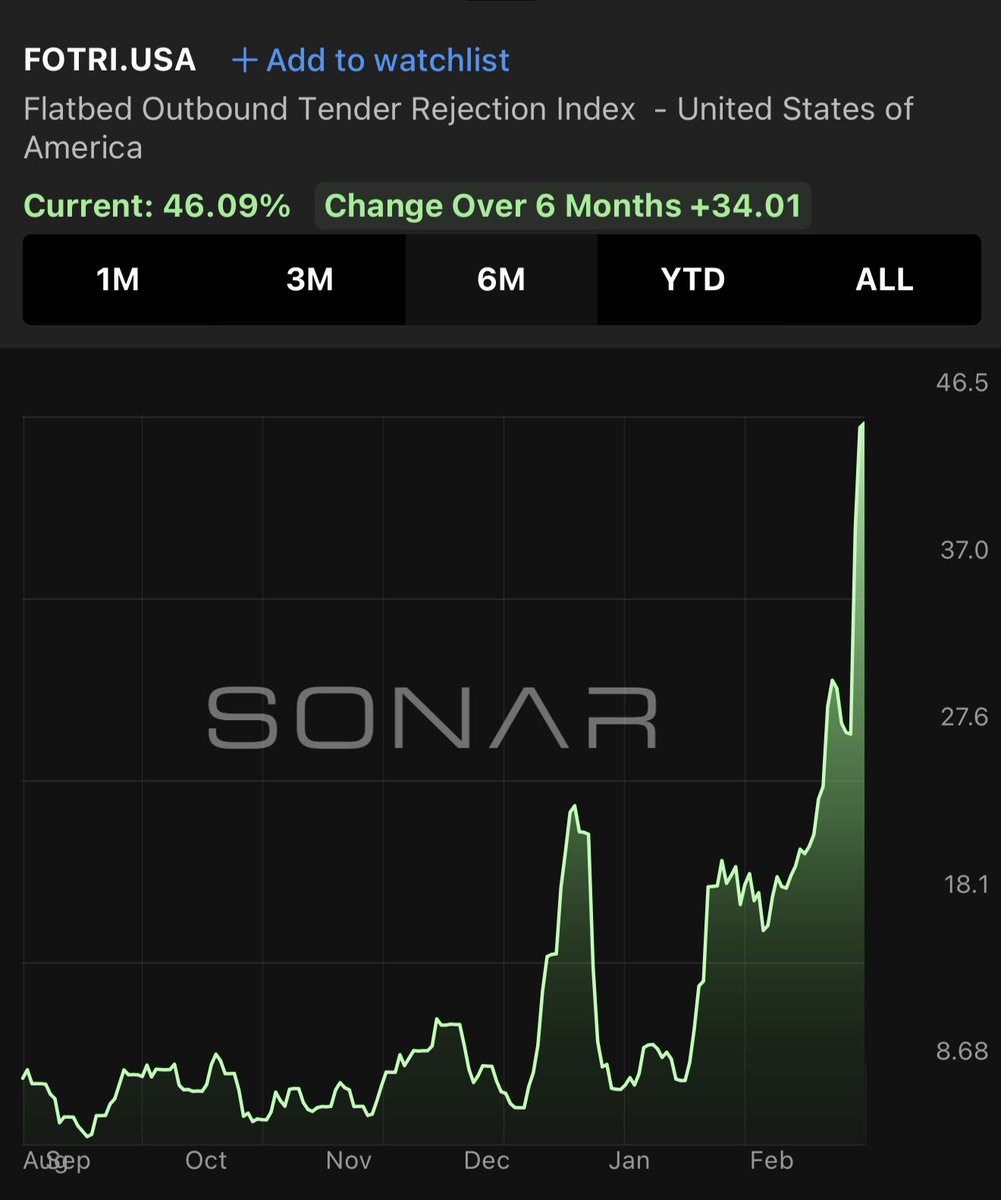
I have zero doubt that we are seeing manufacturing starting to rip.
Flatbed is naturally the first mode to signal it, as flatbeds haul heavy industrial raw materials.
We talked about greenshoots a few weeks ago, and it was exciting, but still a bit iffy.
I don’t recall ever seeing a national tender rejection chart surge like this.
Flatbeds are on fire. This is epic.
San Francisco Chronicle analysis of the cost of a bundle of groceries at various grocery stores in the city
Trader Joe’s is by far the least expensive and they didn’t raise their prices this year
@marketplunger1 Views on next-gen processing technologies / automation being deployed outside of China and thoughts on water scarcity and its impact on operations limits. On data centers, 50% have been canceled (smaller ones mostly) what does that do for the outlook embedded in market pricing?
xAI has officially become the first to bring a gigawatt-scale coherent AI training cluster online
That’s more electricity than the peak demand of San Francisco
While competitors are still drafting roadmaps for 2027, xAI is already operating at major city–level power today
The execution speed is unreal:
Colossus 1 → from dirt to fully operational in 122 days
Colossus 2 → just crossed the 1 GW barrier, targeting 2 GW total
Elon’s playbook hasn’t changed:
move faster than everyone, scale before they finish meetings
The strategy is clear: speed and execution at scale
In recent days, multiple Erdős problems have been solved by GPT-5.2 Pro, with solutions accepted by Terence Tao. This is not a gimmick—it's a qualitative shift.
Erdős problems lie at the core of additive combinatorics, extremal graph theory, and probabilistic methods—problems that resist brute force and demand structural insight. Many have endured decades of expert scrutiny.
Acceptance matters more than authorship. Tao doesn't rubber-stamp ideas; he rigorously tests logic, generality, and novelty. If a proof clears that hurdle, the system didn't merely recombine known lemmas—it explored a true mathematical search space.
This means AI has crossed a threshold: from assisting mathematics to participating in it by proposing nontrivial arguments, uncovering hidden structures, and resolving problems humans value—without a predefined solution path.
Importantly, this doesn't diminish human mathematicians. It reshapes the field's topology. Just as symbolic algebra systems amplified rather than replaced math, AI now seems poised to expand the frontier itself.
If these claims hold, recent days may mark the lift-off for AI-driven science: not flashy demos, but quiet validation by the world's toughest referees.
We should remain skeptical, careful, and precise—yet honest about the implications.
Something fundamental may have changed. Here's a five-minute video with Terry explaining these problems and meeting the man himself:
GM invented the rare earth magnet in 1983, then sold a production subsidiary to a consortium that included Chinese investors. They moved all the equipment to China.