I think of my goal as a mathematician as something like: to better understand the fundamental concepts “shape” and “number,” and to convey that understanding to others. I think this is a valuable goal for many reasons. The primary reason discussed on social media is the (admittedly slow, but I think very real) diffusion of mathematical ideas into technologies that better our lives. There are others, though: production of human capital (which plays some role in this diffusion), and diffusion of mathematical understanding into culture, for example. It is not obvious to me that even the bare technological need for mathematics can be filled without human experts; this seems to me to be a tricky question of institutional design.
For me the most compelling reason is simply that we feel a pressing need to understand. While deep understanding is largely limited to professional mathematicians, the existence of mathematicians and of the institutions they make up is a huge part of what makes mathematical understanding available to those who want it. I believe that the capacity to understand mathematics (and the universe as a whole) is part of a good life, and we should try to provide people with a good life.
We operationalize the goal of understanding in a number of ways, problem-solving and theorem-proving among them. My own research is oriented around certain open questions that I believe measure our lack of understanding (of numbers, shapes and so on), and I think resolving those is genuinely important. I would welcome a solution with any provenance. But I think proof is only a measure of progress—what actually matters (for technology, human capital, culture, a good life) is a bit harder to get at.
Crucially it is very hard to measure progress—plausibly theorem-proving is used in large part because it is easy to measure rather than because it is a perfect proxy for what we care about. I worry a bit that we may automate many easy-to-measure things without automating the correlates we care about for which they are proxies. This presents a clear problem for the design of institutions aimed at achieving progress.
In part because I think problem-solving is a proxy for something else, I don’t feel that my goal of understanding “shape” and “number” is particularly threatened by a machine that is good at problem solving. I expect that machine to be a substantial boon, instead. Ultimately I think we will operationalize mathematical progress in better ways. But how to do this is a difficult question and I think many on here are too quick to dismiss concerns about it.
WHERE'S ED BOYDEN?
Oh. He was only a PhD student when he co-invented optogenetics and performed the first demonstration, so he gets no credit. Instead his advisor gets all the credit.
From National Academy of Sciences: Boyden, "in parallel to his PhD, as an independent side project, co-invented optogenetic control of neurons."
One of the worst snubs in Nobel history IMO!
arXiv has updated our policy on rate limiting for all submitters.
This update was made to fairly distribute moderator time & support the arXiv community of staff, volunteers, readers & authors.
Please read our announcement to learn more: https://t.co/lvzWuiv0hx
@jababi@optiML It’s hard to feel the joy when I have to think how to advise students to write careful and substantial papers while my esteemed colleagues are too excited to hold themselves to the same standard.
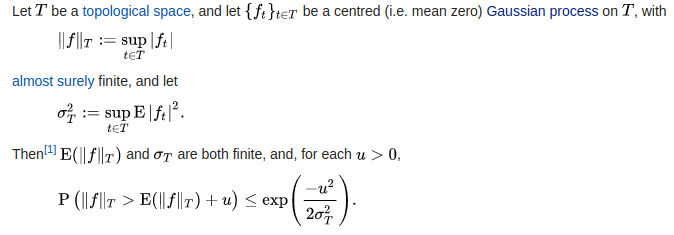
The Borell-Tsirelson-Ibragimov-Sudakov inequality referred to as the "single most important tool" in the theory of Gaussian processes https://t.co/WyuVNlrWhp. It's a kind of Hoeffing's inequality for the suprema of Gaussian processes
Thanks to institutional subscriptions, commercial scientific publishers operate a lucrative market. How lucrative? Spectacularly so. A brief thread focusing on Elsevier, for reasons that will become clear. (1/n)
@ElsevierConnect
My main disagreements: (1) Fisher's worst beliefs were opposed to popular ideals when he held them (2) eugenics was core to Fisher's scientific work and career (3) removing his name from contemporary honors is not the same as reevaluating his contributions to the field.
Urmila Mahadev spent eight years in graduate school solving one of the most basic questions in quantum computation: How do you know whether a quantum computer has done anything quantum at all?
https://t.co/tWD62vJFzV
The leadership of the ASA @AmstatNews has recommended to the awarding organization – COPSS -- that the R.A. Fisher Award and Lectureship be retired and that this year’s award be retitled.
The point at which academia has become about getting N papers in Y conferences for the sake of...counting...is the day that science has truly died.
This is not just the architecture community's problem, it's all of our problem. 1/4
I'm formally calling on @NeurIPSConf to extend the deadline. No one can concentrate on work as our fellow citizens are getting tear-gassed and beaten. I imagine this time is especially hard for URMs and POC. Plz retweet if you agree.