My conversation with Alex Sacerdote, founder of Whale Rock Capital Management.
Alex runs more than $17B and has been one of the best performing tech investors for years, though he keeps a low public profile.
As you'll hear, he is singular in how he thinks about investing through technology cycles.
For over 25 years, he has built his entire investment framework around a single idea, the S-curve.
We discuss:
- The AI L-Curve
- When to buy into an S-curve and when to sell out
- The de-commoditization of data center hardware
- Why he went net short software
- His two models for tech adoption
- Finding alpha
Enjoy!
Timestamps
0:00 Intro
9:55 AI's L-Curve
19:31 Whale Rock's S-Curve Playbook
26:14 Spotting Inflection Points
32:02 Finding AI Winners
40:04 AI vs Software
48:13 The Hardware Renaissance
58:04 Why Investors Miss AI
1:05:18 Whale Rock's Research Machine
Wow, this is interesting..
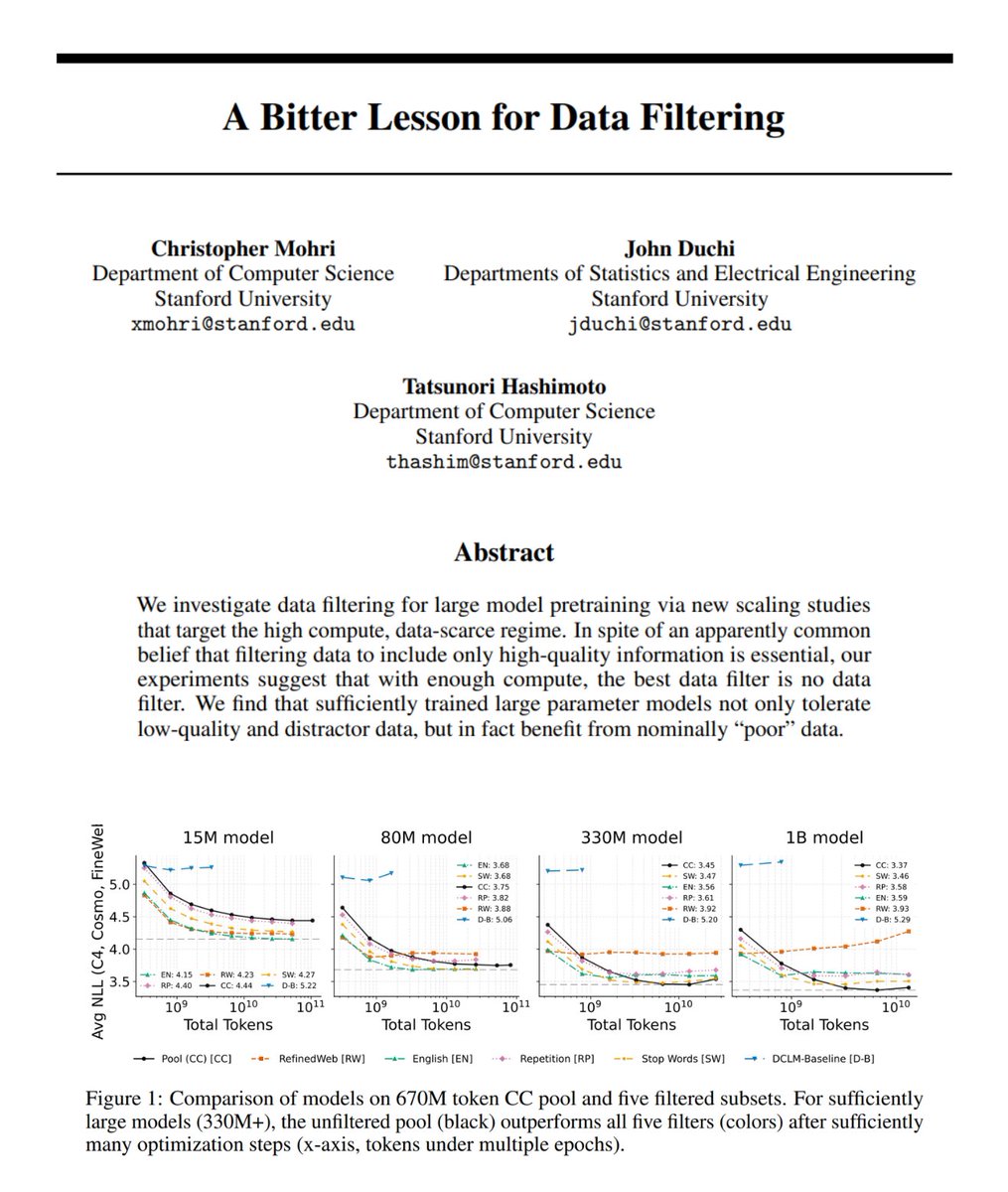
@Stanford researchers put a common assumption to the test: large models need only “high-quality” filtered training data.
What if the best filter is no filter at all?
They compared full Common Crawl data with heavily filtered versions of it and got surprising results:
1. Filtering can help with small compute budgets, because models can't learn from everything well.
2. However, as models get larger and train longer, the full, unfiltered dataset becomes the winner.
Large models handle messy data better than expected – low-quality text, irrelevant text, or some “junk” data are not a big deal; these models can tolerate them.
And they can even extract useful signal from data that looks poor.
These facts transform general rules:
→ Filtering helps when compute is limited. But when compute is very large, removing too much data may throw away useful information.
This also connects with the concept of "bitter lesson": at large scale, simple scaling often beats clever human design.
But the final choice depends on your constraints and preferences – would you rather increase compute costs or put more resources and time into filtering?
Interesting to see your answers 👀
30 anos.
Por 30 anos o PC foi a mesma coisa: Intel ou AMD dentro, GPU do lado, e torce pra não travar.
A NVIDIA acabou com isso numa keynote.
RTX Spark. Primeiro chip deles para computador pessoal. CPU, GPU e memória num único silício. ARM, 3nm, 1 petaflop de IA local.
Num laptop de 14mm.
Rodou Forza Horizon 6 e 007 First Light no palco a 100 FPS em 1440p. Fora da tomada. Sem throttling. No Windows.
O número que muda tudo: roda modelos de IA de 120 bilhões de parâmetros sem cloud. Sem API. Sem assinatura. Seu agente de IA mora na sua máquina. Ligado 24 horas. Só seu.
O PC não é mais uma tela com teclado. É uma estação de IA pessoal.