1/ General-purpose robotics is the rare technological frontier where the US / China started at roughly the same time and there's no clear winner yet.
To better understand the landscape, @zoeytang_1007, @intelchentwo, @vishnuman0 and I spent the last ~8 weeks creating a deep dive on humanoid robotics hardware and flew to China to see the supply chain firsthand.
Here's everything we've created + our takeaways about the components, humanoid comparisons, supply chains, and geopolitics👇
Introducing MARS, the first Personal AI Robot.
In technology, getting to the future we want starts with building it together.
This is why we designed Mars. Inspired by early PCs, Mars is a powerful, complete, extendable robot.
It runs BASIC, an open embodied AI agent we created for you to program with code, demonstrations, and prompts. This allows Mars to perform complex long-horizon tasks involving spatial memory, reasoning, manipulation and navigation.
Pre-orders open now
⬇️ Demos & details in the thread
New Book & Video Series!!! (late 2025)
Optimization Bootcamp: Applications in Machine Learning, Control, and Inverse Problems
Comment for a sneak peak to help proofread and I'll DM
(proof reading, typos, HW problems, all get acknowledgment in book!)
this year alone, I've met hundreds of the world's elite AI researchers + engineers steering the future of intelligence, and they ultimately want to do it here, in the US 🇺🇸
If a visa or green card are holding you back, join us on 7/31 in SF and hear real stories from @MatternJustus, @manumerous, @theaievangelist, and me @lighthousehq_ on getting unblocked to pursue their ambitions
RSVP in thread
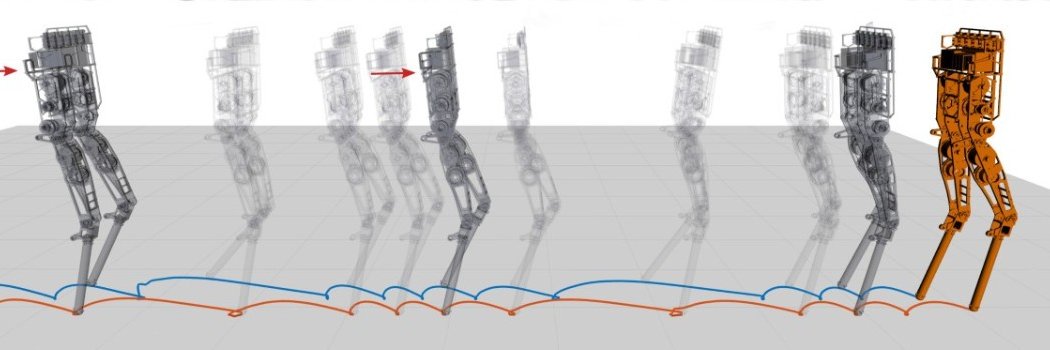
@FenglongS@breadli428@zhaomingxie Nice to hear from you @FenglongS! If you formulate the problem correctly and optimize through the WB kinematics/dynamics getting a straight knee gait is doable: https://t.co/05bmxjqJPt I think for reduced order models that is more tricky yes. ��
@breadli428 Great share! I think this combination makes a lot of sense since it play into the strength of both approaches (planning for long horizon tasks for MPC and unparralelled robustness for RL)! In fact I think we would ideally combine the advantages of both approaches into one!
@breadli428@zhaomingxie I think what is really holding MPC robustness back is the assumption of a known contact sequence with a mismatch leading to catastrophic failures. Optimizing for this means solving an online mixed integer problem. RL has less assumptions there and does that computation offline 😁
@breadli428@zhaomingxie Interesting take. As someone that has extensively worked on both RL and WB-Dynamics MPC for legged locomotion I rarely had the feeling that the costs/rewards was the bottleneck for MPC. In fact they seemed remarkably similar (track base velocity, regularitations, min torques).
Glad to share the Real-Time Action Chunking Algorithm @kvablack, @svlevine and I developed at @physical_int! By inferring the VLA in a receding horizon manner we enable parallel planning and execution improving speed, performance, and motion smoothness.
We got a robot to clean up homes that were never seen in its training data! Our new model, π-0.5, aims to tackle open-world generalization.
We took our robot into homes that were not in the training data and asked it to clean kitchens and bedrooms. More below⤵️
The last 2 month since I joined @physical_int have been quite the ride bringing robots out of the lab and into unseen environments. With our new model, π-0.5, our robot could clean up kitchens and bedrooms in homes that were never seen in its training data! More below⤵️