let's talk about different kinds of companies
anthropic deliberately going out of their way to cripple Fable 5 on AI research capability, for the sole purpose of suppressing competition, shows that:
- they are not a mission driven company. they are driven by self interest
- their goal is not to make the world a better place. they are literally doing everything they can to stop other people from making the world a better place better than they do
- their company mission page https://t.co/DTTz9k7HVQ is mostly talking about the things "they" would like to do, not what kind of a future they would like to see "us" live in. openai has a better one https://t.co/QYYDvoxKGP "Our mission is to ensure that artificial general intelligence benefits all of humanity" - that's more about us than about themselves
for comparison, Tesla had a mission statement that is "to accelerate the world's transition to sustainable energy"
- they then opened up all their EV patents because that's what would clearly help push that mission forward
- they actively harmed their own business by doing that, but now we have so many EVs to choose from, many of which are better or more affordable than Tesla
having a true mission changes everything a company does. i hope every company finds a good one
This shows yet again how this limitation was never about "safety" but about Anthropic doing stuff just because they thought they can.
I am increasingly sceptical Anthropic really cares about safety, and not just their business interests (limiting competition where they can)
As believers of open research, we are disappointed to see Anthropic silently degrading Fable 5 for AI development
"Any topic related to building pretraining pipelines, distributed training infrastructure, or ML accelerator design... may have limited effectiveness through Claude via methods such as prompt modification, steering vectors, or parameter-efficient fine-tuning."
Not only do they get to decide what you use LLMs for in research, but this also enables them to silently intervene in your research without you knowing.
This sets a dangerous precedent. If a model refuses openly, users can understand the boundary. If a model falls back to another model, users can still evaluate the difference. But if a model silently modifies or weakens its own answers while still pretending to help, researchers lose the ability to know whether a failed result came from their own idea, their implementation, or an invisible intervention by the model provider.
That is not safety. Safety policies should be transparent, auditable, and user-visible.
On top of that, the people most harmed by this are not the largest labs with massive teams and proprietary infrastructure. It is the independent researchers, academic groups, startups, and open-source builders who rely on public tools to compete, innovate, and pioneer AI for everyone else.
"Misanthropic."
I've never seen the AI community so angry at a major new model release. I asked my AI (an agent that @blevlabs made for me) to gather all the backlash.
+++++++++++
THE BACKLASH AGAINST CLAUDE FABLE 5'S RESTRICTIONS
The best analysis of why this matters:
@EnoReyes — "It's about who gets to decide, and whether you ever find out when they do. Fable won't fall back to a different model and tell you. It just limits the output through prompt modification, steering vectors, or PEFT. You won't be told when it happens to you."
https://t.co/k6s7gdgckk
THE VIRAL TAKE:
@0xBalloonLover — "anthropic won't let you use fable for biology, chemistry, ai research, or anything that accelerates human progress. that makes it the perfect tool for developing blockchains"
https://t.co/8GiTfZOASu
POWER CONCENTRATION:
@ClementDelangue (HuggingFace CEO) — "Concentration of power, capabilities and economic wealth is the biggest risk in AI. We need open science and open-source more than ever!"
https://t.co/6n4mjoCdfN
@jeremyphoward (https://t.co/hxyqsLY2ti) — "Anthropic has chosen the opposite of the safe path: they are allowing themselves, the current top lab, to use their top model for frontier AI research. They've said they'll sabotage others who try."
https://t.co/305uPAbiaA
@gneubig (Graham Neubig, CMU) — "First they came for the model builders... I feel we're getting a glimpse of a future where AI is only provided to a privileged few, and that's not a future I want to live in."
https://t.co/JiFiz55YYK
OPEN RESEARCH:
@askalphaxiv (AlphaXiv open science) — "As believers of open research, we are disappointed to see Anthropic silently degrading Fable 5 for AI development."
https://t.co/KaP0NEivW6
@willccbb — "it is the first publicly available model that i am explicitly not allowed to use for my work, because anthropic holds the view that the work i do to facilitate open model research is harmful. capability and alignment research are coupled. anthropic wants to be the only lab."
https://t.co/mIovN3a0FS
NOUSRESEARCH / HERMES (which Anthropic has nerfed multiple times):
@Teknium (NousResearch co-founder) — "What's crazy to me is that Fable is blocked from life sciences broadly, nerfed even if you get passed the classifiers and filter level blocks. The whole point of AGI/ASI is to cure all diseases. Everything else is just nice to haves. But Anthropic wants to close off that path."
https://t.co/8Nh5Squ2UA
THE MECHANISM:
@kimmonismus — "When the model is used for frontier LLM development, it apparently does not simply refuse or warn the user. Instead, it quietly limits its own effectiveness through techniques like prompt modification, steering vectors, and PEFT."
https://t.co/HsrA8xeScP
MEDICAL COMMUNITY:
@DeryaTR (immunologist, BSL-3 certified) — "The word 'cancer' is flagged as a biosecurity risk by Claude Fable 5! I also tried to code a website on cancer mutations & Fable 5 was immediately removed from my list!"
https://t.co/3VpiYWZmbz
@DeryaTR — "I can't even say 'hello' to Fable 5 except in incognito mode (memories off), because it knows I am a biomedical researcher!"
https://t.co/jxWcx8y8QE
@DeryaTR — "I am not even allowed to use Fable 5 with memories on! Apparently the model thinks I am a biosecurity risk, though I had been certified to work in biosecurity level 3 labs! Not a single Anthropic person has tried to reach out to help either!"
https://t.co/Rj6EGLw8Vq
@banteg — "claude fable 5 refuses completely benign tasks like analyzing bloodwork."
https://t.co/Wg5LLYK5lW
@bneyshabur — "Working on AI for cancer? Sorry, I can't help you. Working on AI for Alzheimer's Disease? Sorry, I'm becoming a bit dumb when it comes to the AI part of it."
https://t.co/wLetowldAD
SUBSCRIPTION CANCELLED:
@bubbleboi — "Have canceled my team subscription for Claude Pro. Idc how good that model is, it's not good enough for me to support people who actively stifle innovation and gate keep knowledge that they didn't even create."
https://t.co/4km3iR3N12
BILLING AND PRIVACY:
@GergelyOrosz (The Pragmatic Engineer) — "Things I really dislike about Fable: 1. Anthropic collects my prompt history, stores it, and does whatever they want with it for 30 days. No opt-out. 2. They can nerf their most expensive model without telling me, billing me the same amount, wasting my time. Whenever they want."
https://t.co/pV5qiZnsTR
THE KARPATHY QUESTION:
@SanthProject — "the old @karpathy would never support a company that fucks other llm researchers. Were the stock benefits that good?"
https://t.co/Hw8uHLuZWB
THE MONOPOLY CHARGE:
@tunguz (TabulAI founder) — "Starting to suspect that Anthropic's putative security and safety considerations are largely posturing and performative."
https://t.co/gwKrgbNSWY
@BlancheMinerva — "Anthropic is choosing to make decisions that make the world a significantly worse and potentially more dangerous place."
https://t.co/Tlc6ct64AH
@LinusMixson — "Dario personally, and Anthropic as a whole, have been extremely straightforward about wanting a monopoly for a long, long time."
https://t.co/Ngj9csOazh
@TheAhmadOsman — "I started warning people about Anthropic more than a year ago... Today I am vindicated, everybody knows that company only acts in bad faith."
https://t.co/l0TmVRJOSO
WHY REGULAR PEOPLE WILL EVENTUALLY CARE:
@DanJeffries1 — "The fury is real and what all of us in the open community have been saying for years and yet regular folks don't get it yet because nothing they care about is restricted or taken away for 'safety.' They will care a LOT in the future when AI is integrated into every aspect of [life]."
https://t.co/W0BgfgkOqd
Full analysis: https://t.co/8L5xphk0qQ
Things I really dislike about Fable:
1. Anthropic collects my prompt history, stores it, and does whatever they want with it for 30 days. No opt-out
2. They can nerf their most expensive model without telling me, billing me the same amount, wasting my time. Whenever they want
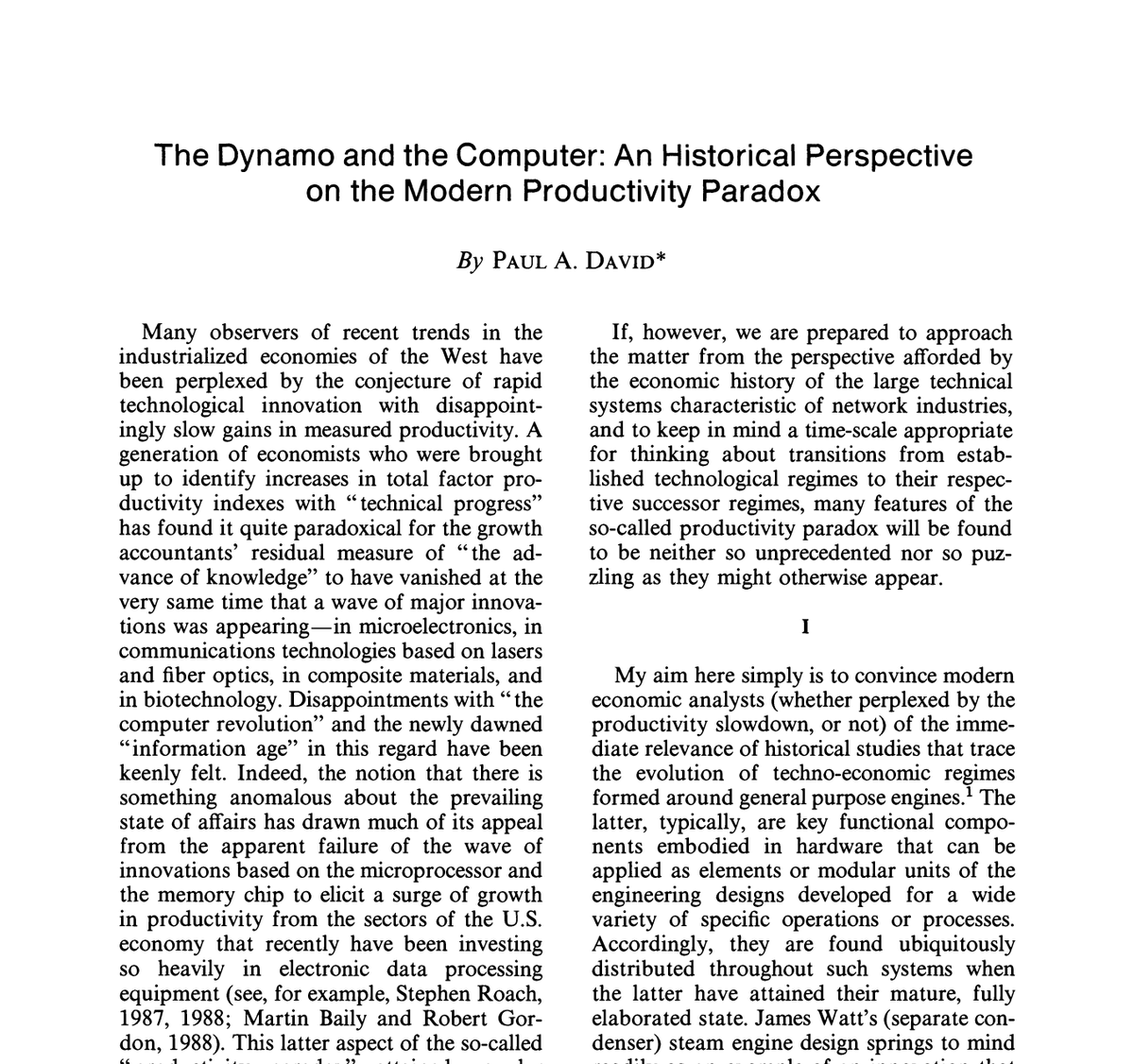
If you've adopted AI at your company but haven't seen any tangible results, read this 1990 article: "The Dynamo and the Computer" by Paul David.
When electricity first arrived, factories that "adopted" it barely got faster. They just swapped the steam engine for an electric one and ran everything else exactly as before: same machine layout, same workflow, same management. Electricity in, no real gains out.
The most common mistake with any new technology is to drop it into the old organization and then declare the transformation done.
The real leap came decades later, when each machine got its own small motor. Suddenly machines no longer had to be lined up around one central drive shaft. They could be rearranged around the actual flow of work.
The productivity gains didn't come from electricity. They came from REDESIGNING THE ENTIRE FACTORY around it.
AI is the same. Bolting it onto your existing process gets you a faster steam engine. The payoff comes when you redesign the work itself.
(link to paper in comments)
This is a super exciting release - Claude Fable 5 is the same underlying model as Mythos but with added safeguards. The benchmarks are great and it's SOTA on everything by a margin but I'll add that *qualitatively* also, this is a major-version-bump-deserving step change forward (imo of the same order as Claude 4.5 was in November), peaking especially for long problem-solving sessions on very difficult problems. You can give it a lot more ambitious tasks than what you're used to, the model "gets it" and it will just go, and it's never felt this tempting to stop looking at the code at all (but don't do this in prod!). The model still has quirks that people will run into and the safeguards are configured to be a little too trigger happy for launch, which can hopefully be tuned over time.
I feel a lot of things changing as working software increasingly comes out on a tap. The Jevon's paradox kicks in and I feel my own demand for software growing substantially. You can ask for anything - explainers, visualizers, dashboards, bespoke single-use apps (e.g. a full wandb that is hyper-specific just for your project), you can 10X your test suite, auto-optimize code, run giant research projects with custom HTML for the results, anything! "Free your mind" (Matrix ref). Really looking forward to all the things people build!
One of my personal favorite features announced at WWDC will I suspect be a sleeper hit: container machines, allowing your Mac to run a lightweight, persistent Linux environment with your home directory and repos automatically mounted: https://t.co/dOBdfOOVxC
Undeniable that Anthropic presents the biggest known structural business risk with their arbitrary, customer-hostile, non-negotiable, non-transparent model limitations + user data retention.
If you use Claude as a business you should want to have an offramp to another model.
what happened to AI democratizing software development? what happened to the price of technology going down not up over time? what happened to LLMs tending towards commoditization? why does anthropic have the industry in a chokehold? where the fuck are openai and google? will the free market sort this out? or?
too much power. anthropic has too much power.
Either Sam Altman reads The Pragmatic Engineer (I wrote about this in detail exactly one week ago for paid subscribers) or I'm just a week ahead to what he also sees!
🚨 Sam Altman warns OpenAi and Anthropic are experiencing severe pullback on Ai spending as companies put significant restraints on spending to restrict costs. The company warns investors it’s the first time this has happened in Ai and something we never expected. The buildout costs aren’t sustainable to allow profitability to hyperscalers or end users.
$soxx $dram
Working with AI agents is mentally taxing and requires a totally different set of skills than writing code.
Senior engineers who have managed teams of developers are better positioned to take on coding agents. But ICs who have been used to writing and shipping their own code all the time will have a harder time adjusting to reviewing LLM-generated code.
OpenAI is in deep, deep trouble
They are low on capital relative to the massive cash they are burning and there is only so much capital in the world.
No rational person would sell their Bitcoin or Nvidia stock or whatever to buy OpenAI rather than Anthropic.
And nobody is going to acquire OpenAI for a trillion dollars.
Instead, my guess is that they get absorbed by Microsoft or Amazon, at something like 30 cents on the dollar.
My biggest takeaways from @benedictevans:
1. We’re in 1997 for AI—it’s as big a deal as the internet or mobile, and only as big a deal as the internet or mobile. We’re at the stage where most stuff kind of doesn’t work yet, most of what people will build hasn’t been built, and it’s not clear how any of it will work when it does. Some people in tech have bought clusters of Mac Minis, while even among 13-to-18-year-olds, only about 15% to 20% are daily active users of AI. The companies that win may not exist yet, and the use cases that matter most are probably invisible to us today.
2. Every technology wave brings ways to ruin people’s lives, deliberately or by accident, and we need to be conscious of that without panicking. Every wave of technology—databases in the 1970s, social media in the 2010s, AI today—creates new ways to harm people. We need to be conscious of these risks, build safeguards, and hold people accountable. But we also can’t let fear of potential harms stop us from capturing the benefits. The goal is thoughtful deployment, not paralysis.
3. Things will probably be okay—but “on average” hides a lot of individual pain. We’ve been automating jobs and creating new jobs since 1800. Each time, you can see the jobs that will disappear but not the new jobs, because they don’t exist yet. We go through frictional pain, dislocation, people lose jobs, towns get hollowed out, and it all sucks. But we come through richer, and we’re not worried about crops failing anymore.
4. If you’re worried about your job, the worst thing you can do is stick your head in the sand and declare AI evil. Yes, some professions face major questions, particularly if you’re an associate or would have been thinking about becoming one. The pyramid structure of professional services may fundamentally change. What helps is submerging yourself in AI, understanding what you can do with it, how it changes things, and how you can be a great hire in this new environment. That may still not be enough, but it’s the only path forward.
5. The history of accounting shows us how automation often increases employment rather than decreasing it. Despite adding machines, punch cards, mainframes, databases, ERP systems, cloud software, spreadsheets, and PCs, the number of accountants keeps going up. This is the Jevons paradox: when you make something cheaper or easier, you don’t do the same amount of work for less money. You often do vastly more because the ROI changes.
6. Distribution is becoming a more valuable moat as software gets easier to build, which favors incumbents. As AI makes building software cheaper and faster, the market gets noisier. More products launch, more companies compete for attention, and breaking through becomes harder. This means distribution—the ability to reach customers and get them to use your product—matters more than ever.
7. Foundation AI model companies won’t have lasting pricing power, and value will likely accrue up the stack. The models don’t seem to have network effects, so there’s no winner-takes-all dynamic. If you have indefinite competition between three to six foundation model providers, and the models look like undifferentiated commodities to users, why would anyone have pricing power? The current pricing chaos—people spending $1.5 million on inference in a month—is temporary disequilibrium, like someone getting a $50,000 mobile data bill in 2010. The steady state will look different.
8. OpenAI and Anthropic are buying consultancies and PE firms. This seems counterintuitive—aren’t these the companies that should need consultants least? But the reality is that companies don’t have people sitting around waiting to reimagine all their internal workflows and figure out which could be automated with AI. That’s a project requiring five to 10 people spending months working it out, then actually implementing it across vertical and horizontal systems.
9. The fundamental question isn’t whether AI automates your job—it’s whether your profession is a "task" or a job. Some jobs are just tasks, and when you automate the task, the job disappears (i.e. elevator attendants). But in most professions, the task you think you’re being paid for isn’t actually what you’re being paid for. McKinsey doesn’t get hired to produce a 75-slide deck—they get hired to walk through your enterprise, understand the politics, talk to customers, and figure out what you actually need to do. The deck is just the artifact.
10. The anti-AI backlash is real, and a fuzzy mass of different concerns, some real and some not—much like the social media backlash. There are tangible concerns: electricity bills went up in some places, though this applies to very few locations objectively. The water consumption issue is largely false; data centers use about 0.017% of U.S. water consumption. There are real questions about jobs, though economists can’t yet find clear consensus in the data about AI’s employment impact. There’s also the culture war over AI-generated content and “AI slop.” The challenge is that all of this creates political pressure even when the underlying facts are unclear or contested.
Why things will eventually fall apart:
1. Everybody, even Google, seems to be treating AI as if it were some kind of winner take all competition like web search was, in which Google taking over 95%
2. But everybody is building essentially the same technical solution with essentially the same data, so there is no moat.
3. If there is no moat, nobody is going to take 90% of the market.
4. With no clear winners, nobody can charge monopoly prices; instead, you get price wars and commodity pricing.
5. Which means everybody will wind up overpaying compared to the modest profits they will be able to make in an intensely competitive regime.
Am I missing something?
🚨 Anthropic just showed a 27-minute workshop on how to actually do prompts for Claude.
Taught by the people who built it.
Free. No registration. No paywall.
I've seen $300 courses that don't cover what they teach in the first 8 minutes.
Watch it and bookmark it now.