The tweet compresses a long meeting into one funny line.
Here is what actually happened.
See, a satellite is basically a car with the fuel tank welded shut. It launches with every drop it will ever have, and when that runs out the satellite is dead even if the camera, the radio and the solar panels all still work perfectly.
That is the problem the petrol pump line is talking about, and it is one of the biggest unsolved problems in the industry.
On Friday, Modi Ji met the founders and CEOs of 20 Indian space startups in Delhi. Twenty companies, one room. What got quoted was the two most cinematic sentences from a session that covered launch vehicles, satellite propulsion, orbital servicing, debris removal, ground stations and agriculture.
Take the fuel thing first.
Satellites burn fuel constantly. Not to fly forward, but to hold their exact slot in orbit, to correct drift, to dodge debris, and finally to push themselves down to burn up when the mission ends.
A communications satellite can have fifteen good years of hardware and only ten years of fuel. Those five wasted years are a multi hundred crore asset floating uselessly.
If you can refuel in orbit, two things change.
Old satellites get extra life.
And new satellites can launch carrying less fuel and more actual equipment, because rocket capacity is measured in kilos and every kilo of propellant you do not have to carry is a kilo of camera or transponder you can carry instead.
That is why it is described as a petrol pump. You need a standard docking port, a robotic arm that can find and grab a satellite that was never designed to be grabbed, and a way to transfer propellant in zero gravity where liquid does not sit at the bottom of a tank.
Bengaluru based OrbitAID is one of the Indian companies working on exactly this. ISRO's chairman V Narayanan inaugurated their R&D facility in September last year and said ISRO would invite private companies into on-orbit servicing and refuelling.
Now the medicines part, which sounds even stranger and is actually the older idea of the two.
On Earth, when you try to grow a crystal of a protein, gravity ruins it. Heavier bits sink, convection currents stir the liquid, and you end up with small, messy crystals. In orbit none of that happens.
Crystals grow bigger, cleaner and more uniform.
Now, to design a drug you need to know the exact three dimensional shape of the protein you are targeting, and you get that shape by firing X rays through a crystal. Better crystal, sharper picture.
One large pharma company spent years running crystallisation experiments on the International Space Station for a cancer antibody, because the orbital version behaved differently from anything they could grow in a lab.
The Indian startup in that room wants to build small satellites that manufacture pharmaceutical material in orbit and then return it to Earth.
That is a hard problem, mostly because coming back down is harder than going up.
The rest of the meeting was less quotable but more concrete.
Skyroot spoke about its 18 July launch, India's first private orbital rocket putting satellites into orbit, and called it a warm up.
The company now runs three factories with the capacity to build one rocket a month, wants to launch monthly by the middle of next year, and eventually weekly. Its Infinity Campus in Hyderabad is 200,000 square feet built for exactly that rate.
One company said it had signed eight launch contracts in the month after its launch, most of them from foreign customers.
Another is building a global ground station network inside 18 months. Another is putting its technology in front of a million farmers. Another is building a robotic spacecraft to catch dead satellites and pull them out of orbit.
For context, India had fewer than 50 space startups five years ago. It has crossed 300 now.
Modi Ji also talked about policy consistency. That entrepreneurs will take real risk only if they are confident the rules will not change under them halfway through a seven year build.
Anyone who has raised money for hardware in India will tell you that is the entire game. Nobody funds a ten year capital intensive bet in a sector where the licensing regime might flip after the next budget.
Now, of course, in-orbit refuelling has been demonstrated a handful of times worldwide and nobody anywhere runs a commercial fuel depot yet. Space pharma is at the stage of returning grams of material, not filling prescriptions. And Skyroot has flown one orbital rocket, not fifty.
But every hard technology starts as a sentence that sounds silly in a press release.
What is genuinely different is that five years ago an Indian founder saying this in that room would have been describing a fantasy.
Now there is a rocket that flew in July, a factory that can build twelve a year, and a regulator saying come in. :)
Surveys show that most Chinese citizens believe that poverty is due to individual failings and laziness, and only 25% support redistribution.
The country’s brutal winner-takes-all examination system helps foster this ideology. https://t.co/QVSRenqM4N
🎯 𝟮𝟵 𝗖𝗟𝗔𝗨𝗗𝗘 𝗦𝗛𝗢𝗥𝗧𝗖𝗨𝗧𝗦 𝗧𝗛𝗔𝗧 𝗖𝗔𝗡 𝗟𝗘𝗩𝗘𝗟 𝗨𝗣 𝗬𝗢𝗨𝗥 𝗣𝗥𝗢𝗠𝗣𝗧𝗦 🚀
Most people use Claude like a search box.
Power users use simple instructions to control how Claude thinks, writes, analyzes, and responds.
Here are 29 shortcuts worth saving:
➡️ 𝟭. /ACT — Assign a specific role
➡️ 𝟮. /TLDR — Summarize long content
➡️ 𝟯. /ELI5 — Explain it simply
➡️ 𝟰. /FORMAT AS — Control the output format
➡️ 𝟱. /BRIEFLY — Get a concise response
➡️ 𝟲. /STEP-BY-STEP — Break down a task
➡️ 𝟳. /AUDIENCE — Adapt for a specific audience
➡️ 𝟴. /CHECKLIST — Turn ideas into actionable tasks
➡️ 𝟵. /TONE — Change the writing style
➡️ 𝟭𝟬. /FIRST PRINCIPLES — Start from the fundamentals
➡️ 𝟭𝟭. /SWOT — Analyze strengths and weaknesses
➡️ 𝟭𝟮. /COMPARE — Compare multiple options
➡️ 𝟭𝟯. /EXEC SUMMARY — Create an executive summary
➡️ 𝟭𝟰. /JARGON — Use industry-specific language
➡️ 𝟭𝟱. /REWRITE AS — Rewrite in a specific style
➡️ 𝟭𝟲. /DEV MODE — Take a technical developer perspective
➡️ 𝟭𝟳. /MULTI-PERSPECTIVE — Explore different viewpoints
➡️ 𝟭𝟴. /NO AUTOPILOT — Avoid generic responses
➡️ 𝟭𝟵. /PM MODE — Think like a project manager
➡️ 𝟮𝟬. /SCHEMA — Build a structured framework
➡️ 𝟮𝟭. /CONTEXT STACK — Maintain layered context
➡️ 𝟮𝟮. /REFLECTIVE MODE — Review and improve the answer
➡️ 𝟮𝟯. /BEGIN WITH — Start with a specific phrase
➡️ 𝟮𝟰. /END WITH — Finish with a specific phrase
➡️ 𝟮𝟱. /DELIBERATE THINKING — Encourage deeper analysis
➡️ 𝟮𝟲. /EVAL-SELF — Critically evaluate the response
➡️ 𝟮𝟳. /ROLE: TASK: FORMAT: — Define exactly what you want
➡️ 𝟮𝟴. /PARALLEL LENSES — Analyze from multiple angles
➡️ 𝟮𝟵. /BIAS CHECK — Look for potential bias
⚡ The secret isn't always a better AI.
Sometimes, you just need better instructions.
🎯 Better prompts → Better outputs
🧠 Clearer context → Smarter results
📌 Save this cheat sheet for later.
❤️ Like
🔁 Repost
🔖 Bookmark
Follow @David_TornAI for more AI tips, tools & prompts.
A defamation case of 2 cr means he had to deposit 2-3 lakh in court in advance (non -refundable if he loses) He has included @JaipurDialogues, X, @Pamphlet_in@LegalTalwar, lawbeat, google and many other in one comprehensive law suit.
In all likelihood the defendants will demand 'misjoinder of parties' since they have no legal, official or personal association with each other... The act is different in all cases. Seperate lawsuits would mean 2-3 lakh for each defamation lawsuit. This will drag on for eternity and Das would be in a jail or hiding somewhere himself (due to his CJP tamasha and violence) before any substantial movement comes in this case.
Point being - whether it is 2-3 lakh or the amount multiplied by 10, where is this unemployed 🤡 getting the money from? Just keeps exposing himself every day... And digging a hole for himself. Overconfident ass.
These empirical findings confirm the numerous anecdotal reports from Kerala over the last 3 decades. Compared with those who have no migration experience, the attitudes of returning migrants from Saudi Arabia toward gender-based violence were more conservative by three standard deviations (!). This is a great cause of concern to all of us.
https://t.co/kNKU5JgpQB
These are disturbing reports. Kerala has long been host to a liberal, progressive practice of Islam, fully in tune with the coexistence and communal harmony prevalent across the state. Kerala is proud of its record of educating Muslim girls and women to the same levels as boys and men. The import of conservative and even reactionary attitudes and customs from abroad, as suggested by this report, is fundamentally at variance with what Kerala has long been about. This requires serious introspection and internal discussion within the Muslim community as well.
Stop telling Claude:
❌“Find a research gap.”
❌“Write my methodology.”
❌“Make my thesis better.”
You’re using a powerful research assistant like a basic answer machine.
10 detailed research workflow prompts you can copy and adapt for better results.
📌Save these prompts and research smarter later.
If there is one Article you should read this Sunday to know what lies ahead Geo-Economically in a monetary reset that could underpin the Geopolitical chaos u see on surface then is the one ! A mandatory read !
The killing of Habib-ur-Rehman Mansour in Badakhshan, a Taliban commander from Wardak province and mayor of Faizabad, in a targeted NRF attack was followed within days by the killing of senior NRF commander Haseeb Qawa-e-Markza, also known as Haseeb Panjshiri. The sequence suggests a degree of sophistication in the Taliban’s intelligence capabilities. The recent rise in resistance operations in Badakhshan and elsewhere, followed by Haseeb’s reported killing in an intelligence operation, suggests that the Taliban is seeking to disrupt resistance networks and counter their growing operational and media momentum through intelligence and psychological operations. The Taliban also disarmed and arrested its disgruntled commander Jumma Khan Fateh in Badakhshan and released an audio recording alleging his links with resistance forces.
The sequence is comparable to the Taliban intelligence operation in 2023 that resulted in the killing of senior ISKP leader Abu Saad Muhammad Khorasani in Balkh province. ISKP had created a sense of fear by killing the Taliban governor of Balkh and senior military commander Dawood Muzammil in a suicide attack. Khorasani’s killing days later not only affected ISKP’s operations but also helped the Taliban counter the perception of its operational reach. It remains to be seen whether the NRF will demonstrate significant activity following Haseeb’s killing.
An important figure associated with these intelligence operations is the Taliban’s Deputy Intelligence Chief for Operations (DDO), Mullah Tajmir Jawad. Known in Taliban circles as “Mullah Sahib" or "Haji Sahib Tajmir”, Jawad served as a mid-level intelligence official during the Taliban’s rule in the 1990s and later became an important commander during the two-decade insurgency, with a network linked to suicide attacks in Kabul and other provinces. He reportedly lost his sight in both eyes around a decade and half ago while making an IED. Since the Taliban’s return to power in August 2021, he has served as a DDO and, despite remaining largely out of the media spotlight, is considered one of the most influential figures in the Taliban’s security establishment.
In this Idea Exchange at Indian Express HQ, we discussed WBG-India opportunities as the gradient for capital floes inverts, new developments at Aadhaar (right at the end), currency movements, growth, reforms, private capital mobilisation, and a range of other topics
https://t.co/0EAJ1zueAC
I was just in Mumbai, and I have to give them credit for the progress they’re making on infrastructure. The new Aqua Line metro is phenomenal. But the amount of work India still has to do on basic cleanliness and sanitation and it is hard to understand until you see it yourself. Would love for more westerners to go just to understand how wealthy they are, but that's a different point.
Mumbai is completely surrounded by water, yet there are almost no places where people can actually enjoy the water. The beaches are filled with trash, the water is badly contaminated, and almost nobody swims, even when it’s brutally hot outside. Walking on the beach is just mud and trash meeting filthy water on the horizon.
There are much poorer places around the world where people can still use the beaches. This is not just about money. India has gone decades without adequate trash collection, sewage treatment, or enforcement for a population of more than a billion people. At this point, the scale of the problem feels almost impossible, and the oceans around the world are paying the price for Indias garbage output as well.
I like the direction Modi is taking the country, but India needs to treat cleanup like a national emergency. Stop with the small campaigns and organize a full scale blitz.
Offer unemployed people paid work picking up trash, clearing drains and waterways, cleaning beaches, and maintaining public spaces. Give them proper equipment and supervision. Then build the collection and waste processing systems needed to stop everything from becoming filthy again a week later.
India has shown that it can build metros, airports, highways, and digital infrastructure. Clean streets and usable water should be treated as infrastructure too.
Mumbai should have one of the greatest waterfronts in the world. Instead, it's has basically an irrelevant feature of the city and feels surrendered to sewage and garbage.
One reason the Canada-US trade deal collapsed:
Canada could not promise / would not stop Chinese steel being transshipped into auto parts & then into the U.S. market.
The U.S. requires a strict “melt and pour” rule. Steel must be melted and poured in North America to qualify for preferential treatment.
This stops Chinese steel from entering Canada, getting light processing, and crossing the border as “North American” content to evade tariffs.
Recall The Canadian Steel Producers Association and Aluminium Association of Canada have both publicly confirmed Chinese dumping is happening, warning Canada risks becoming a dumping ground for China’s excess steel and aluminum.
A recent White House report on the “transshipment scam” also listed Canada as a problem country in China’s shadow network for evading U.S. tariffs.
Canada failed to deliver enforceable guarantees. Mexico accepted the melt-and-pour requirements, raised tariffs on Chinese steel and auto parts, and closed the back door.
Canada left it open and the deal fell apart.
https://t.co/0p2S2YdKaf
China blocked transfer of battery-making know-how to companies outside China
Amara Raja had signed deal with Chinese firm Gotion for LFP cell technology that deal stalled. Now Amara Raja is developing cells on its own, hired engineers from Tesla, and plans to produce 2 GWh of NMC cells by mid-2027.
Exide secured technology and equipment early, before restrictions hit, and is shipping samples from its Bengaluru plant right now. Pain is real in short run, but both firms are building knowledge that imports could never deliver
India targets 50 GWh of battery cell production under its PLI incentive scheme. So far, only 1.4 GWh got built, all by Ola Electric. Ola then cut plans from 20 GWh to 5
Reliance asked for more time. Companies that lost PLI bids, Amara Raja and Exide, are moving faster because they built outside government program with fewer restrictions on timeline and sourcing.
India R&D spending sits at 0.64% of GDP while China spends 2.43% that gap explains why cell manufacturing is behind domestic demand plus Now demand is so high that Nobody want to miss this
But Chemistry is the main game + Effective Ratio
China dominates 99% of LFP cathode supply and 97% of graphite anode production. When Beijing restricted battery tech exports in 2025, Indian manufacturers lost access to shortcuts they had been planning around.
That hurt in short term But Exide locked in tech licenses and equipment before curbs hit, giving them first-mover position. Amara Raja pivoted to in-house NMC development with global talent.
If Indian firms treat this window seriously and invest in deep R&D instead of seeking next licensing workaround, forced independence turns into real capability.
And this is Why I love China and Thanks a lot One should always choose Better peers in life :)
https://t.co/SvXIIeJdsf
Meet Murlidhar and Sangita
- Both got married when Murlidhar was 24 and Sangita was 19
- They struggled to have a child for several years
- They even visited Char Dham praying for a child
- Eventually, they were blessed with a boy and named him Kunal
- Murlidhar came from a poor background
- He droved truck to fulfill most of his family's wishes
- Sent his son to a good school, where Kunal saw other children from wealthy families
- Kunal started crying about getting an iPhone 15 Pro
- He bought it on EMI, but Murlidhar couldn't keep up with the payments
- Murlidhar was 3 months away from family due to driving work
- He was planning to buy his own vehicle and put it on rent so that he can run his family smoothly
- Kunal went near a cliff and pressured his father to pay the EMI
- His parents kept pleading with him not to go there
- Eventually, Kunal fell. His father, who was trying to save him, also fell after Kunal grabbed his hand
- Watching her family fall into such a horrifying situation, Sangita also jumped over the cliff
All three lost their lives. This is what you get for spending your entire life trying to be a good parent 💔
Half the cost of a lithium-ion battery is the cathode. China makes roughly 90% of the world's supply. Tesla just switched on the first plant in North America producing it at large scale.
America finally makes the hard part.
For twenty years the deal was that we design the product and China makes the chemistry inside it. A car could be assembled in Texas, with cells built in Texas, and still be strategically Chinese, because the powder inside those cells crossed the Pacific. In 2025 Beijing even added cathode production technology to its export control list. Governments don't restrict the export of things that don't matter. China looked at its cathode position and decided it was leverage worth protecting.
Tesla built it anyway.
And they didn't copy the Chinese process. They leapfrogged it. Conventional cathode lines need solvent slurries, football-field drying ovens, and a solvent recovery plant. Tesla's dry coating deletes all three. The material fought back for years, cracking and delaminating under compression, and Tesla only confirmed fully dry production of both electrodes in January 2026. Seven years after buying Maxwell for the technology, it works at scale.
The permit for this building was filed in 2022 under the codename Project Cathode. Four years from dirt to powder, sitting next door to the cells it feeds.
Every other automaker on the continent still imports theirs.
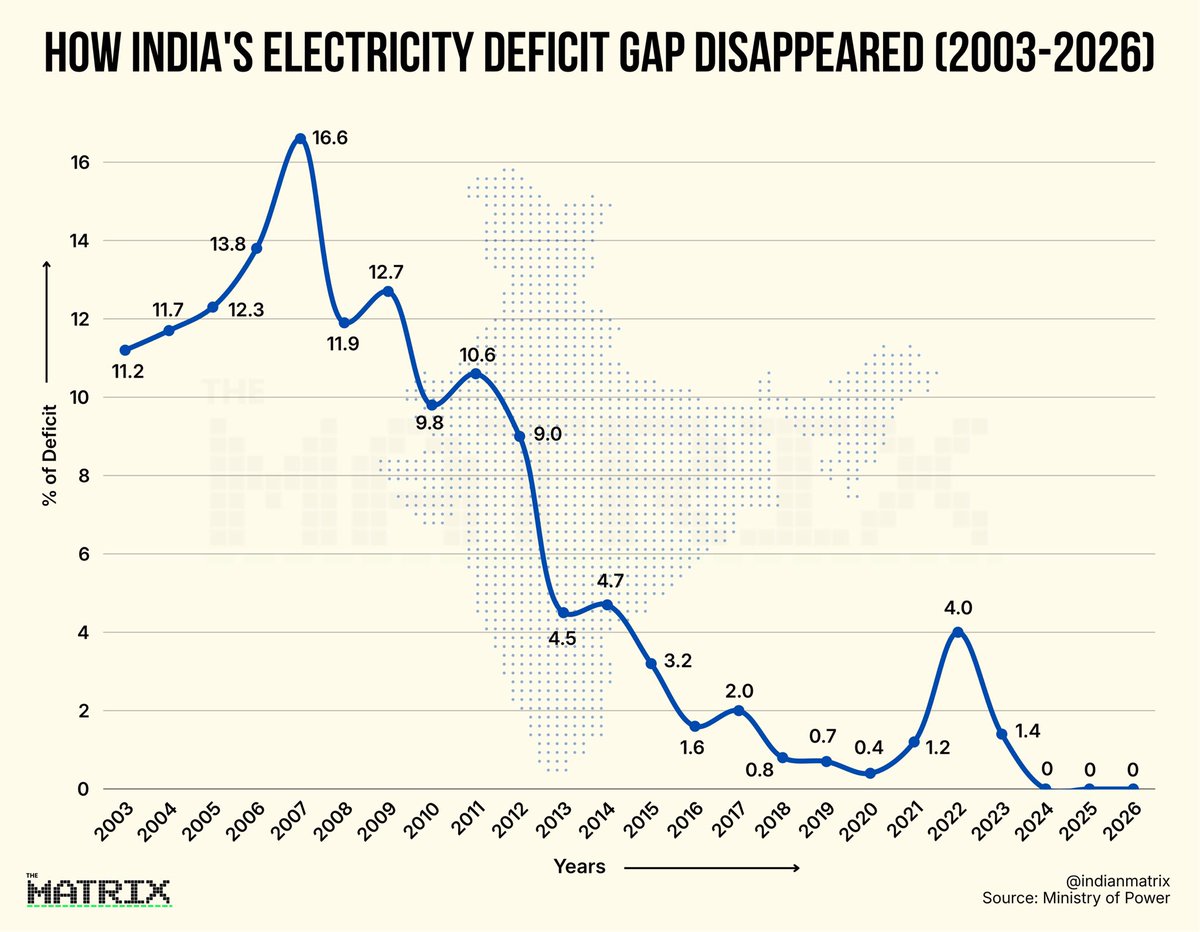
In 2005, India couldn’t meet 12.3% of its own peak demand. By 2007, the shortfall had widened to nearly 16.6%, and close to 18,000 megawatts were unavailable.
India today draws 52% of its electricity from non-fossil sources. More than half of every unit generated comes from the sun, water, wind, or nuclear.
The deficit percentage, which once sat stubbornly above 10%, has now collapsed. Since 2024, it has been effectively zero.
Electricity reliability is, in the end, a quiet form of equity. When the grid is unreliable, those with money buy backup. Those without simply go without. India's closing of its power deficit means that the gap no longer falls along economic lines.
The country that once rationed darkness now delivers light on demand, at the moment of highest need, to everyone connected to the grid.
This is the most impressive to me, more than the 100m world record.
This requires autonomous real-time planning and action in response to a fast-moving target and dynamic environment.
Galbot is one of China’s top humanoid robot startups.
50 Web Sites Google Doesn't Want You to Know About
1.) 'https://t.co/ElNBmlQM4R' — Bypass any paywall
2.) 'https://t.co/fgmC7Fwu9l' — Millions of free textbooks
3.) 'https://t.co/RLNx06Hapr' — Free academic articles
4.) 'https://t.co/gOkFgZk8Bq' — Find free app alternatives
5.) 'https://t.co/oKnODbmu1k' — Find where any content is published
6.) 'https://t.co/Q31kxdRdCm' — Access any old web page
7.) 'https://t.co/JGLJ1vBMd4' — 70,000 free classic books
8.) 'https://t.co/pOv1iYSBhf' — Free PDF downloads
9.) 'https://t.co/mNJNoPjb0A' — Free courses from top universities
10.) 'https://t.co/yrpzRcVq4X' — Solve any math problem instantly
11.) 'https://t.co/PSQWFnBqHS' — Free Photoshop in your browser
12.) 'https://t.co/dVHCcpl8zq' — Compress any image for free
13.) 'https://t.co/Wv5dNqTyKU' — Remove image backgrounds for free
14.) 'https://t.co/AfwRqOXsE6' — Remove objects from photos
15.) 'https://t.co/f2lId2H619' — Remove video backgrounds
16.) 'https://t.co/ZxmRK0LWeE' — Turn code into art
17.) 'https://t.co/JQKgXzGKhR' — Stylish code screenshots
18.) 'https://t.co/fh5UrMWUda' — Free product mockups
19.) 'https://t.co/j6pp31pbLd' — Create mockups without Photoshop
20.) 'https://t.co/vORyZ5C5Xb' — Check if you've been hacked
21.) 'https://t.co/mTeWBUC3l5' — Scan any file for malware
22.) 'https://t.co/whAuSUyU4c' — Send self-destructing messages
23.) 'https://t.co/Sz27b2GxfH' — Instant disposable email
24.) 'https://t.co/yc4pV95Xkc' — Auto-deleting file sharing
25.) 'https://t.co/p6N6ZfqYkZ' — Permanently save any web page
26.) 'https://t.co/zHDnEAe2uB' — Find alternatives to any site
27.) 'https://t.co/bDEEnoZEJh' — Listen to any radio station worldwide
28.) 'https://t.co/VWfuIn1LAo' — Discover every music genre
29.) 'https://t.co/Fb2EKFPd2O' — Find songs from any TV show
30.) 'https://t.co/ueLYHaL6Fp' — Focus music
31.) 'https://t.co/xEb9mdypc1' — Custom focus soundscapes
32.) 'https://t.co/9N1pHsZUnw' — Cafe sounds that boost productivity
33.) 'https://t.co/RSV0kxbeFa' — AI academic paper assistant
34.) 'https://t.co/V188KncLe7' — Search scientific consensus
35.) 'https://t.co/B9cuT2Gscy' — Visualize academic paper maps
36.) 'https://t.co/rS84uZ1UAb' — Free academic search
37.) 'https://t.co/fW70smp4rC' — Understand any academic paper
38.) 'https://t.co/fP3HQjL5gg' — Summarize any YouTube video
39.) 'https://t.co/Ho3G2rYfLp' — AI search engine for developers
40.) 'https://t.co/jYuShbP6wE' — Test any regex instantly
41.) 'https://t.co/hWk2CgZiL6' — Format code cleanly
42.) 'https://t.co/VOzFrBSHzi' — Read JSON like a human
43.) 'https://t.co/isVS4wQPrE' — Understand terminal commands
44.) 'https://t.co/J4HQwNWk9x' — Effective bookmark manager
45.) 'https://t.co/cHDOA1zSyI' — Check if any site is down
46.) 'https://t.co/M1ui3gEwUS' — Reverse image search
47.) 'https://t.co/nUl8ALGeLY' — Check internet speed
48.) 'https://t.co/UZei8ObR3V' — Free PDF editing
49.) 'https://t.co/6Weq5y7fyH' — Merge and split PDFs
50.) 'https://t.co/0iez5I3gqn' — Second-long temporary email
The internet is much bigger than what Google shows you.