We are a protein biochemistry & biophysics lab at CRG Barcelona. We use in vitro reconstitutions and systems approaches to understand cytoplasmic RNA transport.
Reconstitution of bidirectional #mRNA motility with the help of kinesins and #microtubule dynamics! https://t.co/ilkHy4uTCJ Movie: KIF5A (magenta) drags APC-RNPs (cyan) along microtubules. Thanks to @SebasBaumann, @GrawenhoffJulia, @ElsaCRodrigues&the lab!
Thanks to @CRGenomica for all the support. One of the last articles from @maurerLab:APC couples neuronal mRNAs to multiple kinesins, EB1, and shrinking microtubule ends for bidirectional mRNA motility | https://t.co/ilkHy4uTCJ
APC couples neuronal mRNAs to multiple kinesins, EB1, and shrinking microtubule ends for bidirectional mRNA motility | Proceedings of the National Academy of Sciences https://t.co/ilkHy4dQAJ
Reconstitution of bidirectional #mRNA motility with the help of kinesins and #microtubule dynamics! https://t.co/ilkHy4uTCJ Movie: KIF5A (magenta) drags APC-RNPs (cyan) along microtubules. Thanks to @SebasBaumann, @GrawenhoffJulia, @ElsaCRodrigues&the lab!
@LabBoke@Nature@AidaRoNu Super cool how you figures that out. I still remember how you mentioned the first time that you can’t detect ROS in oocytes and wondered what was going on :)
APC couples several #mRNAs to different #kinesin motor proteins, EB1 & shrinking #microtubule ends which enables bidirectional mRNA motility on dynamic microtubules (mRNA=yellow,EB1=cyan). Thanks to @SebasBaumann, @GrawenhoffJulia, @ElsaCRodrigues&the lab! https://t.co/HowvUfIb5m
In vitro reconstitution of full-length adenomatous polyposis coli (APC) #microtubule (MT) plus-end tracking. APC (red) tracks polymerizing MT ends via EB1. Due to APC’s high dwell times on the MT lattice, it also tracks shrinking MT ends (channels shifted for better perception)
Our view on what's known and where to look at regarding mRNA transport complexes!
Lots of fun digging through the literature and summarizing it for you 😍 take a look please!
Mammalian Neuronal mRNA Transport Complexes: The Few Knowns and the Many Unknowns https://t.co/bLVUzpeVxh
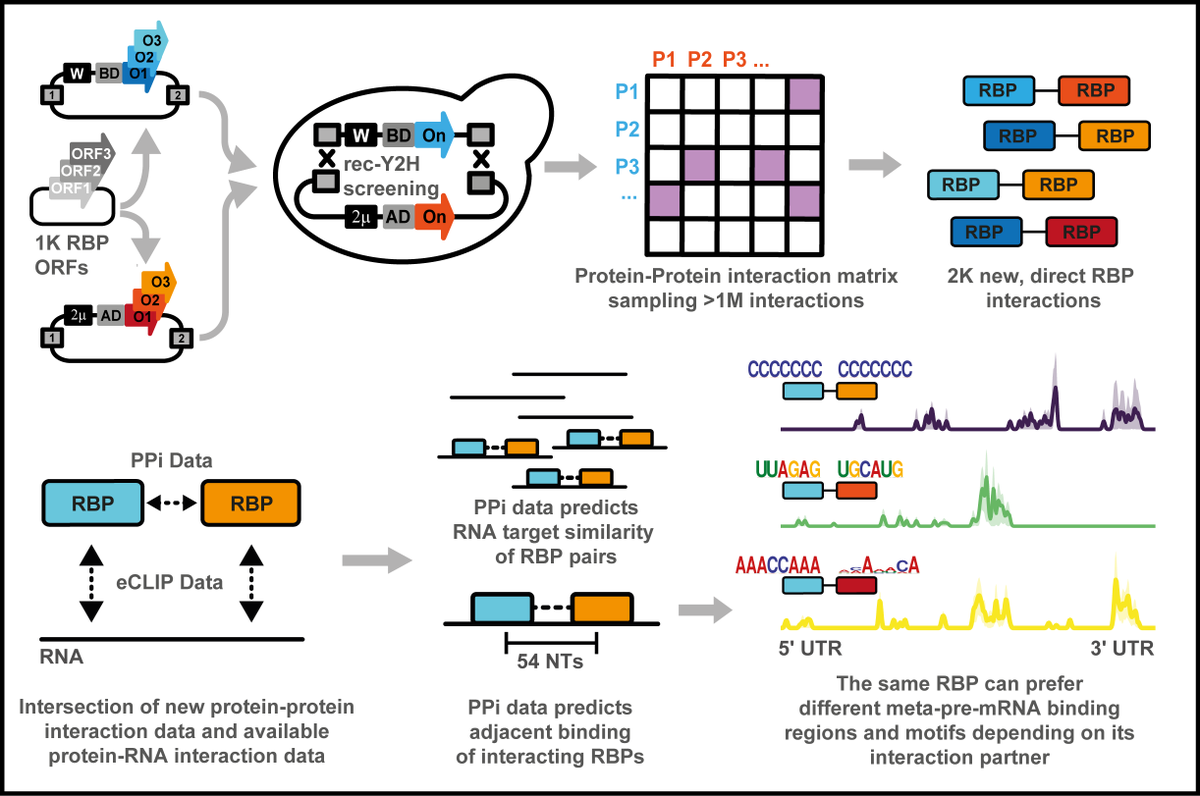
Interacting RBPs bind similar RNA sets at distances characteristic of known RBP complexes. The choice of the interaction partner of an RBP affects its #mRNA binding profile and motif preference, indicating that the combination of RBPs guides their function.
Liquid-Gel Matrix-Screening (rec-Y2H) revealed a vast potential for direct protein-protein interactions among RNA binding proteins - A great collaboration with @langbnj & @tartaglialab https://t.co/7rMKoFYhVp
@ElsaCRodrigues & @GrawenhoffJulia@maurerLab carefully went through decades of primary mRNA localization data asking: Which minimal mRNA transport complexes can we propose for mammalian neurons? All evidence is concisely summarised in TableS1! https://t.co/RkywEYWOJr
Happy and proud to share a novel post-translational protein modification: the RNAylation!
Viral ADP-ribosyltransferases attach RNA chains to host proteins https://t.co/pIeOmQS9j7
3'UTRs often contain several regions important for localization and just motifs are not enough to trigger mRNA localization. Who would have thought :) - Great work!
How do neuronal RNAs know where to go? Happy to share the result of my time in the @moorlab and of my first months @UofHaifa, now available on biorxiv. Many thanks to @AndreasMoor@elettod@MinkyoungLee1@Ati_lz and everyone else involved in this project.
https://t.co/72fT1uYAu5