Let us know what you think! We're excited about further characterizing the evolutionary forces that interact to give rise to the highly polymorphic, absolutely beautiful TE landscape of the maize genome🌽
We've tested it out on lots of plant species (and even a goldfish!) and recover not only large scale structural variation, but also base pair resolution of conserved regulatory sequence, and gapped alignment across TE-rich regions
Really excited about AnchorWave! @baoxing_song taught me so much about alignment, and put together an approach that works for the real life messy stuff about genomes - like lots of TEs and paleopolyploidy
It works by finding conserved gene anchors between assemblies, then uses an implementation of the wavefront algorithm that allows for two gap penalties to perform a global alignment of each anchor and interanchor region
Transposable elements (TEs) are #DNA pieces that move around the #genome
Stitzer et al model the roles of TEs & reveal a diversity of survival strategies of TE families in the #maize genome
🔎: https://t.co/BSwxtTM0R8
@mcstitzer@sna8@SpringerNathan@jrossibarra
Congratulating to Michelle Stitzer (@mcstitzer) this year's winner of the @ucdavis Outstanding Dissertation in Ecology and Evolution Merton Love Award. She'll give her seminar "The Genomic Ecosystem of Transposable Elements in Maize." on May 28th.
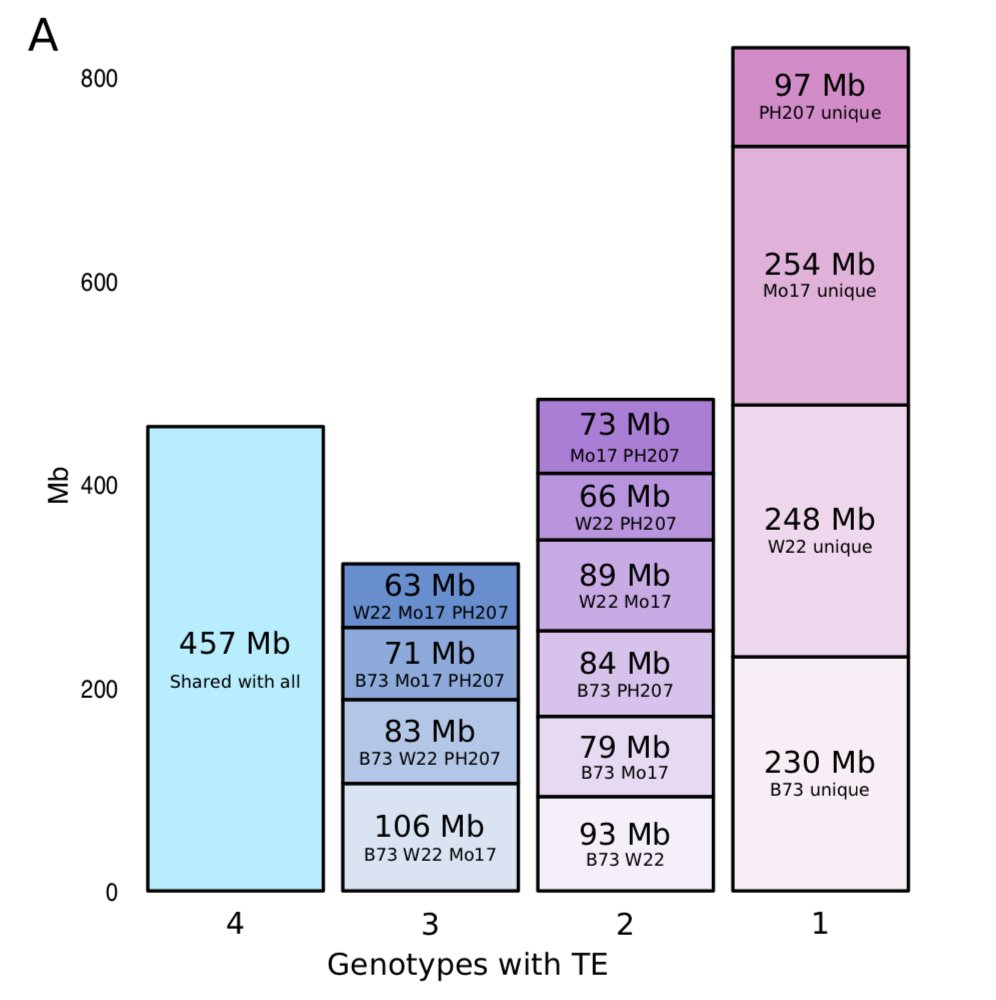
@sna8@mcstitzer@abrohamm1@SpringerNathan@HirschCandice In only four maize genomes we find 100's of thousands of variable TEs, more than an order of magnitude more TEs that vary among lines than were found in 3,000 rice lines! That's about 1.5Gb of variable TE DNA in FOUR HAPLOID GENOMES. 2/6
Had such a great time at #UppTransposon2018 and so excited to now have the complete Mobile DNA trilogy on my shelf! Thanks again to organizers Patric Jern, @ClaudiaKutter, and @alexander_suh.