@janieserna3 A29: I remember using the cubes as a measuring tool that were also used to represent one for base ten. I think the length of each cube is 1 cm so it was a great way to learn that length with an object I was already familiar with. #OSUElemMath
@LayneMorton2 @KayleySchick @SallyMc84272297 I agree as well! I think there might be some resistance to introducing fractions early but obviously we wouldn’t be giving terms like numerator and denominator. Establishing the idea that a whole can be broken into parts will be beneficial for these students in the future
@alymekinda@MadelineSprowls@SallyMc84272297 My teachers were always the same way. I always liked drawing them with a slash better and we would get points taken off. Also I had some teachers who wanted mixed fractions and some that only wanted improper fractions so it was very confusing.
I grew up thinking I was REALLY bad at math. I was told by multiple teachers that only those “gifted” at math could become engineers and scientists. not only were they wrong about me, they were wrong about math. it’s not only for the gifted— it’s for the curious.
@rmkuzmaOSU@WolfordCassidy A17: This is such a good point and I didn't think of this. Like connecting the ABCs to real life objects, I agree that connecting numbers to real things to give students a chance to visually see this 1:1 correspondence would be really beneficial #OSUElemMath
@WolfordCassidy A18: In high school, we would write our solutions on the board from the homework we had the night before and discuss. I can't remember doing this as much in elementary school but I plan to do what we do in class and have students work in groups to share their work. #OSUElemMath
@WolfordCassidy A19: Like we did in Math 1125 and 1126, I would work with my students to figure out why these shortcuts work. If students can understand why the short cuts work when they are using them, they are still increasing their mathematical understanding. #OSUElemMath
@KatieKonrad1@KatieKreczmer A16: I love this idea! I think drawing on past knowledge is critical in math instruction. Along with multi step problems, I think projects would be helpful too. This project could involve other subjects besides math to really connect what children are learning. #OSUElemMath
@Madison43189033 A14: I can’t think of a time where I’ve observed this but I think you could ask students to try to find another way to solve a problem even after they’re finished. You could also have students work in groups to talk about different ways that they found the answer. #OSUElemMath
@alymekinda A15: I think a good way to incorporate mult/divi into very early childhood classrooms is having students add small groups. It can be treated as an addition problem but it will give students a foundation to solve mult/divi problems in the future. #OSUElemMath
@EllieStammen A13: Similar to what we do in class, I think working in collaborative groups and having one or two students per group show their solutions on a white board would be helpful and I think it would prompt a lot of discussion. #OSUElemMath
@LayneMorton2 @KatieKonrad1 A12: I agree with rewording the question which is what the teacher was trying to in the video. Maybe even having a piece of paper that says "store" that she can physically get 6 cubes from might be helpful. #OSUElemMath
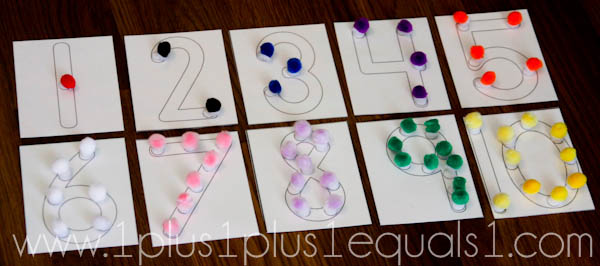
@mikusamouse A11: At the preschool I work at, I have seen many math activities where kids are encouraged to match little toys or objects to spots that correspond with the number shown on the paper as seen in the photo. #OSUElemMath
@mikusamouse A10: I don't think I've ever had social justice connect with my math instruction and I've never really thought about ways to do it. I think it would be cool to do a math activity where you solve an economic crisis problem so students can understand the power of math #OSUElemMath
@mikusamouse A9: One myth that really resonated with me from the reading was the myth that math has to be worksheets. I have heard this myth and while I think worksheets are sometimes okay, doing a single math problem in collaborative groups is a really good way to learn math.#OSUElemMath
@MariaMurphy103 A8: Ginsburg mentions that you should show the student that you value their thinking and figure out how they're thinking. I had a teacher that would only solve our work for problems and not the answer which showed that she put more value in our thinking process. #OSUElemMath