What the fax?! I guess faxing isn’t dead 🤷♂️ Use Dropbox Fax by @DropboxSign to send and receive faxes from anywhere. #DropboxFax https://t.co/GnYZpowRdc
The sheer evil of Netanyahu’s murderous regime
The mathematics of starvation: how Israel caused a famine in Gaza. It has calculated how many calories Palestinians need to stay alive. Its own data shows only a fraction has been allowed in
https://t.co/3j2x9hxLce
I got a lot of questions about the government cutting off access to weather data from DoD satellites. I tried my best to answer them as best I could here: https://t.co/iOUKThRrD5
@TheEyewallWx
Can't believe this must be stated, but the following statements can both be true:
1. NWS provided timely and actionable forecasts and warnings ahead of the flooding disaster in Texas.
2. NWS' ability to work with EMs and other agencies is -vely impacted by cuts and vacancies.
I just spent hours reviewing the final version of Trump’s “Big Beautiful Bill,” which he will sign into law in the coming days. There's a lot of important stuff related to EVs, renewable energy, and more. Here's everything you need to know:
• $7,500 EV credit for new vehicles: Ends September 30, 2025
• $4,000 used EV credit: Ends Sept 30th
• EV fees: There is nothing in the bill about an annual $250 EV fee, so no need to worry about that.
• Solar credit: Terminates the 30% tax credit for rooftop solar on Dec 31, 2025
• ZEV credits: While this bill does not directly eliminate regulatory Zero-Emission Vehicle (ZEV) credits—the type that Tesla and other automakers have earned billions from by selling EVs under California’s ZEV mandate and other state-level programs—it effectively guts the system that creates demand for those credits.
First, Trump’s bill eliminates penalties for automakers that fail to meet federal Corporate Average Fuel Economy (CAFE) standards. Previously, automakers that didn’t meet fuel economy targets had to either improve efficiency or buy credits (including ZEV credits from Tesla) to avoid stiff fines. Now, those penalties are reduced to $0, removing a major incentive to purchase credits.
Second, and more significantly, Congress recently used the Congressional Review Act to revoke EPA waivers that allowed California (and the 17+ states that follow its lead) to enforce stricter emissions rules, including ZEV mandates. These waivers were the legal foundation of the state-level ZEV credit programs. Without them, states can no longer require automakers to meet ZEV sales targets or buy ZEV credits to comply.
Together, these two actions remove both the federal and state compliance pressures that created the market for ZEV credits. As a result, demand for Tesla’s (and other EV makers) credits will likely collapse in the U.S., unless courts overturn the waiver revocations in the coming legal battles. Tesla can still generate ZEV credits outside of the U.S. (such as Europe).
• Home Geothermal: Terminates tax credit for geothermal heat pumps and other home devices on Dec 31, 2025
• Battery manufacturing credit: The bill keeps this around, which is great, but there are new sourcing restrictions. I did my best with interpreting the complicated bill language on this topic, so please correct me if I'm wrong:
It sounds like Tesla’s new Nevada LFP battery plant can qualify for the 45X credit ($35/kWh for battery cells + $10/kWh for modules) for batteries made at that facility, but it looks like it will need to meet increasingly difficult content requirements (60% U.S. content in 2026, rising year by year to 85% in 2030). If the plant uses CATL equipment, it will be tough. The batteries Tesla makes at Giga Nevada in partnership with Panasonic, as well as the batteries made at Giga Texas, should continue to qualify for the manufacturing credit as long as they meet requirements. We will get further clarification/guidance from the U.S. Treasury in the near future on the manufacturing credit which should help clear up any remaining confusion.
• Qualified commercial clean vehicles credit: Cancels the credit for companies that buy electric cars or trucks, including businesses that lease the vehicles to consumers, by Sept. 30, 2025
Deduction for car loan interest for American-made vehicles: From 2025 through 2028, interest paid on loans for purchasing a personal-use vehicle will no longer be considered "personal interest" and can be deducted. To qualify for the deduction, the vehicle must meet all of the following:
• Original use begins with the taxpayer.
• Manufactured primarily for use on public roads (not rail-only).
• Has at least two wheels.
• Is a car, minivan, SUV, pickup, motorcycle, or van.
• Has a gross vehicle weight rating under 14,000 lbs.
• “Final assembly” must occur in the United States
Max deductible interest of $10,000 per year. Deduction phases out for taxpayers with income above: $100,000 (single) and $200,000 (joint).
• Advanced manufacturing production credit: Terminates credit for wind power components after 2027 and disqualifies facilities that use certain components from China and other “foreign entities of concern.”
• Clean electricity production credit: Phases down tax credits for low-emissions electricity sources like wind, solar, nuclear and geothermal power. New restrictions on the use of components from China. Wind and solar projects can still claim the credit as long as they either begin construction within a year of the law’s enactment or come online before the end of 2027. Nuclear, geothermal or battery projects would have more time. They also removed a controversial tax for projects that have ties to Chinese firms
The bill kills clean electricity investment and production tax credits for wind and solar that have been in place since 2005 and 1992. Solar and wind farms that enter service after 2027 would no longer be eligible for the credits, a big blow to the US' renewable industry.
• Energy efficient home improvement credit: Terminates a tax credit for energy audits and renovations to improve efficiency by Dec. 31, 2025 Terminate the credit for companies that buy electric cars or trucks, including businesses that lease the vehicles to consumers, by Sept. 30, 2025
• Clean hydrogen production credit: Companies must begin construction by the end of 2027 to claim credits
• Energy efficient credit for new homes: Terminates a tax credit for the construction of new homes that meet energy star standards by June 30, 2026
• Alternative Fuel Vehicle Refueling Property Credit: Ends June 30, 2026
I hope this breakdown was helpful. Let me know if I missed anything.
Joint NLA and EAS session; @CBallantyneMD at #EASCongress2025: Lp(a) associated ASVC risk: Remember that per particle Lp(a) is much more atherogenic BUT...The amount of LDL circulating particules is by far larger! And what about cutoff values? See pic from NLA. @EASCongress
Once again. Worth reminding people that two years ago we were seeing a boom in the opening of new factories in the US. Didn’t get a lot of attention from Influencers, but wasn’t that long ago in history.
Delta says corporate travel started the year strong but a reduction in confidence stalled growth in Feb and March? Any ideas what may have caused that?
Justice Sotomayor with bone-chilling warning today: “The implication of the Government's position is that not only noncitizens but also United States citizens could be taken off the streets, forced onto planes, and confined to foreign prisons with no opportunity for redress if judicial review is denied unlawfully before re-moval. History is no stranger to such lawless regimes, but this Nation's system of laws is designed to prevent, not en-able, their rise.
Regardless of what you made of Biden-era industrial policy, is an amazingly grim irony that US tariffs are being raised with the stated aim of reindustrialising America, ignoring an *actual generational boom in industrial investment* which the tariffs now pose a huge threat to.
CEO Sentiment @CNBC
- "going to be a wild ride”
- “increased probability of stagflation”
- ”‘tariff math’ was disappointingly stupid and illogical”
- “This is a Trump recession”
- “we are war rooming scenarios”
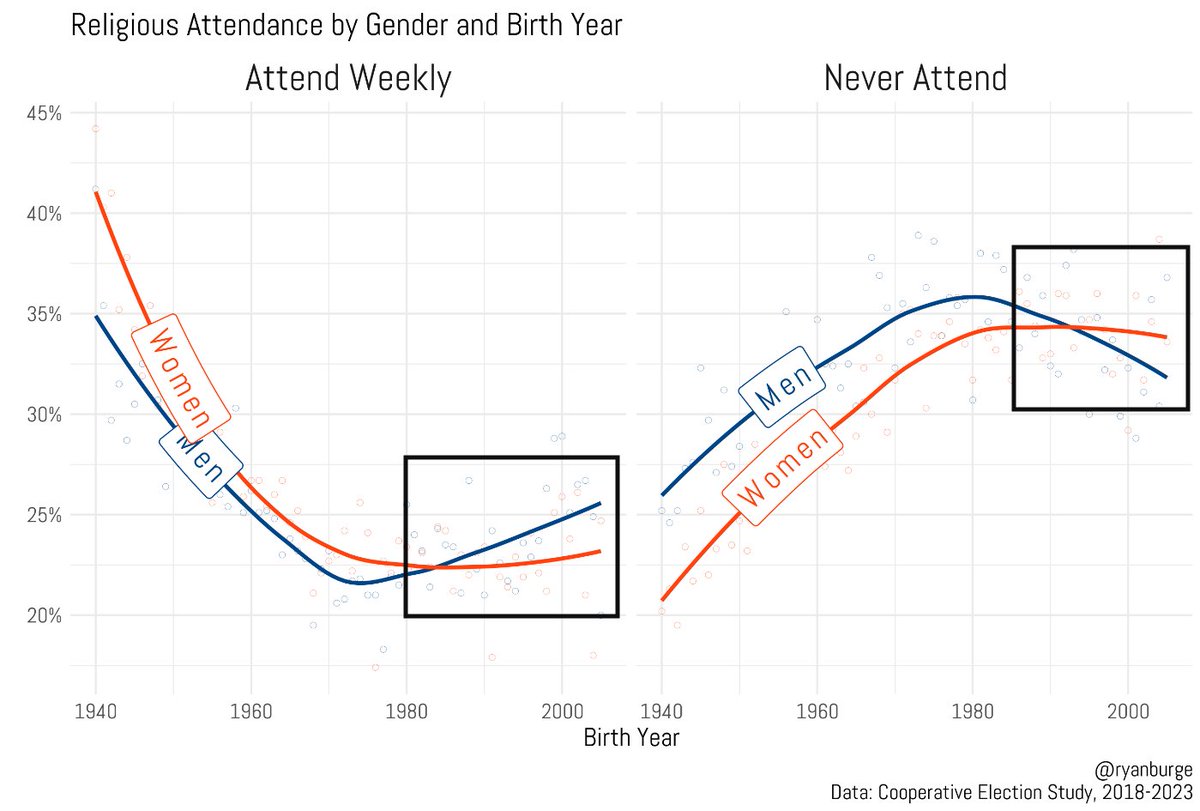
If you compare men born in 1950 to women born in 1950, the women attend church just a bit more than the men.
But look at the black boxes.
Among men born in 2000, they are ~3 points more likely to be weekly attenders than women of the same age.