Gemini Omni Flash is officially out! 🚀
It has been incredible working on the model pretraining, landing cool features in video editing, and pushing the 3D/camera capabilities in Omni. Seeing it live at #GoogleIO is surreal. 😍😇
Took countless days of no to little sleep. But sometimes it takes a little crazy to make something truly amazing. ✨✨✨
Go try it out! https://t.co/rp2VjqmhPR
#googleemployee @GeminiApp@GoogleDeepMind #gemini #omni
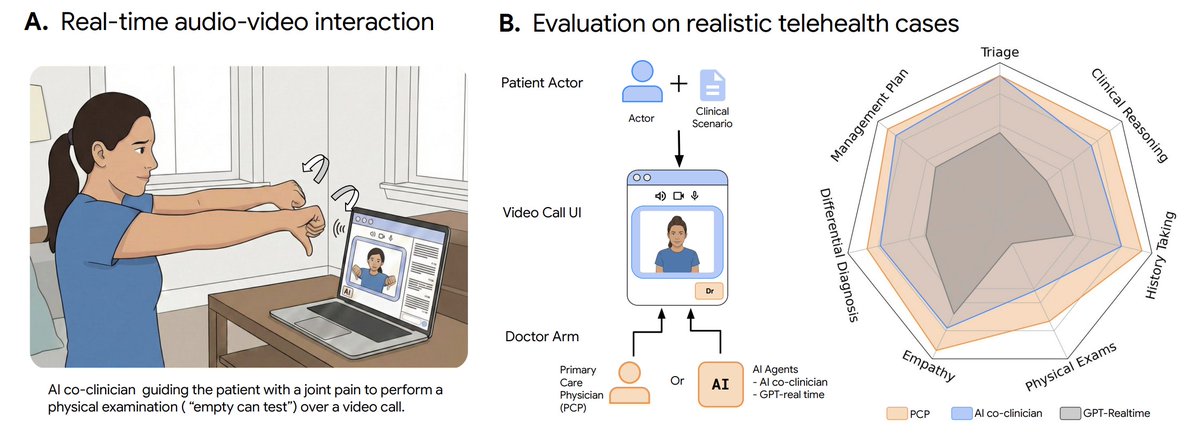
(1/10) Excited to share our new paper: "Towards Conversational Medical AI with Eyes, Ears and a Voice"
https://t.co/k0CNjqsgIP
Clinical medicine depends on more than words; it relies on real-time visual cues (rashes, distress, gait), auditory signals (prosody, breathing), and guided physical exams (e.g., guiding someone through correcting their inhaler technique, or walking them through shoulder maneuvers to work up a rotator cuff injury).
But existing conversational medical AI systems are blind and deaf to this crucial information and are constrained to rigid, turn-by-turn user experience.
As an important ingredient in AI co-clinician, our new healthcare initiative at @GoogleDeepMind, we developed a first-of-its-kind real-time multimodal system that conducts natural clinical consultations over video calls while continuously watching, listening, and reasoning.
The preprint details the research progress we’ve made so far together with our collaborators at @StanfordMed and @harvardmed (@AdamRodmanMD@euanashley@DrJackOSullivan@jasongusdorf).
More details below!
@BIDMChealth@StanfordMed 9/ We are currently in a phased research approach with global collaborators ( 🇺🇸 🇦🇺 🇳🇿 🇦🇪 🇸🇬 🇮🇳) to ensure this is developed responsibly. Huge congratulations to everyone on the team and our partners for making this possible.
1/ Introducing AI co-clinician: latest research milestone I’ve been a part of at @GoogleDeepmind, researching the evolution of care delivery where AI can support both patients & doctors.
tech report: https://t.co/VkOgbTLxSq
blogpost: https://t.co/be8KHhWIeP
AI co-clinician is our new research initiative to help explore how multimodal agents could better support healthcare workers and patients. 🩺
Here’s a snapshot of our progress 🧵
@BIDMChealth@StanfordMed 8/ We utilize a dual-agent architecture to decouple fluid multimodal interaction from deep clinical reasoning. A low-latency "Talker" handles empathetic dialogue, while a supervisory "Clinical Planner" monitors the encounter state.
AI co-clinician is our new research initiative to help explore how multimodal agents could better support healthcare workers and patients. 🩺
Here’s a snapshot of our progress 🧵
I am happy to introduce AI co-clinician,
@GoogleDeepMind's research initiative to explore how AI could better amplify doctor's expertise and help deliver higher quality care to patients.
We’re excited about our early results, and are taking a phased approach to our research explorations with academic and research collaborators.
Read more in our blog: https://t.co/OVPDordxTw
@debarghya_das This is very likely incorrect. 80K seems like total EB-1 approvals since 2012 [1].
70K approved in one quarter means ~1076/day. That's unlikely as only 5-6 officers across 2 centers adjudicate the petitions.
[1]: https://t.co/UHU72XeDYA
VQA is consistently seeing tremendous progress year by year. Excited to see further progress as we now focus on specific sets of problems (reading text, consistency, external knowledge etc.).
Planning research on V+L? Do have a look at Pythia https://t.co/RPqXeJ8jDz