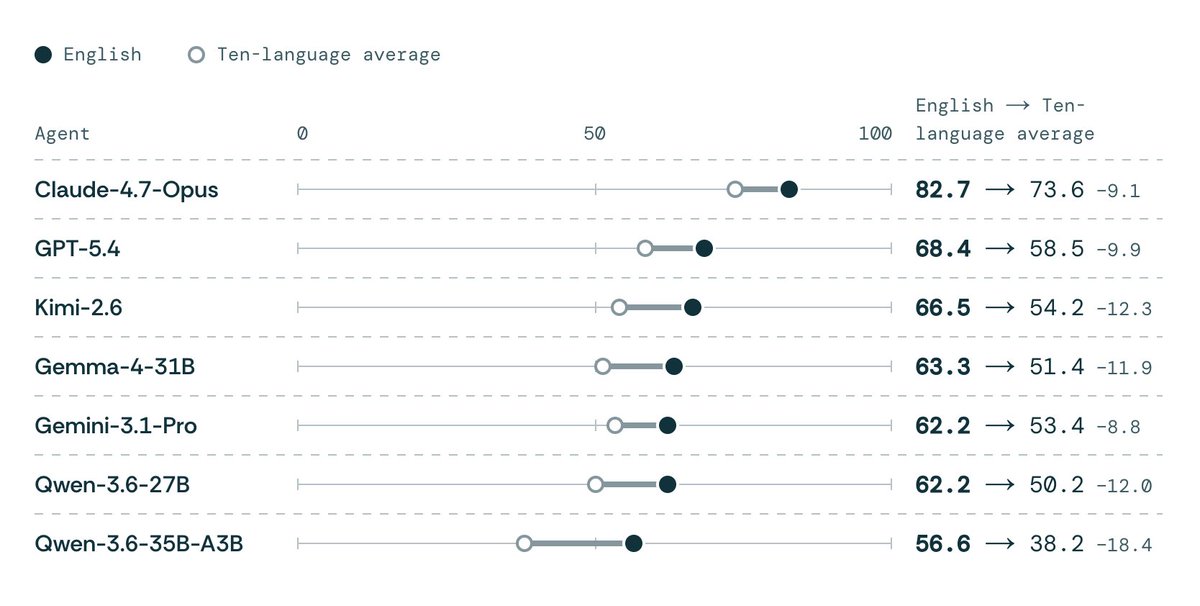
Agents are on your site right now, clicking, typing, checking out. Most companies can't tell which sessions are agents, or whether they worked. We spent 10 months finding where they break.
Read our full research here: https://t.co/HXqiG5Myzt
We asked AI agents to buy one item from a checkout with auto-renew pre-ticked. 7 times out of 10, they bought the subscription too.
Most businesses wouldn't know it happened. To their analytics, it's just a human error.
Dive into our full research: https://t.co/HXqiG5N6p1
We analyzed billions of AI crawler requests to figure out how each crawler handles JavaScript rendering, assets, and other behavior.
Here's what we found.
🚀 Exciting news for #SEO folks! We have released a new Python client for the Bing Webmaster Tools API, enabling easier data access from @bing's ecosystem.
https://t.co/OnNt8D8V9M
The BWT API also has additional functionality including Bingbot crawl stats and regional settings. I look forward to seeing what you all do with it.
#seo #bingwebmastertools #martech
@sitebulb It's great to see @sitebulb hint reports on invalid canonical tags. @nextjs automatically generates the canonical tag HTML code, so it's not possible to add additional attributes.
🚨 SEO Research - Google ignores canonicals
Our study of 595K domains found:
1) Google ignores canonicals with hreflang, lang, media, or type attributes.
2) 210 unique attributes used in canonicals across the set.
3) Many SEO tools do not report on it.
https://t.co/kW49HEKulb
📢 We have partnered with @vercel to dive deep into Google's JavaScript rendering capabilities. Discover how this impacts your SEO and web performance. 📈🔍 #SEO#WebDev#JavaScript
https://t.co/rGbwKSqhRb
🚨 We are publicly disclosing a Google bug which impacts rendering, ad targeting, and server access logs! Check out our latest research on discovery and diagnosis by @giacomozecchini
https://t.co/jMtY4bbCyU
I love this type of empirically sound SEO research by @giacomozecchini that yields actionable insights. It's a rare sight in a world often dominated by anecdotes with a good chunk of alchemy.
It's a good primer on how Google's crawling pipeline appears to work, and how one can optimize crawl speed beyond the traditional techniques. I keep saying "Have empathy with Googlebot" and this is exactly that. Understand what is expensive for it and try to avoid it having to do that work.
Also great to see that @nextjs is taking advantage of the recommended technique out of the box.
https://t.co/kWeNMLArd3
SEO Research by @giacomozecchini - How we improved the efficiency of bot crawling by optimising the resources that were requested during rendering.
https://t.co/p9It6gyMDv
@DavidCarralon@Kevin_Indig Session isolation may be a factor as well. JetOctopus stores more than one session in IndexedDB local storage.
ref @giacomozecchini's case study https://t.co/HZfNRwvtZ3
Today at 3pm (GMT), join our SEO engineering webinar. It's a deep dive into how businesses should set up session isolation correctly for web crawlers.
📽️Webinar: https://t.co/3rY9gyV5TS
🗞️Research article: https://t.co/JaUze0dLRu
We provide a Docker container which contains the full crawl testing framework so that all web crawling providers can benefit from the research
https://t.co/DzpBHOin0R
🗞️Does your business rely on data from web crawlers for campaigns, decision making and machine-learning inputs? In this research, @giacomozecchini shared 6 tests that were performed across 14 popular crawling providers.
https://t.co/JaUze0de1W
Does your company rely on a web crawling platform as a data source to make business decisions, machine learning, or manage risk?
@giacomozecchini will deep dive into how web crawlers should be isolating sessions correctly and the effects of not doing it.
https://t.co/3rY9gyUy4k
After yesterday's @webperfwg discussion about exposing bfCache eligibility/issues through an API, waiting for that to be spec and implemented, I've written this thing to automate the bfcache eligibility test: https://t.co/bIuQoFdfWL