Opus 4.5 was a game changer for AI workflows. Suddenly, things started to „just work“ without bugs and when a bug popped up, Opus knew exactly what to do. Eye opening moment. Before: several iterations with sometimes introducing more bugs. Although, since Opus 4.5 my learning curve on web app development also flattened. Sure it is intentional, but I liked the “early days”’ where you worked hours on creating PRD files, create task and subtask md’s, bug fixing and trying to improve your workflow with every iteration.
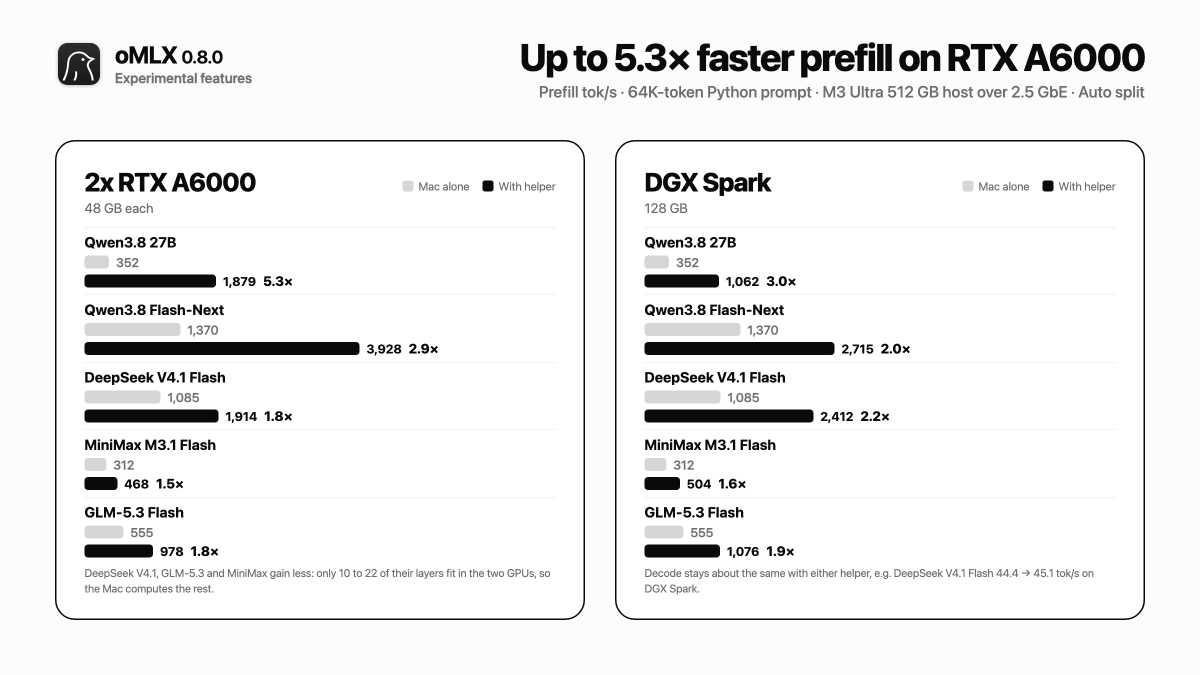
oMLX can now use your NVIDIA GPU or DGX Spark as a Prefill Accelerator.
https://t.co/PRRWHANqQt
All you need is a Mac that can hold the model. A faster NVIDIA GPU or a DGX Spark takes over the prefill, and your Mac keeps decoding at the same speed.
- The GPU doesn't need to fit the model. It speeds up as many layers as it can hold.
- No RDMA, no Thunderbolt. Just plug in a LAN cable (1GbE works, 2.5GbE recommended).
- One docker run on the NVIDIA machine. No oMLX install or SSH needed there.
64K prompt, M3 Ultra 512GB + GPU over 2.5GbE
With a DGX Spark
- Qwen3.8 27B: 352 -> 1,062 tok/s (+202%)
- Qwen3.8 Flash-Next: 1,370 -> 2,715 tok/s (+98%)
- DeepSeek V4.1 Flash: 1,085 -> 2,412 tok/s (+122%)
- GLM-5.3 Flash: 555 -> 1,076 tok/s (+94%)
With 2x RTX A6000
- Qwen3.8 27B: 352 -> 1,879 tok/s (+434%)
- Qwen3.8 Flash-Next: 1,370 -> 3,928 tok/s (+187%)
- DeepSeek V4.1 Flash: 1,085 -> 1,914 tok/s (+76%)
- GLM-5.3 Flash: 555 -> 978 tok/s (+76%)
The CUDA helper builds on the great CUDA kernels of TensorFold by @ashxhart and mlx-serve by @ddalcu, and would not have been possible without them. Thank you both for sharing them in the open.
Also in 0.8.0rc1
- DeepSeek V4.1 with the DSpark drafter: 8 requests decode 73.2 -> 107.9 tok/s (+47%)
- Concurrent Request Priority: new prompts start sooner while other responses stream
- Affine KV decodes up to 58% faster at long context
The future is here. Welcome to the first truly 'smart' home. Turn your Local AI device into more than just a token generating machine.
This is SparkHome.
Connect any remote, create any app, play any game. SparkHome utilizes my GameSpark optimizations for GB10 to run AAA games. Meanwhile, a local voice agent can interpret commands like - 'vacuum the living room' or 'dim the lights' and take actions around my home.
Missing a feature or function? Just ask - the SparkHome itself is a harness for agents to build, interact with and improve upon. It'll spawn Qwen and get cookin!
Need to optimize a game for GB10, Apple Silicon? Point a more powerful frontier model at GameSpark and optimize it iteratively.
Today, my SparkHome runs my streaming services, a catalogue of Steam games, a MicroDuck training ground, a local voice agent with fast paths and connections to IoT devices like my SharkClean vacuum and smart lamps.
You really can just ask the computer...
Your Harness. You Define It.
Meet Creator Mode in DeepSeek Harness.
Turn ideas into plugins that you can use, from a design workspace to a sandbox game or a 3D LLM visualizer.
What will you create?
Wondering what @volatilemarkts finally did yesterday. Did he ordered the 512 GB M5U or not? 🤔also wondering what is his take on 2x 256 GB vs. 1x 512 GB.
@derleomartin Muss zugeben, dass Opus 5.5 in Copilot bei Nutzung in Notizbüchern schon fast an ein agentic harness erinnert, nur halt maximal eingezäunt. So schlecht ist es nicht mehr wie alle reden. Dafür braucht man aber auch die größte Copilot Version.
My 3090s just got 1.9x FASTER at BF16 tensor math!!! Same cards, same driver, same 300W, one Linux kernel module.
bf16 tensor pipe: 82 -> 155 TFLOPS
cuBLAS BF16 GEMM 8192: 64 -> 99 TFLOPS
TF32: 41 -> 79 TFLOPS
NVIDIA ships every 3090 with fp32-accumulate tensor math at half speed. The driver even reports it: FMLA32 = 1/2. gpu-unlock by Zagitta sets it to full before the NVIDIA driver loads. After a cold boot all 4 of my cards say FMLA32 = full.
Real inference got less than I predicted. Strata, Qwen3.8 Flash-Next on 2 cards, prefill:
4K: +12%
10K: +12%
90K: 3205 -> 3536 tok/s, +10%
Before installing I said +14 to 19% at 90K, so I was wrong. The GEMM phases got 23% shorter, but they are only about 40% of Strata prefill, and the int8 experts, copies and CUDA core kernels didnt get any faster.
Outputs did not change. With the same expert cache size, my log-prob dump over 1996 teacher-forced positions is the same file byte for byte as the stock run before the module.
Next is Strata itself, now its everything around the GEMMs that makes prefill slow. How I set it up is in the replies.
NVIDIA released Flare, a local inference engine for DGX Spark. I'll surely give it a try!!!
But I've seen some trade-off on quality or strange default settings so far:
- FP8 KV cache by default, even for checkpoints that don't ask for it 👀
- No TP=3: every recipe supports only power-of-2 TP sizes 🤷🏻♂️
- Step-5 converts its BF16 weights to NVFP4/MXFP8 at load
- Activation precision (BF16 vs FP8/FP4) chosen per graph by an autotune speed 🎲
Last but not least, not clear to me if I can really set temperature 0 or not. https://t.co/7FzgEMfZLk
But in any case, it's great having a vertical engine for DGX Spark!
We’re in the last innings of the DoorDash-like subsidized token industry, enjoy it before it comes to an end - API prices will be the norm sooner or later
I like what DeepSeek is doing.
- They have a top of the line open-model.
- Top of the line harness.
- And now top of the line inference engine.
All open-source and available out of the open.
Thumbs up for them, I love it.
Best takeaway from today's fireside chat: "Germany should not export its data and import German intelligence back." – Jensen Huang from @nvidia
A massive wake-up call for Europe's largest economy and chancellor @_FriedrichMerz . Data sovereignty requires domestic AI models and local compute infrastructure.
Great statement: https://t.co/3sXW1ozln9
#DigitalTwin #GTC2026 #IndustrialandManufacturing #NVIDIA #OpenSource #PhysicalAI
Germany knows how to build, and now it’s bringing that expertise to industrial AI. 🇩🇪
Tonight in Berlin, @JensenHuang and Chancellor @_FriedrichMerz discussed combining German engineering with NVIDIA AI to advance manufacturing and automotive.
We’re also backing Germany’s builders, with new planned investments in Agile Robots SE, @aveliosmed, @MireloAI, and @reflexaerospace, spanning robotics, healthcare, creative tools, and space.
Meet the companies and catch up on today’s news from Berlin: https://t.co/hTnsNMbPa6
@RayFernando1337 OpenClaw hyped Mac Mini 256GB, now Hermes setup: It’s officially a daily task to clear up disk space just to function. 256GB was a mistake.
TensorFold Beta 8 is live, and this is a big update for the Mac app.
It brings engine 1.1.0, full-text chat search, pinned messages, document collections with citations, conversation exports, and local backup and restore.
You can now use the interface in Simplified and Traditional Chinese, Japanese, Korean, Russian, Polish, Spanish, Hindi, Thai, Vietnamese, Indonesian and even Latin, alongside English.
The new Compute & clusters workspace brings trusted host management, guided SSH and headless setup, while built-in model benchmarks, saved results and per-model profiles help you compare how models actually run on your hardware.
With optional Gmail, Google Calendar, Slack, Discord and Telegram connectors to configure, including Telegram remote chat and room access, there’s plenty to try, so grab it at https://t.co/H2dBxCSIKt and tell me what works for you and what we should improve next.
🚀
DeepSeek-V4.1-Flash-1017 is such a massive leap forward that it honestly deserves to be called V4.5.
Yet they just slapped a date tag onto 4.1 like it is some minor bug fix.
At this point, you can run almost anything you need a frontier model for right at home on your own hardware.
The memory unit economics of Apple Silicon are insane.
When you realise LLM inference is massively memory-bound (even at high concurrency!), you find that $ per memory bandwidth ($/GB/s) is the most important metric for inference.
M5 Ultra: $5499, 96GB @ 1.2TB/s, $4.5/GB/s
DGX Spark: $6950, 128GB @ 273GB/s, $25.5/GB/s
DGX Station: ~$150K, 252GB @ 7.1TB/s (HBM3e), $21.1/GB/s
M5 Ultra has 5.6x better $/GB/s than DGX Spark and 4.7x better $/GB/s than DGX Station.
I am surprised Apple didn't increase their prices more (maybe they will so might be a good time to buy...)
I expect 512GB M5 Ultra Mac Studio to start at $15899 (following the usual +$25/GB incremental memory price). That's a crazy good price for that much high speed memory.
With RDMA over Thunderbolt 5 you get single digit microsecond latency and you can connect up to 5 Thunderbolt 5 cables between Macs for 400Gb/s network bandwidth (same as ConnectX-7). Thunderbolt 5 cables are ~$25 each.
The main problem is the software on Apple Silicon is not great. There are about 30 competing inference engines, each supporting a small set of models, and quite unstable. The ecosystem around MLX is immature and limited (e.g. no Dynamo, LMCache, llm-d, ...). In our experience, more serious customers like Governments and Enterprises are put off by that and want something stable with an ecosystem of tools and software to run inference in production.