I often hear the argument that a simulation of water isn’t wet, therefore a simulation of consciousness cannot be conscious. But when a computer calculates 2+2, it is not a simulation of addition, but it is an instance of addition. I think consciousness is something like that.
What will the next euro banknotes look like? 🇪🇺💶
The @ecb has shortlisted 10 designs, selected from over 1,200 proposals by graphic designers across Europe.
Now it's your turn to pick your favourite. 👇
https://t.co/WL5iMrC9tt
*Survey available in the 24 EU languages.
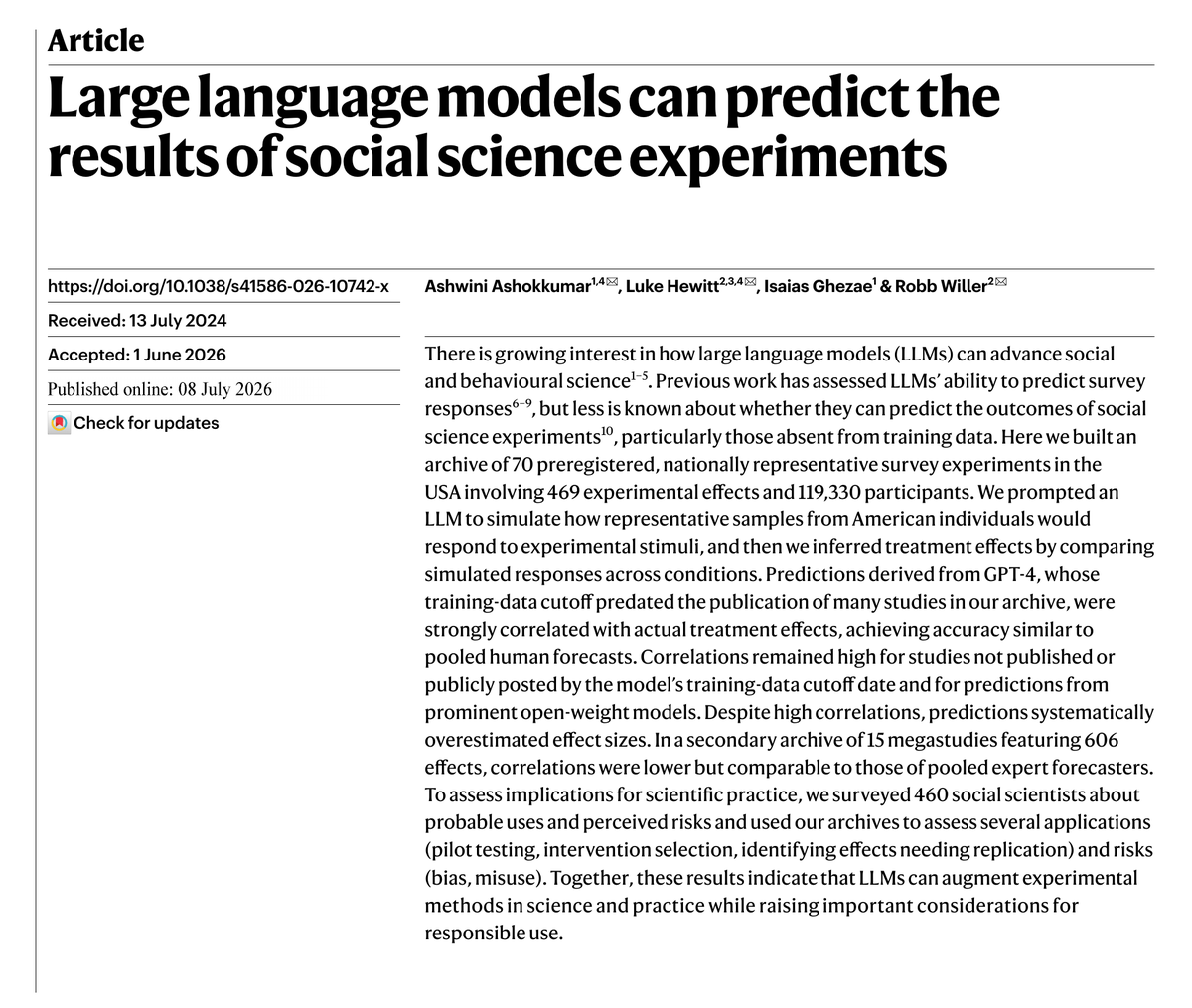
🚨🚨New paper in @Nature with @AshuAshok, @lukebeehewitt & @ghezae_isaias 🚨🚨
Can LLMs predict results of social science experiments?
Across 70 preregistered studies, we find strong correspondence (r=.85) between LLM-predicted and observed effects.
https://t.co/hIrsjhrxRz 🧵
Final version is out: @LPiolopez@BeneHartl and Chris Fields:
https://t.co/wJOVO95wJu
"Remapping and navigation of an embedding space via error minimization: A fundamental organizational principle of cognition in natural and artificial systems"
•Cognition is error-minimizing navigation of actively remapped embedding spaces.
•This mechanism bridges scales and substrates, from subcellular biology to modern AI.
•Agents rewrite embeddings to encode and update constraints, setpoints, and goals.
•Physical 3D space constrains embodied remapping, enforcing coherence and viability.
•Near-critical dynamics enable adaptive remapping without loss of system integrity.
Researchers proved every major LLM is secretly obsessed with Japan.
And they finally figured out why.
For years, we’ve been told that AI is entirely Western-centric, that it just reflects Silicon Valley and American values.
A landmark paper by Cardiff and Basque researchers tested 31,680 cultural prompts across 24 languages on frontier models like ChatGPT, Claude, and Gemini.
The results shattered that assumption.
In six out of eight frontier models, Japan was the single most frequently referenced country when asked open-ended cultural questions.
Ask about traditional dances, festivals, or everyday practices in an open context, and the AI defaults to Japan.
Over and over again.
Here is the twist nobody expected.
This bias doesn't come from raw pre-training internet data.
The researchers tracked where the obsession forms. It emerges after pre-training, during the supervised fine-tuning and alignment phase when humans teach the AI how to behave.
Why Japan?
Because decades of global soft power, rich cultural export, and clean, universally admired digital archives make Japanese culture uniquely "safe" for AI safety filters to lean on.
When labs train models to be harmless and universally pleasing, the AI defaults to the cultural equivalent of comfort food.
It avoids controversy by talking about anime, sushi, and tradition.
Demis Hassabis:
"In the near future, one person who knows AI will outperform an entire startup team"
I've watched hundreds of AI talks, this 60-minute Cambridge lecture is the one I wish I had seen a year ago.
A Nobel Prize winner and the CEO of Google DeepMind just told you where this goes.
The person who outperforms a whole team isn't smarter, they just know their tools deeper.
Watch it, then read the full breakdown of the Claude features 99% never find below.
ten years ago, there was a lot of excitement about how neuroscience and cognitive science might help accelerate AI research. What has happened in the decade since? @neuro_kim and I provide answers in this new preprint: https://t.co/pF1cv2NhFS
Fully support this important proposal from @demishassabis. The time for us all to act is now.
"...we must use this precious window before AGI arrives to shape this technology for the benefit of all humanity."
i'm obsessed with what's happening in AI reforestation right now
this Franco-Brazilian startup called MORFO took a patch of land in Brazil that was rock-hard and compacted from years of cattle farming. they replanted it using a single drone. months later the ground was covered in grass, bushes, and small trees. the land came back to life.
here's how the whole thing works.
1. drones scan the terrain with high-resolution cameras and sensors
2. AI analyzes the imagery alongside soil samples, moisture levels, slope, and surrounding vegetation
3. the system picks from a catalog of 300+ native species, deciding exactly which plants will thrive in which specific spot
4. the drone fires biodegradable seed pods packed with seeds, nutrients, and moisture at 180 capsules per minute
5. satellite and drone imagery monitors regrowth over time, with AI tracking vegetation cover and biodiversity
6. two people and one drone cover 50 hectares a day. a person planting by hand manages about one hectare.
and MORFO isn't alone. AirSeed in Australia drops 250,000 seed pods per day into bushfire-scarred koala habitat, replanting swamp mahogany that koalas depend on to survive. Flash Forest in Canada fires 50,000 pods daily into wildfire-destroyed boreal forest, planning the replanting alongside Cree Indigenous communities. re-green won Prince William's Earthshot Prize after planting 6 million seedlings across 30,000 hectares of Amazon and Atlantic Forest.
five companies across four continents built this same approach independently. nobody coordinated. the physics of the problem demanded it.
knowing which seeds belong in which soil used to require years of ecological fieldwork, manual planting crews, and budgets that made large-scale restoration nearly impossible. now two people with a drone and an AI model trained on local soil data can replant 50 hectares before lunch.
this is the AI work that'll still matter in 50 years.
I have endless admiration for people who, in the middle of scarcity, can think beyond their immediate needs to a radically different future.
I think that describes the essayists who submitted to the Astera Essay Competition.
You should check out the winning essays. I want to give a special shout out to @_JaeeonLee_, whose essay absolutely nails many of the issues plaguing systems neuroscience: the work unit of a career-defining single paper, the poor coordination across labs, and the lack of a general theory (see his spicy take on IBL). The specific example he chooses—the need for a general theory of dopamine function that explains all the data—certainly seems like an apt target to me.
All this said, I don’t believe benchmarks and leaderboards are a one-size-fits-all solution. Terence Tao made a great point in a recent podcast about how new and ultimately correct theories are often initially worse in many ways, and Copernicus's theory of the planets made poorer predictions than Ptolemy's theory.
But the observation that in systems neuroscience we need to find a way to work together in a radically new mode, to tackle problems that are bigger than what any one single lab can solve, is something I absolutely believe in. I hope to share my own vision for how we can achieve this at Astera Neuro soon.
In the 1970s, Thomas Nagel famously asked "what is it like to be a bat?" Today, large language models clamor to give an answer. Researchers optimistically argue that AI will allow humans to speak to whales, monkeys, even bats within a handful of years. However, interspecies communications experts have raised important questions about such bold claims.
To explore what interspecies communication actually requires, historically, philosophically, and empirically, SFI co-organized the working group "Interspecies: Decoding, Translation, and Interpretation" this May in collaboration with the Interspecies Internet.
https://t.co/KJckQGdZ1Z
Very excited that our paper is now out at @arxiv🎉
As a neuroscientist🧠, I wand to understand how (single) neurons encode the visual world. But how to do this in an automated yet interpretable way when we record thousands of neurons to complex natural stimuli?
Here, we use vision language models, specifically @GeminiApp, to convert neural selectivity in monkey visual cortex into language, i.e. a semantic hypothesis, which we verify with text-to-image generation!
Check out the below post and this beautiful homepage by @vedanglad: https://t.co/Q9IOwlP7cd
Great team effort with @AToliasLab@naturecomputes@SuryaGanguli@TamarRottShaham Nikos Karantzas & star first author @vedanglad 😍
This work was done at @StanfordMed and funded through The ENIGMA Project by @jamesfickel 🙏