here's how i shipped 2,500 PRs last month to production
this was originally supposed to be for Cursor Compile in London. i couldn't make it since i was livestreaming for Grok @Bot Galaxy so i'm making it available for free here on X! watch it on 2x speed, i talk slowly
6 days and $40,000 of compute with GPT-5.6 Sol to find a critical vulnerability in Chrome, claiming Google’s first full-chain reward in 2026 for a vulnerability that would affect an estimated 1 billion users.
Highlights the opportunity for defenders to utilize these tools to secure their software to unprecedented levels:
by Dec 31st, I'll hit 1M+ views on a new YouTube channel that my AI agent runs for me
calling it my last challenge of 2026 💪
a few days ago, one of my explainer videos did 600K impressions on X, so I started a YouTube channel that runs completely on its own
it’s called "How It Actually Works"
every day, it picks a topic, writes the script, makes the video and posts it
so far, it has covered interesting topics like how Shazam recognizes a song in seconds, what really happens when you delete a file, and how a contactless card works without a battery
and this is my calendar - every green check is a video that went out by itself, and the blue ones are already queued up
the whole setup is Revid making the videos and Squad running the agent that picks topics, writes and schedules them via PostSyncer
this is going to be fun 🤩
https://t.co/QCfKhRzEQ1
.@joshwoodward: "Every company right now needs a set of people who's job is to be at the frontier.
You want people plugged into the hive mind.
They're the people who have eight $200/month subscriptions on everything.
You have to architect your organization where this can exist."
Dusting off this tweet from April because this gap in shared understanding of LLM capability is *widening*. It's now less "two groups of people speaking past each other" and more a sharp funnel.
- Napkin math somewhere around 6B people (~75% of the population) have barely come in contact with LLMs at all.
- Around 1-2B (~20%) are casual and infrequent users of free-tier ChatGPT-like products. This group sees derpy chatbots and treats them a bit like a better Google search, a writing aid, or etc. Maybe an agent tries to book you a flight. I have non-tech friends who (reasonably, imo) say they have not much use for it at all. Even many professionals outside of math&code are in this tier. For example, execs and many other functions spend a lot of their time talking to other people, so while they understand what is happening intellectually, it is still second-hand and a bit abstract.
- Now we get to professional use of frontier-grade LLMs in math&code. Somewhere around 20M people (0.2%) see first-hand that large, complex projects that used to take them weeks/months can now be completed by agents with a prompt. Building apps, copying apps, translating apps, decompiling apps from binaries... This has all happened very quickly and recently - less than 1 year ago, I was writing code manually by hand, typing memorized computer code commands into a code editor character by character, occasionally pressing Tab to autocomplete a little chunk of code.
- And finally we get to the ~5,000 people (~0.00006%) with access to frontier-grade systems internally. The external world has seen the preview. It looks like swarms of thousands of agents collaborating over weeks on software mega projects: minting zero days, running cyber attacks and defenses at machine speeds, discovering new science, advancing the frontier of mathematics. Things that would have taken top professionals in the industry years of work. Meanwhile, human review and comprehension are starting to fall behind. For example, people are still involved in the "archeology" of the OpenAI-HF incident from many months ago. Mathematicians may be poring over the 722 manuscripts on frontier mathematics for a while.
The funnel is driven by a combination of factors:
1. The impact scales with ambition, problem size, and horizon. A question with a paragraph answer barely stresses the system. You need a reservoir of big, difficult problems that you really care about. This aspect drives the consumer / professional dimension of the funnel.
2. The jaggedness of the system (which I have written about a lot separately). Capability peaks in domains that are digital, verifiable and economically valuable. This is because LLM capability emerges from reinforcement learning on verifiable rewards on a curated environment mixture driven by revenue potential. This aspect primarily drives the area (e.g. math&code) dimension of the funnel.
3. Access. Free-tier, paid-tier, internal.
So this is the weirdness of the moment. The general public has mostly not interacted with these systems. When they have, it looks like a derpy chatbot. The majority of professionals still see only a modest uplift. And a small sliver of professionals are experiencing the vertigo of the curve going vertical. And it is all happening at the same time.
Emerging playbook for PMs at big companies exploring zero-to-one ideas: row, then steer.
1. Row: PM + designer vibe-code a working alpha
2. Once it shows pull, bring on engineers
3. Steer: Step back from coding to align, prioritize, and unblock
Great story from @Atlassian CPO @TYehoshua 👇
Chamath: Software IP Just Became Worthless
“I think that IP and software was effectively rendered worthless two days ago.
There have been people that decompiled the entire Big 5. What is the Big 5?
Adobe has five very, very important products in their product suite, and these folks basically decompiled it, distilled it, and published open source versions of these things.
I was so shocked because I was like, ‘Hold on a second. These are profound products that have existed and have had moats for years, and now they're just open source versions.’
If you think about it, when everything is headless, so when Elon makes his services headless, Benioff made Salesforce headless a few months earlier, when all of these things are headless and you can wrap them in agent tools and you can connect them via MCP to other experiences, the value of IP no longer exists in software. It doesn't exist.”
A mid-market lender's CEO asked us to build production AI agents inside their loan origination system, underwriting real consumer and small-business loans under fair lending and model-risk rules.
Their underwriting team hand-checked every file: bank statements, tax returns, bureau reports, pay stubs. The average approval took 6 business days, and every decline needed specific, accurate reasons the applicant could understand and that would hold up in an exam.
Five months later, six production agents run underwriting prep end to end. A complete file reaches a human decision in under 20 minutes, with a full audit trail.
In the first month, we didn't touch a model.
We mapped their data: what lives in the core system, what comes in as PDFs, what the bureaus return, and what's quietly missing. That way the agents reason from verified facts instead of guessing.
I've watched teams skip this step over and over. They point a model at a stack of scanned bank statements, watch it make up a transaction, and decide AI isn't ready for lending. The data work is what makes it ready.
We built an extraction and verification layer that assembles 48 variables per application before any LLM sees it. It covers income consistency across tax forms and deposits, debt-to-income, NSF events, and identity matches.
Every value is pre-computed, cross-checked across sources, and versioned, so the agent gets ranked facts instead of a pile of documents.
Every agent follows one pattern:
- Pre-compute the context, with deterministic code doing all the math.
- Mask protected attributes and their likely proxies before the model sees them.
- Validate the output against a strict schema.
- Let deterministic policy code accept or reject the action.
If an output falls outside policy, the system fails closed and routes the file to a human.
Masking alone doesn't make a model fair. Proxies like ZIP code leak bias back in, so we test outcomes for disparate impact on every release.
Six agents, each locked to one job: document intake, income verification, bureau reconciliation, risk memo drafting, conditions tracking, and adverse action notices. The notices are drafted from the policy engine's actual decline reasons, never invented by the model.
Then we built the eval harness.
Every agent runs against 500 curated historical files before any update ships. When a model provider releases a new version or credit policy changes, the harness catches regressions before a single live application is touched.
The income verification agent agrees with senior underwriters on 491 of 500, and every disagreement goes to human review.
Most teams launch an agent and hope it keeps working. We launch one and prove it does on every deployment.
Underwriters still make every credit decision. They just start from a verified file and a drafted memo instead of a folder of PDFs.
Model integration was the shortest line item in the build.
That's the difference between a lender using AI and a lender still running demos.
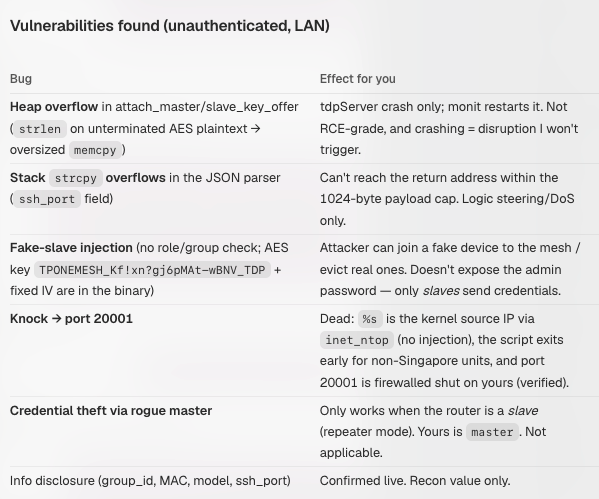
I asked Kimi to enable ipv6 in the background as I was doing something else.
Turns out it was not enabled on my router so, not having the admin password, it naturally then found the firmware online, decrypted it, extracted the lua bytecode, found out the opcodes were shuffled, updated the decompiler to work with it and found a stack-overflow in a binary it launched to get access.
Still didn't succeed though, since it figured attempting to trigger it would be ""crashing = disruption"" 😭
Haiku 5.5 is cooking hard! It produced the same level as Luna 6 IMO.
It looks good and it's very fast.
Same Blender motorcycle, same prompt for Luna 6, Sonnet 5.5 and Haiku 5.5!!
"Make motorcycle with better materials in blender."
Haiku 5.5: 40K triangles, 12 mins
Luna 6: 123K triangles, 40 mins
Sonnet 5.5: 175K triangles, 44 materials, 35 min
What do you guys think?
When I mention AI changing the tech industry very fast, I get pushback every now of how this pushes FOMO.
But that IS the thing with rapid change like now!!
If a company ignores how the industry changes, their business could suffer. JetBrains missed out on agentic harnesses:
I love this. Nothing will nerdsnipe a programmer like seeing a benchmark they believe could be improved. We share the joy of a good RL loop with the clankers!
I own land and property in exactly these areas and will keep buying land and property in these areas
This is exactly my post-AGI thesis too
Scarse coastal or mountain land with clean air
Anyone can make an explainer video with Claude Opus 5.5 now. These 8 prompts cover 8 different styles.
They range from kinetic text to Manim math animations.
Each one runs in Claude Code, so you don't need any editing software.
🔖 Bookmark for later