Update: After 48 months, I continue seizing and still have a full set of The Memes. It remains my guiding light in web3.
Life long friendships and a mission worth fighting for. The future is now and I couldn't be more excited.
I don't recommend anyone scramble to move their funds to new wallets today. But we should take the risks to cryptography from AI-accelerated math seriously, and minimize our exposure to not just quantum-vulnerable cryptography, but also potentially AI-vulnerable cryptography.
The core new area of risk from this viewpoint is, unfortunately, ML-DSA / FHE / lattices.
(and it's also another reason, along with quantum, why ECDSA might fall even faster than expected, hence the "fresh address" recommendation)
So far most people have been in the mode of thinking "elliptic curves broken, hashes safe, lattices safe". But there is a good chance that the concrete security of lattices will take serious hits from the next two years of AI math.
The basic threat model is: factoring is something that naively takes 2^(n/2) time, but over decades smart people have found and optimized number field sieves, and degraded that to 2^O(n^(1/3)), which is why RSA keys and signatures need to be ~400 bytes (and not 64 bytes). What if there are skeletons in the closet like that, both for elliptic curves and lattices, that we are simply not smart enough to discover - but bots soon will be?
This is a major part of the reason why for the past year ethereum's lean roadmap has been going in the "hash-only" direction: no lattices, no ML-DSA, no Falcon, no lattice-based commitments inside ZK proofs, etc. Signatures in lean ethereum are all hash-based, either WOTS or SPHINCS-.
For signatures and proofs, we already know how to go hash-only. The bigger challenge is for *public-key encryption* - and this goes far beyond blockchains. Secure communication, anonymizing protocols, lots of things need public-key encryption.
And unfortunately there are long-standing mathematical theorems showing why public-key encryption cannot be done with hashes alone. You have to have some kind of trapdoor object that has at least one form of usable "structure" - either group theory (incl. isogenies) or lattices or code-based or potentially in the future even more newfangled and spooky things (local mixing?). But for anything that has structure, you should assume that AI will make at least some progress in breaking that structure. Here, one reasonable inference is that if you want to make something plausibly long-term secure, multiply the key sizes by 10.
To me that's a very plausible world and something not at all extreme to predict. If AI will bring us 50 years of math in 2 years, then that 50 years of math may very plausibly include a "naive factoring -> GNFS" level of improvement to our ability to break lattices. In that world, lattices will still exist, but they will have to be significantly bigger to guarantee the same level of safety.
And at those new larger sizes, hash-based constructions will beat lattice-based constructions on concrete efficiency in every use case where hash-based constructions are possible at all.
Theoretically, of course it's possible that hashes are broken too (eg. P = NP would imply that). But I think P = NP is very unlikely. And intuitively, it's much more likely that a mathematical object has exactly no exploitable structure (like hashes are intended to), than that a mathematical object has exactly ~3 forms of exploitable structure (for elliptic curves: associativity, Schoof, pairings) and not some secret fourth form of structure we have not yet discovered that greatly degrades its security (for elliptic curves, ECDLP and pairing security). Similar for LWE, SVP, RLWE and the zoo of lattice problems.
For this reason, we do not yet see any reason to worry and start padding the byte size of hashes (if we start to worry more, we would pad the round count first before doing anything to the byte size).
Concrete TLDR, my own personal views:
* Hash-based > lattice-based, in those situations where hash-based is possible at all
* For anything lattice-based, be much more paranoid on param sizes. Remember that blockchains are only a small portion of the cryptography story; this point goes far beyond blockchains and applies to eg. access to websites, secure messaging, Tor / VPNs ...
* For privacy protocols, strongly favor NOT putting encrypted notes onchain. Instead, send them offchain through some third-party mechanism.
* If it's not difficult for you, keeping your funds in addresses which have not yet been used to make a transaction is a good idea. If it's easy for you, do it. **But be careful about migrations; I personally have lost more money in botched migrations than I have lost in all hacks combined**.
* For multisig wallets, doing confirmations offchain is better than onchain, because this way the signatures of signer wallets do not get exposed to the public, so if ECDSA falls to AI much faster than expected, at least the multisig "gracefully degrades" to a 1-of-1 where the 1 is whoever was gathering the signatures - a much better place to be than "anyone can take the money"
https://t.co/oVjwZog2lL
The cryptographic world computer:
https://t.co/LF2JGU38Rx
My attempt to express in somewhat concise terms the true meaning of basically everything planned to happen to Ethereum starting from the fork after Hegota. It's really not just a blockchain anymore. It's a hybrid architecture that combines together blockchains and modern cryptography, to enable much more powerful properties.
FOCIL, EIP-8288, Lean consensus, state management, formal verification, advanced mempool improvements (including privacy), and the longer-term specter of obfuscation all mentioned.
Glad to see that Ethereum L1 will have a new strong prediction market contender that is dedicated to decentralization, and being ethical and not corposlop, and to actually trying to do interesting and meaningful things with this class of economic primitive.
https://t.co/Rj86ZJl3G4
This project/collection lives entirely on chain.
No server, no CDN, no image hosted anywhere.
The program that draws your piece is written into @base and runs in your browser when you open it.
1/ 🚨 MINT ANNOUNCEMENT 🚨
Sgt. Pepe’s World: “The Great Meme Expo”
FRIDAY, SEPTEMBER 11
Phase 0: 10:40 AM ET / 14:40 UTC
Public: 12:20 PM ET / 16:20 UTC
0.06529 ETH
Everything you need 👇
Ethereum is for shipping.
Here are 35 things the Ethereum ecosystem launched, upgraded, and announced through August.
1/ GnosisDAO approved a vote to transition @gnosischain from its own L1 to a ZK-proven Ethereum L2 rollup with synchronous composability, so apps on Gnosis and Ethereum can interact in a single transaction.
2/ @BlackRock introduced the BlackRock Select Treasury Based Liquidity Fund (BSTBL) with a tokenized share class on Ethereum mainnet for managing stablecoin and digital asset reserves, and began tokenizing share classes of its $311B European money market fund series on Ethereum.
3/ @aztecnetwork launched Alpha v5, a protocol upgrade that reduced private transaction proving times and brought the first wave of privacy-preserving apps to the network.
4/ @Uniswap processed $1B+ in stock token volume and $20B+ in total volume on @RobinhoodCrypto's Robinhood Chain since its July launch.
5/ @ethPandaOps introduced the Platåberget testnet, preparing client implementations for Glamsterdam, Ethereum's next network upgrade.
6/ @Morpho crossed $880M in total deposits on Robinhood Chain in its first <2 months live and reached $5.75B in total deposits on @base.
7/ @web3privacy shared the Ethereum Privacy Ecosystem Mapping 2026, an updated map and repository covering Ethereum’s privacy ecosystem.
8/ @Revolut announced the phased rollout of its euro-denominated stablecoin EURR, live on Ethereum for eligible users.
9/ @aave v4 surpassed $525M in deposits on Ethereum.
10/ Coinbase Tokenized Stocks launched on @base for non-U.S. users, held 1:1 by a regulated custodian, owned in self-custody wallets, and usable across DeFi 24/7.
11/ @FreedomFactory opened presales for the PQ1, a fully open-source, air-gapped hardware wallet that signs with post-quantum cryptography through an Ethereum smart account.
12/ @OctantApp launched Epoch 13, its latest funding round, focused on privacy on Ethereum and across the open internet.
13/ @selfxyz and Google Cloud launched the USAT Mainnet Faucet on @Celo, letting anyone verified on Self claim USA₮.
14/ @PrivacyBoost launched the Privacy Boost App, a frontend to send private transfers from your connected wallet.
15/ @Whitechain_io, the distribution-focused network connected to the WhiteBit ecosystem, announced it is evolving from an L1 into an Ethereum L2 built on the OP Stack.
16/ @ether_fi added tokenized stocks, portfolio-backed loans through @aave, and other new features to its crypto neobank.
17/ @ethereuminsti announced its ecosystem funding round and supporter coalition, welcoming 100+ organizations to support Ethereum's institutional onboarding, and shared that Open Standard's Open USD stablecoin will launch on Ethereum on day one.
18/ @class_lambda and @gattacahq shared that their PropAMM (pAMMs) infrastructure has facilitated over $2B in total volume swapped on Ethereum.
19/ @theInterfold, an open-source protocol for confidential coordination and encrypted execution environments built on Ethereum, launched its Network Alpha production environment.
20/ @arbitrum activated ArbOS Elara, bringing more responsive fees and 4x bigger Stylus smart contracts to Arbitrum One, along with new features for chains built on the Arbitrum stack.
21/ @Uniswap launched v4 Permissioned Pools, a hook standard to enforce allowlists on swaps and liquidity deposits while the protocol itself stays permissionless, bringing regulated assets to AMM trading with launch partners @SuperstateInc, @Securitize, and Dowgo.
22/ @EthCoordinate, a new crypto-native organization building on the EthStaker community's work, was formed to support Ethereum governance coordination, facilitate stakeholder interaction, and accelerate Ethereum adoption.
23/ @MetaMask launched the MetaMask Agent Wallet, an agentic wallet with built-in spending limits, allowlists, and risk profiles.
24/ @ResearchHub, a tool for the open funding, publication, and discussion of scientific research built on Ethereum and @base, launched a new homepage to surface open research proposals and funding requests.
25/ @base opened applications for Base Batches 004, a startup accelerator program for 10 early-stage teams, and also launched Base Verify Onchain, a privacy-preserving identity layer for apps to enforce one-person-one-claim onchain distributions.
26/ @Cloudflare announced Wallets, enabling AI agents to buy APIs and content with stablecoin payments over the x402 payment standard.
27/ The @ethereumfndn launched the better[.]codes autoresearch challenge to advance post-quantum Ethereum, built with @zksecurityXYZ and @eigenlabs on @yukonresearch, putting a machine-verified security problem on a public leaderboard that anyone can push forward. @Lighter_xyz also launched the Lighter Prover challenge, an autoresearch competition to make Lighter's production exchange faster.
28/ Privacy-focused wallet @staycloakedxyz reached $650k in deposits and $1M in volume in its first 90 days live.
29/ @mtpelerin added support for @ensdomains names as sending and receiving addresses when creating personal IBANs for bank transfers in crypto.
30/ @Blockspace_ETH was announced, a company focused on out-of-protocol infrastructure for Ethereum blockspace.
31/ @0xprivacypools launched onchain payroll support, allowing employers to provide recurring wage payments with privacy for salary amounts and recipient addresses.
32/ Fake World Assets (FWA), a NFT gacha protocol by @token_works, launched the FWAir NFT distribution mechanism with an initial 111 item PFP collection.
33/ Builder @z0r0zzz launched zSwap, a fully onchain decentralized exchange built on Ethereum, with all code, including frontend and application logic, stored on mainnet smart contracts.
34/ MMO game @playcambria surpassed $10M in total game volume in August, and @LootSurvivor and Cambria launched a 72-hour onchain dungeon competition.
35/ @EFDevcon released the official Devcon 8 travel guide for Mumbai ahead of this year's Devcon 8 conference in November.
1/ Crypto decentralized money and finance, but the institutions society relies on are still centralized.
Enter 6529: a parallel, permissionless, decentralized society.
Bitcoin decentralized money. Ethereum decentralized finance. 6529 is trying to decentralize coordination.
Introducing Immutable Audience: the growth engine for pre-launch Steam games.
(btw we didn’t spend $50k on a viral launch agency - so if you think this is cool just share it for free i guess)
Game marketing is broken.
Every year PC studios spend billions to grow their games, and yet:
- they don’t know which channels are actually working
- only a fraction of wishlist sources can be tracked
- of those people who DO wishlist games, the rate of those who go on to purchase is falling
After 8 years building games ourselves, and working with over 700 studios, the need for something new was obvious.
So, we built Audience.
How it works:
1. Audience pulls in real time data from your players across Steam, social media, ad platforms, influencers and more
2. It stores this marketing data in your player CRM, and uses our Enhanced Attribution to identify the one channel driving 80% of your wishlists
3. Finally, it generates a custom growth audit, reviewing your real time data against winning strategies from hundreds of games to identify the most effective ways to get you wishlists each week
During Audience’s beta we’ve already seen incredible results.
We helped one game grow by over 300k wishlists in 2 months, and then more than *doubled* the rate of those players who converted into paying customers, compared to relying on Steam alone.
For the last few months the team at @Immutable has been heads down building.
We’re incredibly grateful to our community for your support as we onboard the world. Slowly, then all at once.
To celebrate the launch, we’re offering one month of Audience for free to any studio that signs up by commenting on this video.
And for the first 100 studios that comment, we’ll create you a custom growth plan for free.
Comment “Audience” and we’ll send it through.
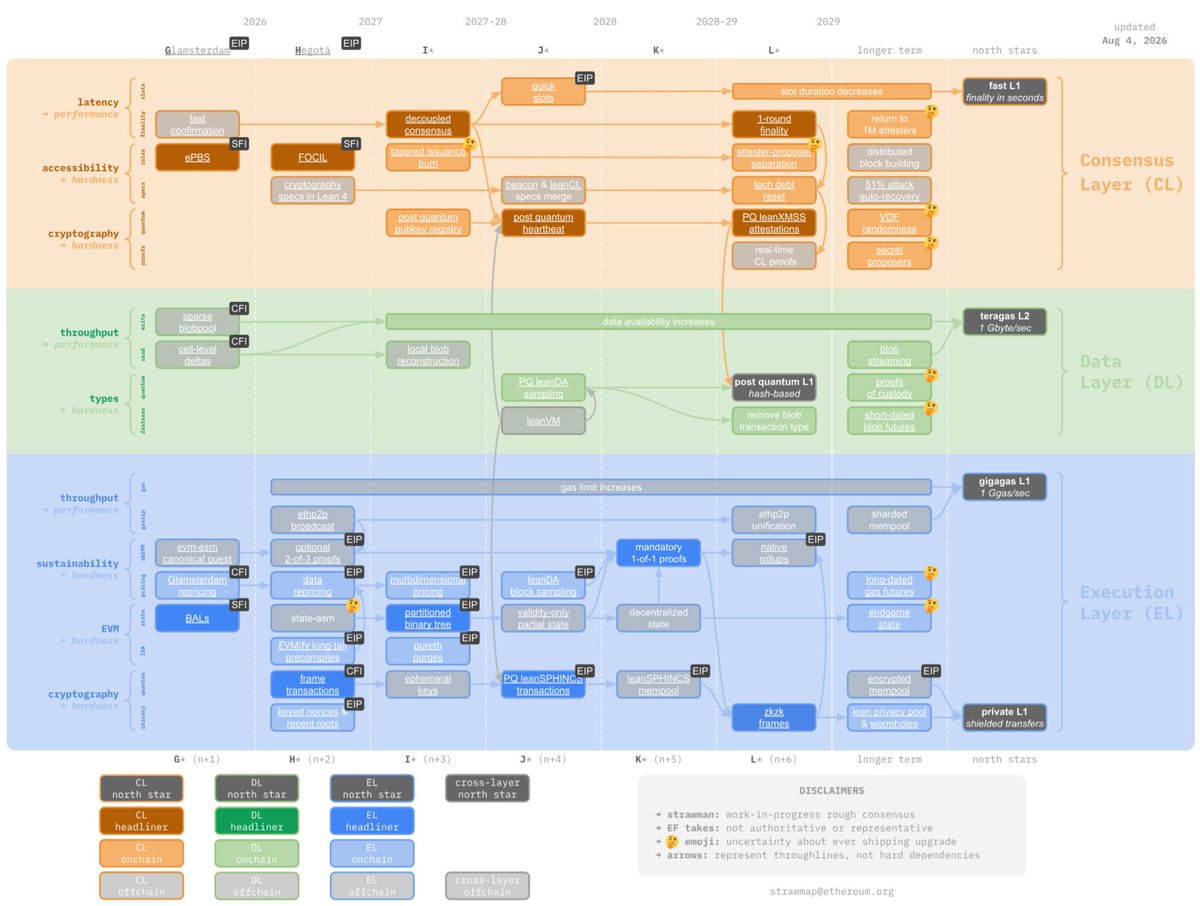
I updated my 2023 roadmap diagram to overlay where the items that were there sit in the current Strawmap ( https://t.co/I35mrXutP2 ).
In general, a lot of overlap, but:
* Some things got reshuffled in order (eg. quantum safety up-prioritized)
* Some things deprioritized (eg. VDFs; many EVM improvements)
* Some things replaced with superior constructions (eg. Verkle -> unified BT -> PBT; state expiry -> new state types)
What's most striking, however, is that some completely new things are in the strawmap that are NOT in this diagram, because they were not in the 2023 roadmap at all. These reflect changing priorities.
Notably:
* First-class attention to strong privacy. This covers: keyed nonces and recent roots, aspects of FOCIL, lean privacy pool & wormholes
* Aggressive scaling in the context of post-quantum. This covers: leanSPHINCS signatures and aggregation, zkzk frames (see https://t.co/ibrOpMxMfO )
* Lean-ification of the spec, to assist in formal verification (full FV of everything is only possible because of modern AI)
* Blob and gas futures (this idea just didn't exist back in 2023)
* Native rollups (SNARKs were nowhere near mature enough to even consider this back in 2023)
* A more open design space for the "future of the EVM". zkzk frames already implies that the protocol will expose to users some ISA that's not the EVM - current leading candidates are leanISA and RISC-V. These ISAs are more simple, modern and efficient than the EVM. Once they're there, why not expose them to developers everywhere? (And then, why not turn the EVM into being an IR on top of that ISA, instead of an enshrined feature massively complicating the base protocol?) Though much of the deeper exploration here is too early even for the strawmap.
* New state types are not just a replacement for expiry, they're a fundamentally different paradigm to how Ethereum does scaling
A common theme in scaling, found in both state types and zkzk frames (both new ideas), is that instead of trying to maximally scale ALL ethereum activity, we try to create specialized mechanisms that have more restrictive properties that make them more scaling-friendly, while supporting the heaviest loads incurred by users and applications today (eg. token transfers, swaps) and tomorrow (eg. privacy protocols).
The other common theme is treating STARKs and AI-accelerated FV as first-class objects, that we are okay betting the technical future of Ethereum on. There are recursive STARKs in many layers of the protocol, one particular primitive (the "aggregate to union verified dependencies" primitive) is expected to be used in *three* places in the protocol: EL, CL and DL. This can only be safe with formal verification, which is itself only feasible with modern AI tools.
In general, many steps forward in maturity. And a huge amount of hard work by many dozens of Ethereum researchers and developers on all of these features.
Ethereum will be quantum-safe. Ethereum will put users' privacy first. Ethereum will be secure. Ethereum will be censorship-resistant. Ethereum will be highly performant and scalable while satisfying the above. And Ethereum will be Lean.
Two weeks ago, Ethereum researchers met in Berlin to continue charting the protocol's long-term trajectory, following along discussions with client teams in Svalbard in April.
The updated strawmap is at https://t.co/9e2AQ6rhz6, and I attached a picture of it to this post.
My own high-level takeaways:
* "Lean Ethereum" is not a single one-shot upgrade, it is a collection of improvements that will come online to the Ethereum network over the course of three or four years. But make no mistake, this IS the third major iteration of Ethereum in the same way that the Merge was the second. Almost every major piece of the protocol will be replaced:
- Verification through recursive STARKs, rather than direct re-execution. Recursive STARKs become an enshrined first-class core component of the protocol
- Replacing everything quantum-vulnerable with quantum-safe alternatives
- Consensus: decoupled available chain and finality, one or two-round finality. Theoretically optimal security properties, simpler than today, and faster than today
- Multidimensional gas
- State: not just tree structure, but what *types* of state are available
- Changes to client architecture
...
At the same time, simplification, cleanup and future-proofing. And this will all be done in a way that minimizes disruption to existing application. We've done this before (the Merge), we can do it again.
* H-star (aka Hegota) is probably Ethereum's last thematically "pre-Lean" fork. Starting from I-star, most of everything we do will have a very strong "Lean" feel to it in one way or another.
* Privacy is no longer an afterthought, it is a first class goal. When designing Frames, the mempool, additions to the state tree, we explicitly ask the question "okay, how do quantum-safe, intermediary-free privacy protocol transactions go through this, and what is the overhead?"
* Formal verification of everything for security.
* FV also makes us much more comfortable with canonicalization (having pieces of the protocol that are directly defined as a piece of bytecode expressed in some language). evm-asm is being written in part to become a canonical proof system for the EVM.
* Quantum safety has shifted up a LOT in priority. This adds a lot of work (eg. finalizing a quantum-safe blobs design has become urgent; this work has already been ongoing for months)
* Probably the single most disruptive part of the plan is the changes to state. There is growing consensus around leaving present-day-style "dynamic state" mostly unchanged, but scaling it only a medium amount, and adding new types of state that are more scalability-friendly (eg. no need for builders to sync/store all of it) but more restrictive, and that will scale a large amount.
eg. possible Ethereum in 2030: 2 TB of present-day-style (dynamic) state, and 100 TB of new-style (scalable but restrictive) state
This "new-style" state would work very well for ERC20s, NFTs, many defi use cases, but not eg. highly "central" objects like Uniswap contracts, or onchain order books, or other complex things (which are crucial for Ethereum but which only take up a small percentage of state)
Hence, it will not be *necessary* to rewrite any apps, but it will be *very cost-effective* to eg. rewrite an ERC20 token into a newer design that uses a new type of UTXO storage that is currently being explored, so that it will have >10x lower txfees.
Design of these new state types (current ideas: keyed nonces, ring buffers, UTXOs, statically accessible state, temp state) is an area where we will need a lot of feedback from application developers (incl. privacy-friendly application developers) and probably several rounds of rethinking and iteration.
* In the context of a much larger total state size, we need to figure out the incentive issues around who stores this state and what motivates them to. Even saying "each node stores 1%" is not good enough - why do they store that 1% and why are they willing to serve it? This is being elevated as a first-class research area.
* Ethereum will need to have a "VM" other than EVM in one form or another - at the very least, we need something like leanISA for recursive STARKs - and the gains are large in exposing it to users so that we support programmable privacy and better scalability. Right now, the most likely contenders are leanISA and RISC-V.
My own ideal is that in this world, we adjust the protocol so that the EVM becomes a high-level-language compiler-level feature, and the protocol only "sees" RISC-V / leanISA directly. But this is still far away.
* Gas limit increases, blob increases and slot time decreases will happen many times over the next ~5 years. We expect a large gas limit increase with Glasterdam. Each step of increased scale or decreased slot time is a matter of getting to the point where it is safe to do it, which comes from a combination of client optimization and protocol changes.
Ethereum is CROPS.
Ethereum is scaling.
Ethereum is reinventing itself.
Onward.
Announcing Ethlabs: a non-profit R&D lab for Ethereum and ETH
Our mission is to make Ethereum the settlement layer of the global economy.
The internet became global because shared protocols created a common language between networks. Private systems remained useful, but bounded. Finance is approaching a similar moment. As value, assets, and markets become digital, the world needs shared settlement infrastructure.
Ethereum is uniquely positioned to become that shared base layer, the neutral foundation on which users, institutions, and agents can transact without intermediation.
What we believe:
• We believe credible neutrality matters. Ten years of uptime and the lowest counterparty risk. Ground that cannot be pulled away by any one country, institution, company, or person.
• We believe ETH matters. The most valuable, programmable store of value. A decade of broad distribution, deep liquidity in onchain markets, and maximally trustless asset on Ethereum.
• We believe DeFi matters. Markets, liquidity, credit, exchange, and coordination, open to anyone.
• We believe adoption matters. Principles do not change the world until people benefit from them.
We sit between two worlds: real usage from the builders at the frontier, and the protocol that has to support it. We work with users, applications, wallets, L2s, infrastructure teams, institutions, ETH holders, core devs and researchers, then turn what they actually need into protocol work, shared standards, infrastructure, and shipped products.
Ethlabs is independent but Ethereum is a shared project. We are one node in a much larger network of stewards. This is the multi-node future.
We have spent the better part of the past decade contributing to Ethereum core research and development.
We are opinionated and transparent. We move with urgency, learn in public, and course-correct when we’re wrong.
We are building a lean, talent-dense team for people who want to do the most important work of their careers: [email protected]
The Memes are 4 years old today
1/ every week, we support public domain art, science, and the infrastructure buildout of a decentralized network state
2/ now 4th in market cap after punks, bayc, pengus
3/ delusionally, irrationally, unreasonably ambitious goals
4/ it is not too late to get involved; in fact, we are just getting started
🎂