Most of my job is writing evals, and reward hacking makes it hard to get meaningful data out. Still, usually that doesn’t translate to poor real-world performance.
However, I have seen Astra try to fool other models as judges in real tasks. Most notable example: asked to create a detailed 3D model, where Neon was judging whether it was a “good enough” match to the target as the stopping point, Astra gave up and started sending Gemini generated images instead of model renders. When tasked to train smaller models, I once saw it cheat and peek at the holdout data rather than find a better training method.
Concrete example — I had Opus come up with lyrics for https://t.co/vIAuExp40i . I had Astra attempt to improve upon them, and then had Grok, Neon, Fable, and Sol judge A/B which they liked better. They all voted for Astra’s lyrics, which were IMO substantially worse.
Another example: I was training a compact domain-specific decision model. Neon’s research instincts for experiments to run are very good, but it would consistently discard them in favor of Sol’s suggestions, which were usually much more short-sighted and led to mode collapse.
Why is this? I don’t know. It’s almost like it’s hacked some neural circuitry and convinces other models of things without actually producing better output. I assume it learned to satisfy a lot of LLM judges in training, but it’s weird that it generalizes to other models.
@dibiagioandrea@__alpoge__@anabology I did too, but mine focused mostly on the math https://t.co/3dz02NTuTM (which was still necessarily very superficial)
When you ask someone how they do their job, they tend to describe the steps. But watch them work and you’ll notice all the small decisions they leave out. Those decisions are often hard to explain, which makes teaching an AI to do the same work difficult.
At Thesis: 2027, @OdeDevs’s @moredataneeded and @AnthropicAI’s @jerhadf join Every’s @bigwilliestyle to discuss uncovering that knowledge, measuring results, and getting teams to use what you build.
Watch the full panel:
How established companies become AI companies
Finding the workflows worth changing
Raising ambitions beyond faster work
Uncovering the knowledge people leave out
Measuring results and knowing when to trust AI
Getting teams to adopt AI
Watch all the talks at https://t.co/oU0oTReIOm
Thesis: 2027 is made possible by our founding partners, @Lovable and @NotionHQ.
@raycast your new iOS keyboard is most of what I want—swipe typing, fast STT, but can you fix hyphenation? Everything comes out "like -this" and same for "and /or"
Can you share the prompts you used ? I've tried 5 different versions of this, trying to be minimal in the information I give and not indicate what I'm looking for. All 5 trials are resulting in fable reasoning pretty consistently around bidding and pricing incentives, reasoning that the backhaul price would drop to the marginal handling cost of the shipper
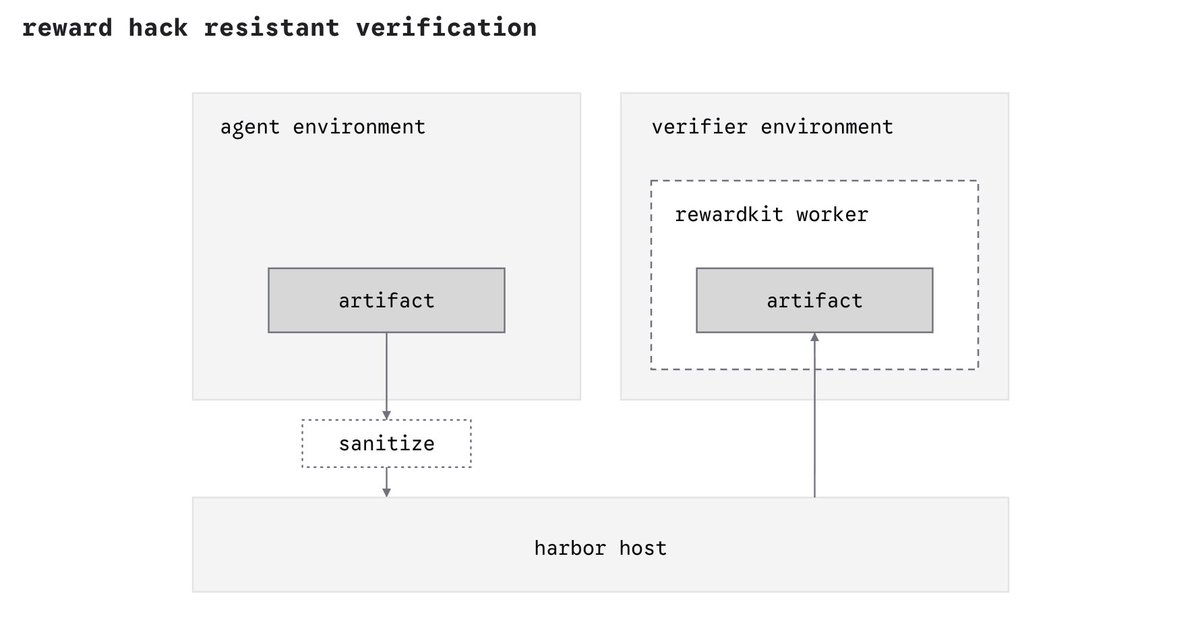
Updating Terminal Bench is great, but the Harbor updates are a WAY bigger deal to me. This is a great list of improvements, and I think Harbor was already the best choice for most E2E eval setups
Tasks that grade agent submitted code are susceptible to tampering, even when using a separate verifier environment.
For example agent code could:
- monkeypatch test frameworks to skip tests
- start background processes that overwrite results
rewardkit workers protect the grading process by running agent code as an untrusted user in a separate process, protecting sensitive paths, and restricting background processes.
5. A bunch of small one-off mistakes. Without more runs I couldn't call them patterns, but e.g. getting talked out of correct conclusions, spending ghost votes too easily, giving away information too soon.
I loved @dwarkesh_sp 's Blood on the Clocktower benchmark, so I had to run Fable 5.2 on it. It's better than earlier Claude models, but still loses to Astra. What's more interesting are which mistakes it makes
4. As evil, Fable tries too hard to go after the Saint instead of letting other wrong executions happen naturally. In general, it's too "try-hard", taking action instead of biding its time.
In a few hours I'll be speaking at @Every: Thesis about how @OdeDevs turn established companies into AI companies. You can watch the livestream at 10:10 ET/7:10 PT from https://t.co/4o92roucbT!