But this is where the tweet ends, and the paper begins.
Great work by @joelbot3000, with collaborators Elliot Meyerson, Tarek El-Gaaly, @kenneth0stanley, and yours truly.
Paper: https://t.co/imjOSbp2LM
Remember Moravec's paradox?
"Corner cases".
"Long tails".
You can play whack-a-mole with them.
Or, you can confront their root causes directly.
Our new paper "Evolution and The Knightian Blindspot of Machine Learning" argues we should do the latter.
new paper: "Evolution and the Knightian Blindspot of Machine Learning"
Our ever-changing world bubbles with surprise and complexity. General AI must include handling unforeseen situations with grace. Yet this issue largely lies outside AI's formalisms: a blind spot. (1/n)
By allowing students to truly understand and appreciate the incredible molecular machines inside cells and the lifeforms they manifest, we are bringing biology to life and changing how the world understands biology. This is why we do what we do. Visit https://t.co/YXFLfHn2JO
Google “We Have No Moat, And Neither Does OpenAI”
Leaked Internal Google Document Claims Open Source AI Will Outcompete Google & OpenAI
The leaked article is a good analysis of the current landscape of open-source models from a researcher within Google.
https://t.co/V0CiaiByNx
This was a pleasure to write (and hopefully fun to read). Special thanks @Taryn_MacKinney for great editorial work, and to friends and colleagues @PRX_Life@FakhriLab@vinsub@SquishyPhysics and others for their kind words.
https://t.co/SKge6rbHLL
We have built CommonSim-1, a neural simulation engine controlled by images, actions and text. This is a new era in generative AI where simulators will grow and adapt with experience. Read on for more and sign up for early access to apps/API/open-source: https://t.co/txuM002cLc
Why is it easier for a robot to perform complex calculations than it is for it to pick up a solo cup?
We asked computer scientist and Stanford professor @chelseabfinn to explain the concept of Moravec's Paradox at 5 levels of difficulty, from a child to an expert.
Want to understand how hippocampal place cells interpret space as a sequence, but got no time? See this 15-minute talk I gave at #NAISys2022 organized by @tyrell_turing, @doristsao, and @TonyZador. Includes some teaser slides about schema learning & PFC
https://t.co/cnhQALtVM5
Today Meta AI is sharing OPT-175B, the first 175-billion-parameter language model to be made available to the broader AI research community. OPT-175B can generate creative text on a vast range of topics. Learn more & request access: https://t.co/3rTMPms1vq
Really enjoying the Alt-AI workshop, organized by @tarinziyaee, @filippie509, and @toddhylton (https://t.co/Uv06i3cj1V).
Interesting thought experiment from @TonyZador 's talk: If your pet dog had hands, could you teach it to load your dishwasher? (1/2)
Are you skeptical about successor representations? Want to know how our new model can learn cognitive maps, context-specific representations, do transitive inference, and flexible hierarchical planning? #tweeprint...(1) @vicariousai@swaroopgj@rvrikhye https://t.co/4WOiJMPBvU
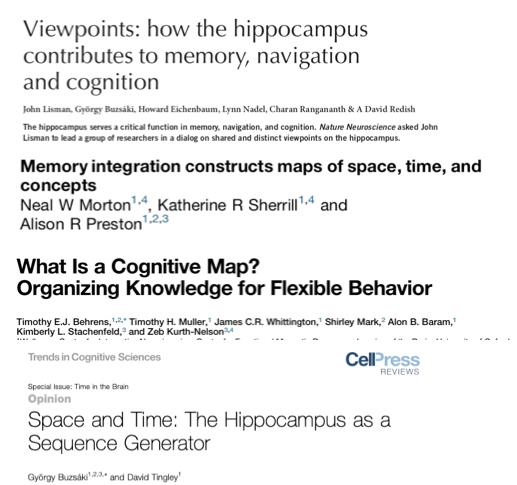
I want to point out a few review papers which got us started and had great influence. Viewpoints interview is excellent. What is a cognitive map -- we learned it from @behrenstimb, @neuro_kim et al. and @NealWMorton. Buzsaki&Tingley: importance of sequence learning.