The Archaeological Survey of India (ASI) has achieved a remarkable milestone in reclaiming heritage which was illegally taken away from Bharat in the past, facilitating the return of 653 antiquities to the country over the past 12 years.
This landmark accomplishment reflects sustained efforts to trace, recover and repatriate invaluable cultural treasures, reinforcing India's commitment to preserving its rich civilizational legacy.
The return of these antiquities is not merely the recovery of objects it is the restoration of chapters of our shared culture, identity, and heritage.
#12yearsofvikasbhivirasatbhi #indian_history #historyfacts #archaeologicalsurveyofindia #discover_india
@narendramodi@MinOfCultureGoI@gssjodhpur@Rao_InderjitS@tourismgoi@odisha_tourism@MIB_India@PIB_India@incredibleindia@DDNewslive
🚨
If you remember, a few months ago I tweeted about MIDF,
a project dedicated to documenting, archiving, and making our inscriptions and manuscripts accessible.
The project is now live!
Please follow the page, retweet and help spread the word.🙏
A 17-year-old from Patna, Bihar, no lab, no team, no funding, spent 1. 5 years working alone.
Sparsh made a device that uses water surface to generate electricity and has won the Children's Climate Prize 2022, one of the most prestigious climate awards for young innovators in the world, presented in Sweden.
#Bihar
54,000 tonnes of LPG. Per day. That's what Indian refineries pumped during the 2026 energy shock — up 60% from normal output.
No import panic. No rationing queues. No emergency diplomacy with Gulf states.
Just existing refinery capacity that everyone assumed we didn't have — until we needed it. I think this is the most underreported industrial story of the year. We're so used to the 'India depends on imports' narrative that actual domestic resilience gets zero airtime.
In the screaming, blood-slicked labor wards of colonial Calcutta, young mothers were dying by the 1000s in absolute, unmentioned agony. The heavy, crude steel instruments imported from Europe were designed exclusively for Western anatomy, turning a difficult childbirth into a literal death sentence for Indian women until a quiet Bengali daaktar stepped out of the ward, walked into a local forge & picked up a blacksmith’s hammer.
Long before he became the silent savior of the unborn, Kedarnath Das was just a quiet, intensely observant boy navigating the dusty lanes of mid 19th century Bengal. Born in 1867 into a modest middle-class family, Kedarnath did not possess a lineage of wealth, but he inherited a sharp, analytical mind. He watched a changing India, a nation adapting to Western education while its people quietly starved under colonial economic policies.
He fought his way into the prestigious Calcutta Medical College, graduating in 1892 with a brilliant academic record that forced the British faculty to take notice. While his peers chased lucrative private practices/drifted toward general medicine, Kedarnath chose the messy, chaotic & deeply tragic world of obstetrics. He did not just want to treat disease; he wanted to stand at the very threshold of human life.
By the turn of the century, Kedarnath was appointed as an obstetrician at the Eden Hospital in Calcutta. It was here that he walked into a silent, horrifying epidemic. When a baby was stuck in the birth canal, doctors had to rely on obstetric forceps: metal tongs used to gently guide the child into the world. But the British Empire supplied only British tools, specifically the massive, heavy Simpson & Barnes forceps.
These instruments were engineered for the larger pelvic structures of European women. When British doctors/trained mid-wives applied these brutal, oversized steel clamps to the smaller, deeply delicate & often malnourished frames of Indian mothers, the results were catastrophic. The heavy steel routinely crushed the fragile skulls of the infants or caused fatal, uncontrollable internal hemorrhaging in the mothers.
To the colonial medical establishment, these deaths were dismissed as a mere statistical byproduct of native frailty. But to Kedarnath, it was systemic, mechanical slaughter. He realized a truth that the entire British Empire was too arrogant to see: colonial medicine assumed that 1 imperial size fitted the entire human race.
Kedarnath executed an audacious, decade-long anthropological crusade. Working in absolute silence, away from the prying eyes of British supervisors, he manually measured the pelvic dimensions of 1000s of Indian women across different regions & backgrounds. He compiled a mountain of unprecedented, raw anatomical data.
Armed with his sketches & calculations, Kedarnath bypassed the elite British medical supply chains. He walked into a local Calcutta forge. Amidst the roaring fire, the flying sparks & the rhythmic clang of iron, he instructed the local blacksmith to shape a completely new weapon of survival.
He threw out the heavy, overbearing British design. He forged a pair of forceps that were significantly shorter, lighter & featured a precision-engineered, gentler curve that perfectly cradled the smaller, delicate anatomy of native mothers. Symmetrical, elegant & minimalist, it became known to a handful of stunned specialists as the "Bengal Forceps/the Das Forceps."
When he introduced his handmade prototype into the labor wards of Calcutta, the mortality rates plummeted overnight. Lives that would have vanished into the cold statistics of colonial neglect were suddenly walking out of the hospital doors, healthy & breathing.
The Western world was stunned. British manufacturers in London, who had initially dismissed Indian medical minds, were suddenly forced to mass-produce Kedarnath’s precise design in their factories, exporting the "Das Forceps" across the British Empire & the Americas to save women of similar petite statures worldwide. In 1928, he published Obstetric Forceps: Its History & Evolution, a monumental, 900 page masterpiece that became the definitive global textbook on the subject for half a century. He was knighted for his genius, yet he remained fiercely dedicated to his soil, eventually helping found the indigenous Carmichael Medical College to train Indian doctors on their own terms.
As the 20th century roared forward, bringing partition, independence & the high-tech digital revolution, the memory of Sir Kedarnath Das was quietly, systematically erased. The textbook he authored vanished from modern curriculums. The local forges that once pounded out his life-saving steel were replaced by modern pharmaceutical corporations.
Today, his name does not line our textbooks, nor are there massive national monuments erected in his honor. He has become a complete phantom, a ghost of Indian scientific brilliance. Yet, if you walk into the dusty archive rooms of old medical colleges/look through the vintage surgical kits of vintage rural clinics, you will find a pair of short, elegantly curved, unmarked steel forceps resting in the dark.
Empires have crumbled into the dust of textbooks, & the names of the kings who ruled us have faded from the wind, yet every single time an Indian child is born healthy into a world that once tried to gatekeep its survival, the silent hammer of Kedarnath Das still echoes in the room proving that the ultimate act of freedom is not taking a life, but having the courage to forge the tools that save it.
Her name was Arati Saha.
She was born in 1940 in Calcutta. Her mother died when she was two years old. Her father served in the armed forces and was rarely home, so she was raised by her grandmother in North Kolkata.
At four years old, her uncle took her to Champatala Ghat for a bath. She refused to leave the water.
Her father enrolled her at the Hatkhola Swimming Club, where coach Sachin Nag spotted her talent and took her under his wing.
In July 1952, she stood at the edge of the pool at the Helsinki Summer Olympics. She was 11 years old, the youngest Indian Olympian in history and one of only four women in the entire Indian contingent.
In 1959, she decided to cross the English Channel, 42 miles of freezing, choppy water often called the Mount Everest of swimming.
She was 18 years old and had almost no money. A West Bengal government grant of Rs 11,000 helped fund the attempt.
Her first attempt on August 27 failed. She swam for more than 16 hours and came within five miles of the English coast before a powerful current forced her back.
She did not go home.
On September 29 1959, she entered the water again. She swam for 16 hours and 20 minutes before reaching the English coast, and the first thing she did was hoist the Indian flag.
She was 19 years old. She had become the first Asian woman to cross the English Channel.
In 1960, she became the first Indian sportswoman to receive the Padma Shri.
Arati Saha died in 1994 at the age of 53. Five years later, India issued a postage stamp in her memory.
Most Indians have never heard her name.
Follow for stories India deserves to remember.
Proto-Elamite?
The Pashupati seal has an elephant, a water buffalo and a rhinoceros. Ancient Elam was centred in southwestern Iran. Elephants, water buffalos and rhinoceroses are not native to ancient Elam. BTW, they are native to India. Also, the figure is seated in a Yogic posture. Is Yoga also Elamite now? Seriously?
Your profile says you are a professor. I don't mean to sound rude, but your students deserve a refund. And seriously, Western universities need to improve their hiring practices.
India just joined a club of only 7 nations in the world 🇮🇳
DRDO scientist Dr. Meena Mishra and her team have cracked indigenous Gallium Nitride chip technology, the backbone of next gen radar and electronic warfare systems.
And France refused to give us this technology. We built it ourselves. 👇
• Only 7 nations have mastered GaN: US, France, Russia, Germany, South Korea, China and now India
• Developed at DRDO's Solid State Physics Laboratory in Delhi
• Prototypes built and tested in clean room environments by March 2023
• Zero external technology transfer
• GaN operates at temperatures up to 1,000 degrees Celsius
• Switches power hundreds of times faster than silicon chips
• Directly upgrades India's AESA radar and electronic warfare systems
France denied this technology to India during the Rafale deal negotiations.
Dr. Meena Mishra and her team took that rejection and turned it into a national breakthrough.
That is what real self reliance looks like 🇮🇳
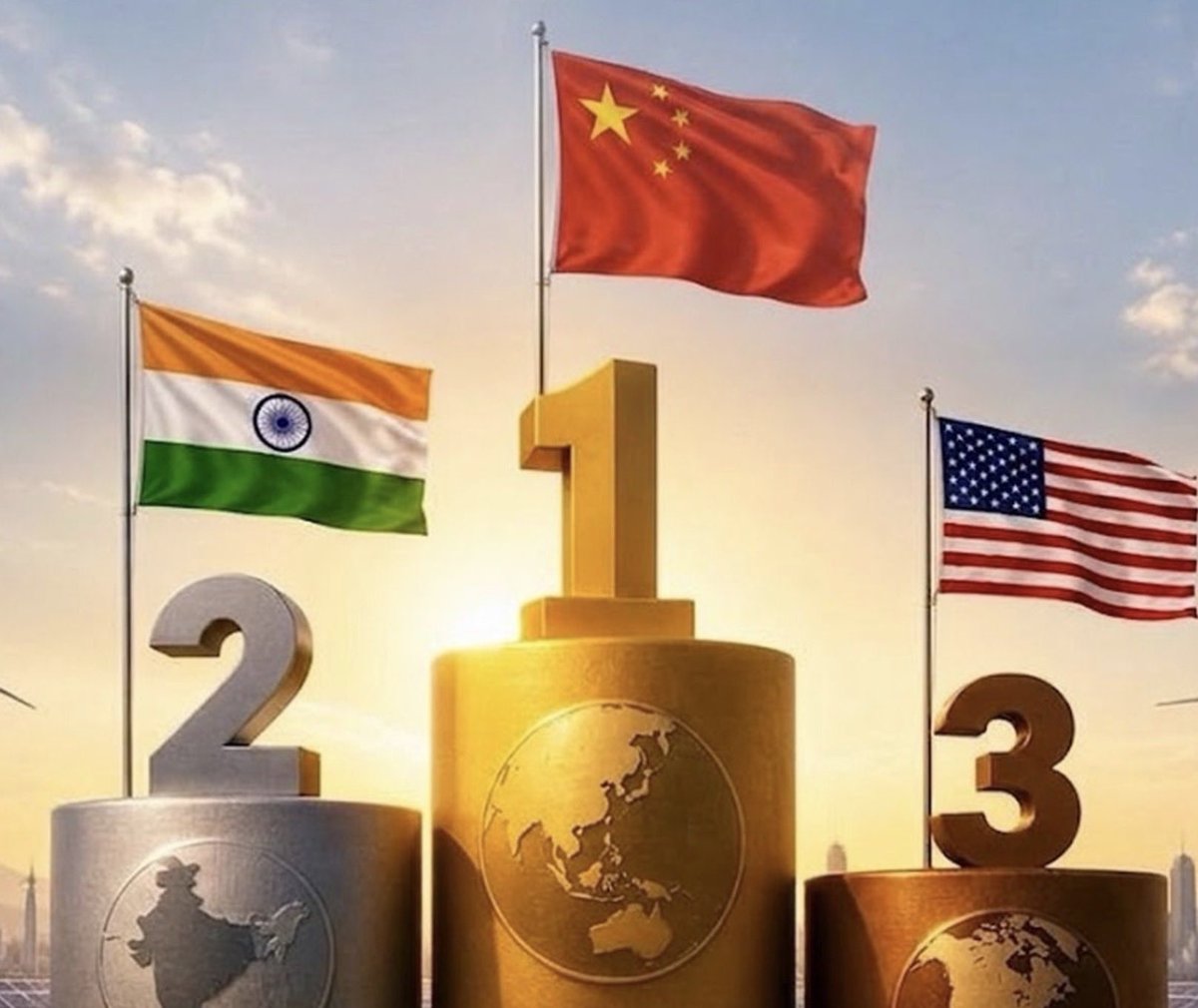
Congrats India 🇮🇳 - now the world’s second largest solar market.
→ 50 Gigawatt of new solar capacity added in 2025 alone
→ Total installed capacity now at 150 Gigawatt
→ China holds #1. The United States has slipped to #3.
US is still number 2 in total installed solar capacity, but India passed in actual deployment. This will be supercharged by the war in the Strait of Hormuz. The sun is Indian. The wind is Indian. The great rivers of india are Indian. Every drop of oil India replaces with renewables, make India richer and more energy independent.
The first 50 gigawatt took India 11 years. The next 50 gigawatt tok India 3 years. The last 50 gigawatt, the one that pushed India past the US, took 14 months.
Most of India's drone motors come from China.
In 2019, the founders of Vector Technics, @prudhvirajp + Karna Raj, set out to change that in a 400 sq. ft. Hyderabad office.
Today, @vectortechnics is India's largest indigenous drone motor manufacturer, producing 5k motors/month.
There's a town in Gujarat where 800 factories sit inside a 60 km radius.
It out-ships Italy. Out-prices China. Italian brands quietly buy from it and stamp their own label on top.
You've probably never heard its name.
This is the story of Morbi 🧵👇
Today's peak demand was met with the following mix: Thermal 62.8%, Solar 22.0%, Wind 5.0%, Hydro 5.8% and rest from other sources. The availability of coal at the Thermal Power Plants is adequate and the supplies are being effectively monitored.