GeoLibre v0.5.0 is out! This update significantly expands data format support, making it easier to work with a wide range of geospatial datasets in a lightweight, modern GIS environment.
Newly supported formats and services include: GeoJSON, Shapefile, GeoPackage, GeoParquet, KML/KMZ, FlatGeobuf, PMTiles MBTiles, GeoTIFF, Zarr, LiDAR point clouds, Gaussian Splatting, and ArcGIS services.
GeoLibre is a lightweight, cloud-native GIS built with MapLibre and Tauri. It runs directly in the browser and is also available as a standalone cross-platform desktop application at only ~30 MB.
GitHub: https://t.co/VXq8c1oACL
Website: https://t.co/7VA2AQpaJK
Live demo: https://t.co/Cq5Mg3oRDo
Feedback, ideas, and contributions are welcome.
#geospatial #opensource #maplibre
🦜 Can #SDMs and satellite #LiDAR improve conservation planning? In Peru, models for seven threatened species reveal key ecological corridors, gaps in protected-area coverage, and how GEDI data can support #connectivity and conservation.
🔗 https://t.co/zTvIlERk9g
“Conservation requires looking beyond Red Lists alone. Across European #foodwebs, non-threatened species play a strong role in maintaining #networkconnectivity.”
🗞️Check out this new paper by F. Mestre, @Araujo_lab et al!
https://t.co/HFxAVGpZZd
🏅 Shortlisted for the 2025 Robert May prize! 🏅
Nina Schiettekatte presents the R package habtools, which includes R functions to calculate complexity and shape metrics from Digital Elevation Models, 3D meshes, and 2D shapes 🌍 🧪
Read more here 👇
https://t.co/tmt80jXCL3
Published 📖
Generalized graphical mixed models connect ecological theory with widely used statistical models
GGMMs connect ecological theory with statistical models that are applied for inference, prediction, and causal analysis in ecology 🖥️🌍
🔎 https://t.co/lAyUo9s4zk
Congratulations to Neil Jun S. Lobite and Veronica Leah, whose excellent presentations were selected for the prestigious Brill Book Award Amphibia-Reptilia, at the recent 10th World Congress of Herpetology in Kuching, Malaysia. https://t.co/uoirQrkeTr
📖Published📖
Michelot-Antalik et al present a handbook of standardized protocols dedicated to floral traits that can be applied to a wide set of temperate plant species to quantify these traits at the scale of plant communities 🌼
https://t.co/oYES6j2WIZ
Ecological Niche Modeling Tutorial with R 🌍
Covers the basics with presence data cleaning, raster processing, variable selection, modeling and projection 👇
🔗 Online: https://t.co/4SaiU1siIh
📄 PDF: https://t.co/vrQ4opW1o2
#Ecology#Biodiversity#Modeling#OpenScience#GIS
Prediction, prediction, prediction...
But I actually prefer inference! Inference allows us to extract powerful insights from our data, and it's always the foundation for making accurate predictions.
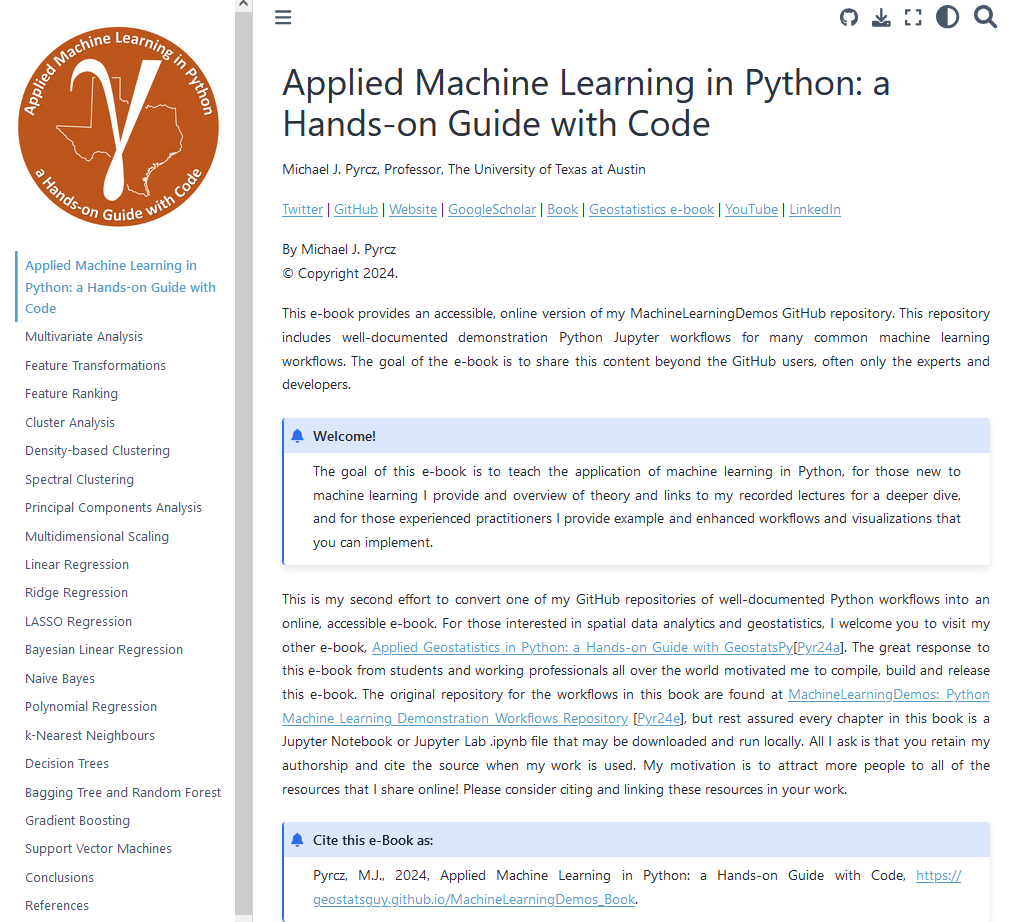
Feeling like my "Applied #MachineLearning in Python" e-book needed more emphasis on inference, I added new chapters on spectral clustering and multidimensional scaling yesterday. These updates include free, well-documented workflows, complete with data and code.
Check it out: https://t.co/kRPpZDexWa ∀. #DataScience
Great to see the preprint of our paper in @ESA_Ecology: a data paper with results of last years field work in #Doñana with camera traps to record plant-animal interactions.
https://t.co/BoDkniyo0W
Suppl. Material and dataset:
https://t.co/Qks56VHWY2
1/5
Many of my students struggle with the distinction between Ordinary Least Squares (OLS) and Maximum Likelihood Estimation (MLE).
To clarify, we use an interactive #Python dashboard that fits parameters to a Gaussian distribution based on a given dataset.
This visual approach helps them see the difference: OLS minimizes the mismatch between the model and the data, while MLE maximizes the likelihood of the data given the model parameters. With this tool, the concepts become much clearer!
I share it on #GitHub @ https://t.co/lNdq4FF4Bl ∀. #DataScience #MachineLearning
Using range maps to improve species distribution models: new method using stacked generalization published in Global Ecology & Biogeography (@GEB_macro) Paper led by Julian Oeser --> https://t.co/51D3rWq22N #SDM#biodiversity#models@BiogeoBerlin @ZurellLab @mfnberlin
➡️Our new🪳🦟🐛🌱🍃SPECIES INTERACTION NETWORK critique & analysis tips! Let's debate & let us know if you disagree! Ask for PDF via [email protected]
A Critical Evaluation of #Network Approaches for Studying Species #Interactions | Annual Reviews - https://t.co/KzvSK74B2d