The July 2026 issue of Science #Immunology is out!
This month's special issue celebrates the journal's 10th anniversary, reflects on milestones, and takes a deep dive on immune memory.
Learn more: https://t.co/NY0DhgThOe
Using a ferret model, Wang et al. show that SMPD4 loss reduces cortical neuron production and impairs neuronal migration, shedding light on the mechanisms underlying the abnormal brain folding, microcephaly, and developmental disabilities seen in patients. https://t.co/8W2pTui3Ff
Cancer research articles with telltale signs of being produced by paper mills garner double the number of citations than do genuine papers in the field
https://t.co/rPcP7AWdol
Failla et al. identify biallelic loss-of-function variants in GIT1 as the cause of a severe neurodevelopmental disorder characterized by microcephaly, brain abnormalities, and growth restriction. https://t.co/muVh99vaQx
Last fall, scientists documented the greater noctule bat snatching songbirds out of the air for a snack. But while this was a finding relatively new to science, a Renaissance artist knew enough to include the behavior in one of his paintings.
https://t.co/hVNtpc177p
Researchers @ucdavis are developing the first standardized method to measure the potential effects of airborne nanoplastics on human health with a nearly $4 million grant.
Learn more: @UCDavisCOE
https://t.co/aMgisf8oRu
Spooky action at a distance of the mouse brain.
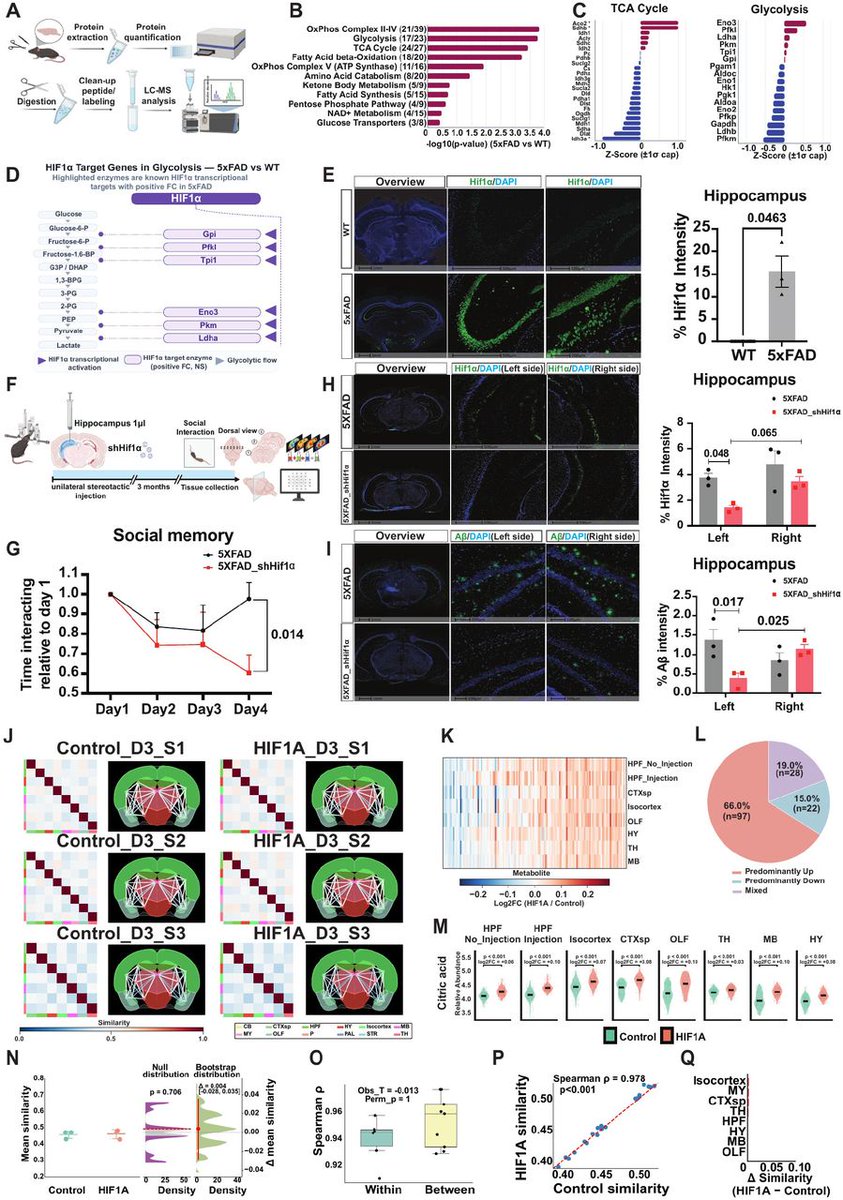
Our new preprint shows that brain metabolism is organized as a coherent network. Local intervention in one region can normalize metabolism across distant but metabolically similar regions — even in an Alzheimer’s model — without direct gene or plaque changes there.
We don’t yet know the mechanism, but we tested it with two different challenges and saw clear network-level metabolic normalization.
How we got there (MALDI imaging → conclusion):
Mapped the spatial metabolome across 12 major mouse brain divisions using MALDI imaging + Allen Brain Atlas registration.
Defined metabolic coherence as an optimal-transport-derived inter-regional metabolite similarity metric. Hippocampus emerged as a hub with high similarity to cortex, thalamus, hypothalamus, etc.
In the 5xFAD amyloid model, individual metabolites and lipids changed dramatically (mitochondrial dysfunction signatures), yet the overall inter-regional coherence structure stayed largely preserved. Metabolites shifted in a coordinated way that maintained network relationships.
Targeted the left hippocampus with two distinct local interventions: lentiviral shHIF1α knockdown and neuronal AAV-AOX expression.
Both challenges normalized metabolites at the injection site. More strikingly, normalization extended to distal regions sharing high metabolic coherence — even though gene modulation and amyloid plaque reduction remained strictly local.
Network-level metabolic rescue was accompanied by improved social memory. Coherence itself was preserved.
Bottom line: Metabolic coherence functions as essential “spooky action at a distance” — a network property that allows coordinated metabolic responses across anatomically distant brain regions.
This opens new ways of thinking about how local perturbations (or therapies) can influence distributed brain networks in health and disease.
https://t.co/mQHF56D73Q
Mice perform active sensing to acquire visual info: check out our collaborative effort, which is our 1st in motor+vision!
Great to work with @AToliasLab Xaq and Cris - 💰by the Brain Initiative @NIH! Led by @celia_bqt & @sainsbury_tom@CurrentBiology
https://t.co/xFnDhnHUOl?
MouseMapper – 3D organ & tissue mapping framework analyses cellular alterations across mouse whole body nervous & immune systems
📹 D Kaltenecker, I Horvath, R Al-Maskari, Y Chen, Z Ilgin Kolabas et al @HelmholtzMunich in @Nature
➡️ https://t.co/aUho7zNBa9 + @DrJohnAnkers
What do lipid droplets do in neurons? Thrilled to share the 🌟1st preprint from my lab, led by Eleni Katafygiotou, showing activity-dependent formation of neuronal LDs in vitro and in vivo, and the impact of LD modulation on neuronal function and behavior.
https://t.co/7V9gwR0vLH
New in @NatureMethods: a new human stem cell model of EMT lets us watch cells transition in both 2D and 3D and shows human stem cells can undergo the transition differently depending on how they are grown.
🔗 https://t.co/6Fpa2xJ4yc