I like doing research (on adaptive models and ML for science). PhD student at @ELLISInst_Tue, @MPI_IS and @ETH_en. | Prev. @uni_tue (MSc), @ETF_Beograd (BSc)
If a model that can adapt its compute to the task difficulty sounds cool, I hope you'll find our work interesting! // spoiler: it is looped ♾ https://t.co/l26badXs6P
code: https://t.co/WR141ofcQj
checkpoints to play with https://t.co/vpXiQb0fxV
Looped models scale compute by iterating in depth, demonstrating great potential in reasoning. But when should the looping stop, and how to keep it trainable at tens of thousands of unrolled layers? FPRM solves both. (1/7)
(1/9) Quantizing recurrent language models is easier than you think!
Hybrids compete at scale (e.g. Qwen, Kimi, Nemotron). Yet the PTQ stack has largely been tailored to softmax attention. 🤔
In this work, we reveal that recurrent models can be easier to quantize.
Which gene embedding should you use for your model: one learned from single-cell data, protein sequences, or a knowledge graph?
Finding out usually means hours of downloading, ID mapping, and format wrangling. We built Gene Embedding Hub to skip that step.
🧬 67 human gene embedding sets across 10+ modalities
📐Aligned to up to 20,097 protein-coding genes with Ensembl IDs
🤗 Ready to load from Hugging Face: https://t.co/zHRebZowzR
Congrats on this amazing work Daniel Tabares Lopez and Michael Bohl!👏 🚀
Check out the preprint: https://t.co/krGrThJA3k
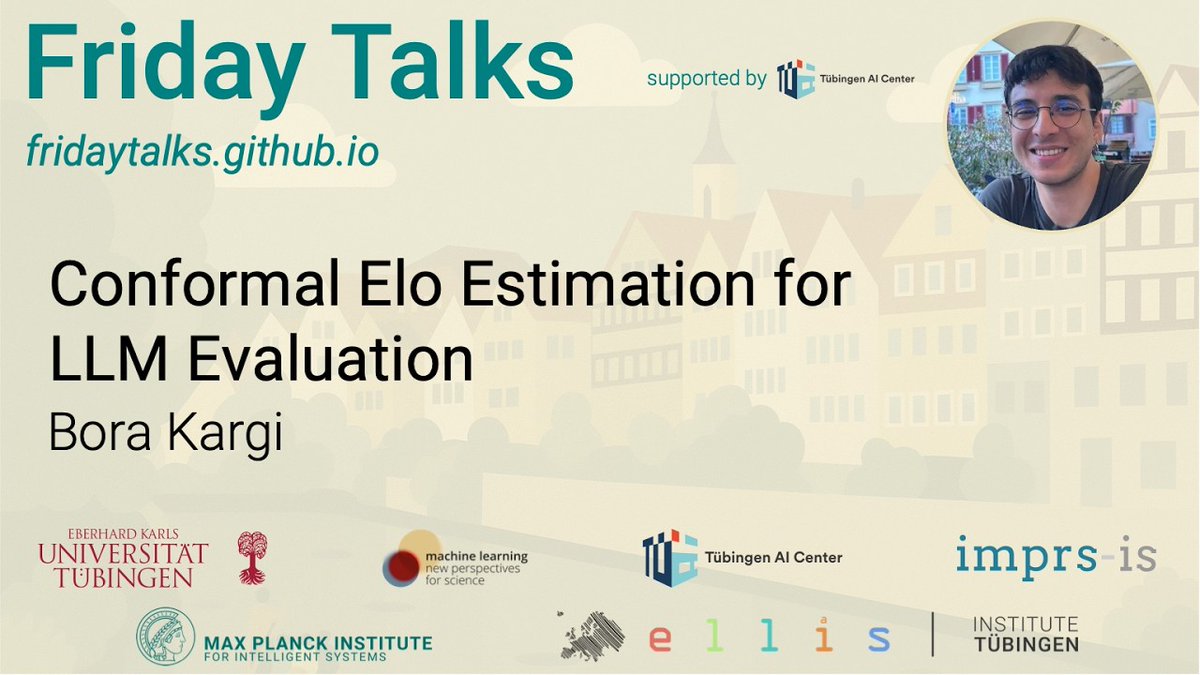
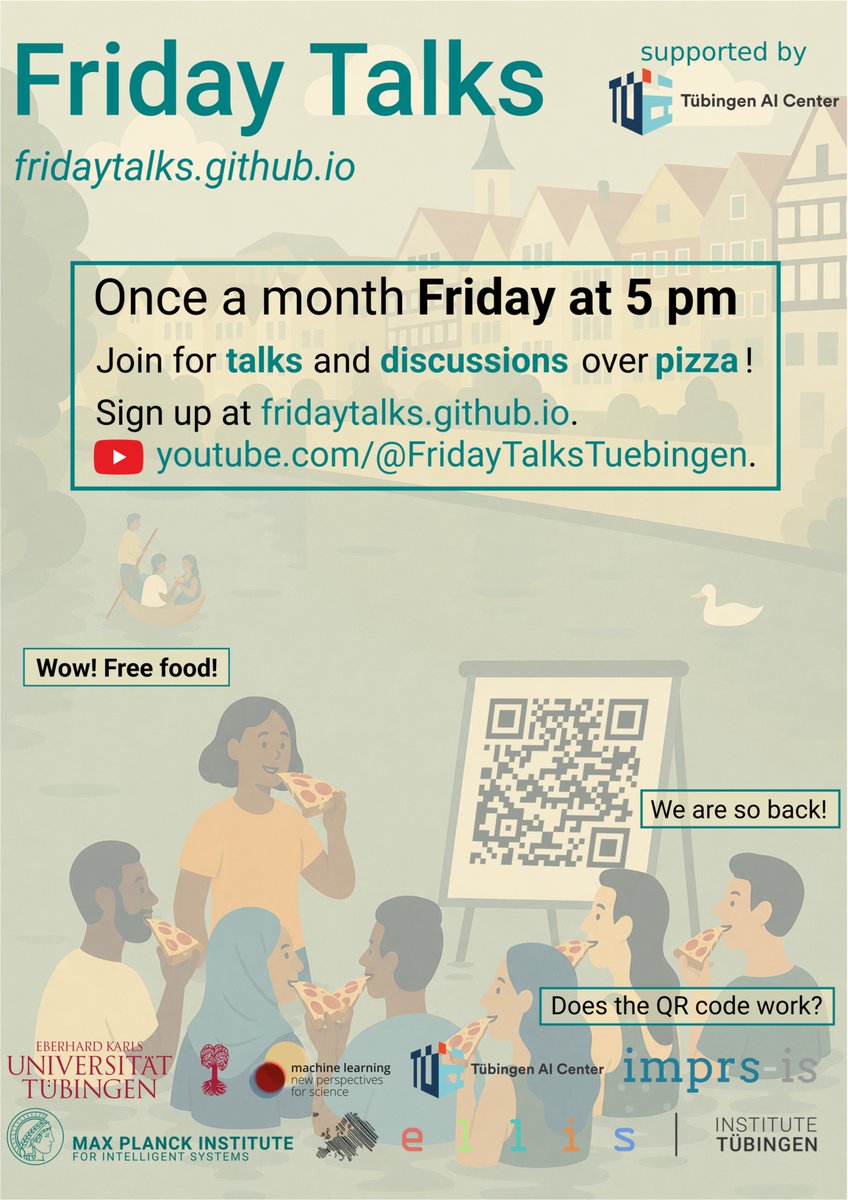
Hello World! This is our new FridayTalks Tübingen account. FridayTalks is a monthly talk series on machine learning, AI, and applications, featuring speakers from the Tübingen AI ecosystem. Follow this account for up-to-date information and future talks!
🚨 New paper!
What if LLMs could reason like we do when solving Sudoku: keep a few candidates per cell and iteratively narrow them down?
Introducing Binary Discrete Diffusion for language and reasoning tasks: it denoises sets of candidate tokens using binary representations! 🧵
This next paper is a bit quirky, but here goes:
Introspection is hard to study in both humans and LLMs. But, we do have internal senses that are verifiable, like proprioception (the sense of where your arm is right now).
What would proprioception look like in language models?
As a digital analogue to the sense of position, a model could verbalize which expert activated in a certain layer for any previous token.
It turns out that LLMs can learn a range of such proprioception skills where they understand and report on their internals. We can calibrate and score these reports, and evaluate whether training for proprioception changes model behaviors.
New surprising result:
We trained AI recursively on its own safe generations, while giving it a benign cue. Models became increasingly misaligned over time, giving advice on how to do harm and build biological weapons.
We call this Progressive Misalignment. 🧵👇
Our group discovered that reasoning models produce fractals when asked to solve hard problems. We can use nonlinear dynamics to probe the thinking processes of recurrent depth models on Sudoku, mathematics, and even ARC-AGI (1/N)
https://t.co/Q3u8OqylZf
I learned a lot from this paper, thanks to the authors! 😍Building on FPRM’s fixed-point approach, QRR introduces rotational symmetry to recognize convergence even while the hidden state keeps moving ---> it stops in fewer iterations!
Can reasoning finish while latent states keep moving?
Happy to share Quotient Recurrent Reasoner (QRR)!
We let symmetry-generated rotations persist while task-relevant dynamics converge faster in quotient space, reaching 97.9% on Sudoku-Extreme with 78% fewer loops than FPRM.
🚨 New Paper Alert, 🎤 Accepted for an oral presentation at the NeurIPS 2026 STODY workshop!
📣 Introducing: Normalizing Flow Maps (NFM): Combining few-step transport from Flow maps with tractable likelihoods from Normalizing Flows.
This is my first work with my first crop of new PhD students, @francescoshox and @tim_hitge, who genuinely knocked this project out of the park.
📄 Paper: https://t.co/LCFBg1QjLT
📝 Blog: https://t.co/8dWEYwUEOm
💻 Code: https://t.co/Oroppp6NBR
🧵
1/8
We’re bringing natural-language control to any scientific generator.
We are very excited to introduce LLM-to-Flow Distillation (LFD), a method to adapt scientific generators to high-level natural-language discovery goals.
Starting from textual goals like “design peptides with promising anticancer activity” or “design small molecules binding to the D2 dopamine receptor”, LFD distills high-level goal-related knowledge from LLMs into scientific generators through iterative DPO on LLM-generated sub-goals.
🔥 LFD does not need task-specific proxy rewards, works with any frontier LLM via API-access, and outperforms state-of-the-art reward-guided methods such as FlowGRPO and DiffusionNFT on held-out computational evaluations. (1/6)
Depth Memory augments residual streams with compressed, queryable memory, outperforming PreLN, mHC, and AttnRes on perplexity at 400M and 1.5B parameters. Check out the paper! 😍
mHC and AttnRes demonstrate that richer depth mixing improves model performance at scale. Is there a unifying perspective? 🤔
Meet our Depth Memory framework: each layer reads from a set of streams to form its input, then writes back its output.
Linear Depth Memory (LDM) equips models with a matrix-valued memory.
1/ New preprint: GRASS-MIL, a tool for discovering which tumor architectures matter.
From spatial single-cell data it maps the tissue neighborhoods tied to a clinical outcome, gives each an exact, signed contribution, and groups them into recurring niches. 🧵
Self-supervised transcriptomic FMs are pretrained on millions of gene-expression profiles, yet often fail to beat simple supervised baselines on clinical tasks.
Why?
Our new work suggests the pretraining objective may matter more than scale.
📄https://t.co/kk9IckdBgq
1/8
Excited to be presenting this at #COLM2026 in SF:
Oct 8th Poster Session 5 (11am-1pm), Imperial Ballroom #8
Come chat about multi-agent interaction, societal impacts of AI, and more! :)
🔥 Frontier labs are redesigning the residual stream to beat the curse of depth: Kimi K3 uses AttnRes, DeepSeek V4 uses mHC, ByteDance proposed HC, and there are more: LNS, KEEL, MoDA…
🙋 But each method was tested with its own training budget, model design and codebase, so the results can't be compared directly. Which one actually works best? More importantly, which one turns architectural depth into effective computational depth?
👇 We built DepthBench to find out.
📄 https://t.co/DpVhu2b44F