My postdoc paper is out ! https://t.co/nyr0WvMBcx We asked what happens in motor cortex when planning multiple movements in parallel. We asked this question through the lens of the (now not so) recent dynamical systems theory of motor planning. (1/n)
Many neuroscience students are steeped in an experiment-first style of thinking that leads to “random walk science.” Let’s not forget how theory can guide experiments towards deeper insights, writes @gershbrain.
https://t.co/nFC1xNmjhk
Here’s our latest work at @g_lajoie_ and @mattperich's labs! Excited to see this out.
We used a combination of neural recordings & modelling to show that RL yields neural dynamics closer to biology, with useful continual learning properties.
https://t.co/nvRhITFTmJ
@SuryaGanguli@TrackingActions@ItsNeuronal So it could be that a dedicated time factor is required to capture variance in the late period of the trial, which is only needed after the perturbation is on (causing the corresponding trial factor to increase only after the perturbation).
@SuryaGanguli@TrackingActions@ItsNeuronal Agreed, also love that paper! Specifically on Fig. 7 though, I always wondered if the adaptation effect is not a by-product of the trials becoming longer as the animal is adapting to the BCI perturbation. 7c clearly shows that the trial duration (time to target) increases (1/2)
What happens in the brain when we plan a complicated action, like tying a shoe ? Does motor cortex plan everything in advance before we move, or does it divide the movement into smaller chunks and replan on the fly? Come by Poster 450 on Wednesday afternoon to find out #FENS2024
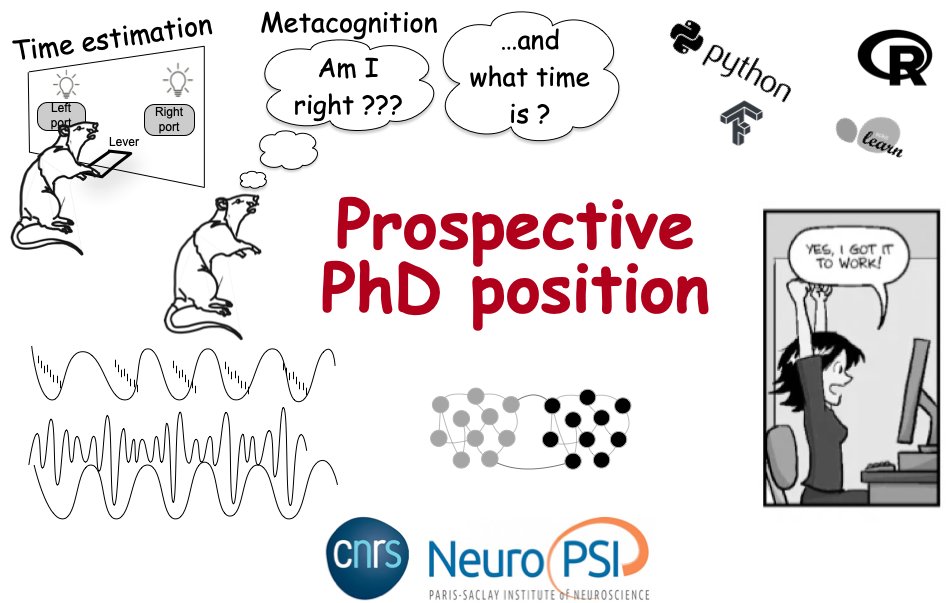
Prospective PhD opportunity on Timing and Metacognition in Rats at @NeuroPSI_saclay. Longer description here: https://t.co/5JAy1qVwow Contact me if interested !
PhD opportunity in our lab ! Join us in Marseille (southern France ☀️) to study the neural basis of motor skill learning in the primate brain. Keywords: neural dynamics, motor cortex, machine learning, BCI. Apply here: https://t.co/7RbBGmcnzf and contact me if interested !
Tomorrow at #Cosyne24 I’ll be presenting our recent study on the neural basis of parallel movement planning in the motor cortex, testing new population-level predictions of the dynamical systems theory. Come by Poster [3-120] if you’re interested !
My postdoc paper is out ! https://t.co/nyr0WvMBcx We asked what happens in motor cortex when planning multiple movements in parallel. We asked this question through the lens of the (now not so) recent dynamical systems theory of motor planning. (1/n)
100% this 👇 I follow a similar process when thinking about how the brain solves a task. Define reasonable inputs/outputs and think through how the system may transform those ins into those outs. Several algorithmic solutions often emerge and give hypotheses to test in the data.
Are you a postbac interested in neural engineering / BCIs? 🧠🤖🗣️
Come join our team!! Work directly with our amazing BCI participants.
Great exposure for prospective grad/med school applicants! https://t.co/nBh3af0O4Y
New from the lab: Cerebellar cortical activity underlying temporal stimuli is heterogeneous, multiplexed and complex not unlike profiles found in the frontal cerebral cortex. Great work by @JovisFilius, Jon Bregman and Marit Runge! Thanks to Chris too!
https://t.co/LZIvfKJZU6
RT is appreciated: We have a fully funded PhD position in CMC lab (at @tudresden_de). You can find more information about the position here:
https://t.co/XwWSPhbPEh
Please email me if you have questions. Deadline is November 30
Find more about CMC lab: https://t.co/z85OIcVTv9
What is the Psyche mission all about?
Here’s a rap summary of the PhD thesis of @eapsMIT scientist Dr. Clara Maurel which contributed research to the mission!
https://t.co/QQPbbTLn7W