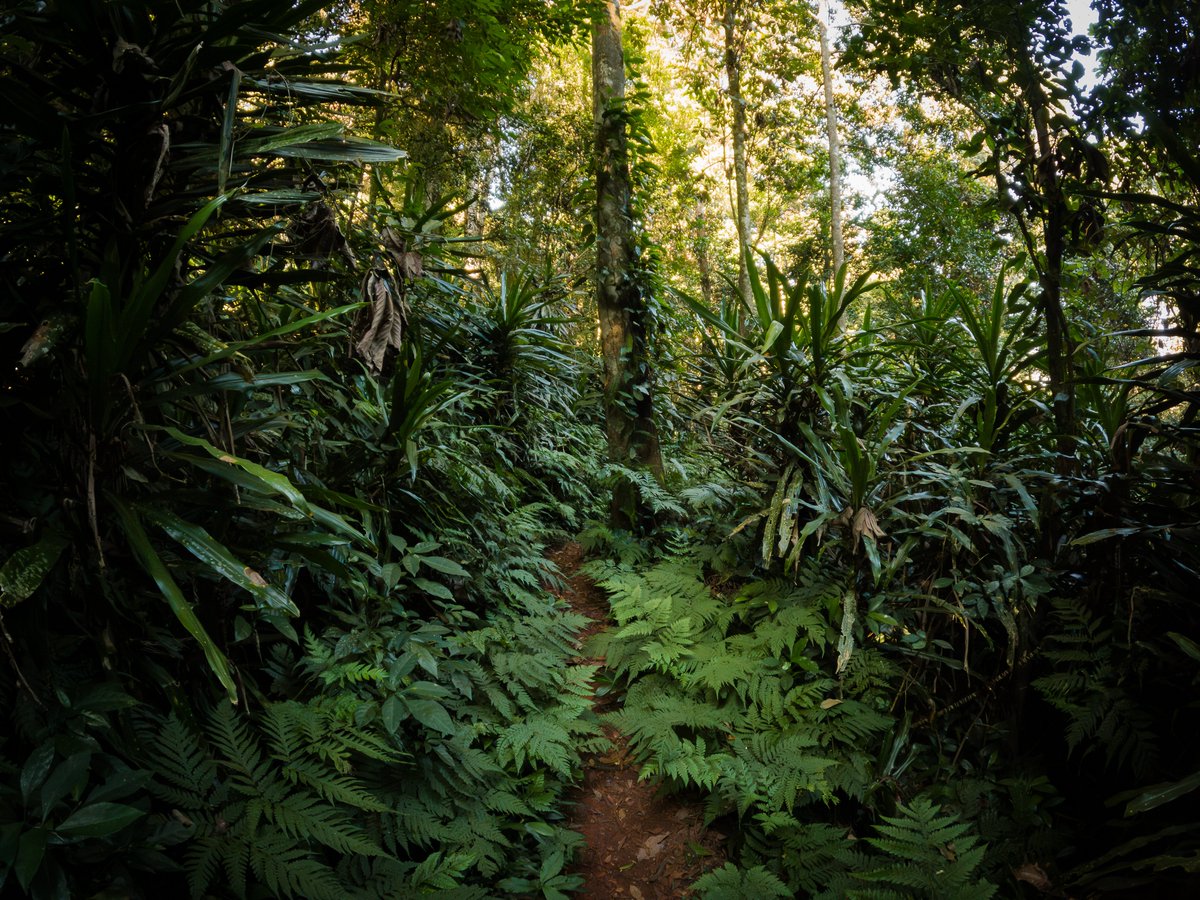
The most productive, biodiverse, and structurally complex forests on Earth grow in some of the worst soil on the planet.
Tropical rainforest soil is typically thin, acidic, and severely depleted of nutrients. Millennia of heavy rain have leached phosphorus, potassium, calcium, and nitrogen downward, below the reach of most roots. What remains is dominated by iron and aluminum oxides: chemically stable but nutritionally near-useless to plants. In conventional agricultural terms, much of the Amazon basin and Congo Basin floor would be rated as extremely poor land.
This has been central to tropical forest ecology for decades. The resolution is in how the forest manages its nutrient economy.
In a tropical forest, almost all nutrients at any given moment are not in the soil. They are in living biomass: wood, leaves, roots, fungi, and bacteria. When a leaf falls, it begins decomposing almost immediately in the warm, wet conditions of the forest floor. The fungi and bacteria decomposing it are in intimate contact with living tree roots. The nutrients released from that leaf are intercepted by those roots before they have a chance to leach downward into the mineral soil beneath. The cycle closes so tightly that nutrients essentially never accumulate in the ground at all.
The implication for land use is severe. Clear a tropical forest and you do not reveal productive agricultural soil. You reveal the depleted substrate that the forest was routing around. Slash-and-burn agriculture in tropical regions works initially because burning releases stored nutrients all at once, creating a temporary fertility pulse. After two or three seasons, those nutrients are exhausted. The forest cannot easily restore itself because the tight below-ground network that captured nutrients before they could leach away has been destroyed along with the trees.
Tropical forest restoration in heavily degraded areas is not simply a question of planting the right species. It is a question of rebuilding the below-ground economy that makes the aboveground forest viable.
#forestfacts #nature #science #ecology
@sweatystartup I really want to get started but I don’t know how I’ll get access to financing given my retirement(no stable source of income). I do have access to capital from prior earnings.
A decline in car break-ins across Oakland is being welcomed as a public safety win, but it is also contributing to a downturn for some local auto glass repair businesses. https://t.co/14r7UeCpS1
Social media trends have turned the world’s most beautiful places into endless bathroom lines at a concert, where everyone waits for hours just to take the same photo to show to people who couldn’t care less 🌎📸
Nothing captures the shallow decay of our time better than this
Kailasa was just scanned with lasers, and if you haven’t been following this place, hold on.
What’s being uncovered here won’t just rewrite Indian history. It could rewrite human history and prove Ancient India had tools far more advanced than we’ve been told.
But first, you have to understand what you’re looking at. Kailasa wasn’t built. It was removed from the side of a mountain. That means there was no room for mistakes while carving one of the hardest rocks on Earth. Between 200,000 and 400,000 tons of basalt were removed to create it. The first mystery is simple: we don’t know where it all went. We also don’t truly know when it was built. The main dating sources are two land grants, but that doesn’t tell us when the actual carving began. Dating matters because it would tell us what tools they had. Ancient India had steel by 600 BC, which later became the famous Damascus steel. But basalt is hardened lava. It’s around a 6 on the Mohs scale, meaning steel barely scratches it. In 1682, a Mughal emperor ordered 1,000 workers to destroy Kailasa. They failed. That alone shows how hard this stone is. Even with modern alloys, humans barely make a dent. Russian researchers tested this by having people strike basalt with modern tools, then measuring the removed volume with photogrammetry. The result? One person working every day for 3 years could remove only about 1 cubic meter. And since Kailasa is unfinished, we still have tool marks. Those marks show cuts deeper than what modern hydraulic breakers can achieve. To penetrate basalt that deeply, we’d normally need huge machinery. But machines that size wouldn’t fit in many of these spaces. So clearly, they had different tools. Not just powerful tools. Precision tools. The detail in Kailasa’s carvings looks like work done in soft soapstone, except it’s carved into basalt. What we know for sure is that our assumptions about ancient India are wrong. At minimum, they were far more advanced than we give them credit for. At most, something was happening back then that we still don’t fully comprehend.
It is the 15-20 inches of top soil that is nourishing every Life on this planet. This is the most miraculous Life-nourishing system, not just on this planet but in the known Universe. Enriching the soil is the most important work for us right now because Life can only be rich when the land is rich. Wonderful to note CSIS care and concern for the wellbeing of future generations. #SaveSoil. Let’s make it happen. -Sg
@CSIS
Former Indian cricketer Anil Kumble and his wife Chethana Kumble are seen promoting the beauty of Sanskrit by speaking it fluently in this video.
It’s inspiring to see a sporting icon use his influence to highlight the richness of one of the world’s oldest languages. Wonderful!
Japanese actor Hiroyuki Sanada spoke about the contradictions of human nature:
“Some people dream of having a swimming pool at home, while those who have one hardly ever use it. Those who have lost a loved one feel a profound sense of loss, while others often complain about their living relatives. Those without a partner long for one, while those who have one often don't appreciate it. The hungry would give anything for a meal, while the satiated complain about the taste of their food. Those without a car dream of owning one, while those who have a car are always looking for a better one.”
The key to happiness is gratitude: truly seeing and appreciating what we already have, and understanding that somewhere, someone would give anything for what we take for granted.
Imagine the thing you choose to critique Elon Musk on is work ethic 😂
Elon Musk:
• Works 80–120 hours per week during peak periods
• Jobs created (direct + supply chain): ~600,000
• Salaries paid out by his companies: ~$110 billion
• Taxes he paid in just 2021: $11 billion (largest tax bill for an individual in history)
• Value created for shareholders: Trillions
• Drives hundreds of billions in economic impact
• Brought human spaceflight back to America (SpaceX)
• Helps paralyzed patients control computers with their thoughts, giving new meaning to their lives
• Created Starlink, enabling people to access internet anywhere
Elon’s wealth increases because his companies build products and services people love, companies that generate hundreds of billions of dollars in economic value in the U.S. and around the world. He isn't buying yachts, expensive houses or cars. He's continuously pushing his chips into the middle of the table and creating companies that are changing the world. His wealth is tied up in those companies, thus he only pays big tax bills when he sells stock, which is rare.
In 2015, I marched for Bernie and donated to his campaign.
In 2019, after years of being a miserable democratic socialist who blamed everyone else for my sadness, I decided that I couldn’t stand being a miserable fuck anymore, and needed to start taking risks and aggressively started doing stuff to change my life.
I started working multiple jobs. I had 3 I was juggling at one point. I funded my life with one of them, and with the additional jobs, I invested all of my dollars in Palantir. It was honestly fun. Yeah, I worked 70 hours a week usually and sometimes would go 60 days without a day off, but it was exhilarating. I was making changes and doing things. It was way better than being miserable and angry and making my entire identity about politics and my disdain for “the rich.” Those were hopeless times and I was glad to be doing something for myself.
I was able to grow a portfolio of 4,000 Palantir shares at an 8 dollar cost basis between 2021-2023. 32,000 dollars from hardcore grinding. Between 2023-2025, that 32 grand grew to over 400 grand. In May 2024 I started rotating some of the profits into TSLA, along with purchasing with new income.
I’ve learned so much about capitalism since 2019, how wealth is created, and the difference between makers and takers. I’ve been inspired by so many amazing builders and entrepreneurs on this platform. I’ve even interacted with many of them. Totally surreal.
Today, I cheered in my car as it drove me home when I heard that Elon’s pay package was approved. I voted my 750 shares on it with a huge grin on my face. If Elon gets paid 1 trillion dollars, I will be a multimillionaire.
After all I’ve been through and after everything I’ve done for myself over the last 10 years, I look at this post by Bernie and know I would’ve cheered it on in 2015, but today, I see it for what it actually is. Manipulative, depressing rhetoric intended to depress a base of voters and make them feel hopelessly dependent on him and his colleagues. None of them build anything or create value or give working class people like me the opportunity to peg my labor against their genius. They did nothing but make me miserable.
I hope even one person can read this get pumped to start doing shit. There are ups and downs, but it’s yours. Nobody can take your grind away from you. Kick ass and build over years of time and watch what happens along the way. Don’t listen to sad miserable people like Bernie.