The Destruction of Sikh Art
Of all South Asia's religions, Sikhism has perhaps the worst-preserved art history. Its heritage was destroyed in three great waves.
The biggest financial cope of the Indian upper middle class is pretending ₹40 LPA equals $190,000 in the US because of purchasing power parity.
PPP is a metric for groceries, not wealth.
Easiest way to understand this: Gold was about ₹28,623 per 10g in India in 2016. Today it is around ₹1.43 lakh means 400% return. Gold rose from about $1,250 to $4,100 means a roughly 228% return.
Did the Indian investor become a better gold investor? No. The rupee bled from around ₹66 to over ₹95 against the dollar. You celebrate currency depreciation as wealth creation.
If both save 20% of income:
• You save ₹8 lakhs.
• The US guy saves $38,000 (₹36 lakhs).
In a decade his globally portable asset base is 4.5x larger. Currency value is absolute, not relative. Markets ignore local PPP when you buy global assets, travel abroad or send a child to an international university.
Keep bragging about cheap full-time maids and drivers. That cheap domestic labor is just a comfortable distraction. It gives you a false sense of pride while your actual wealth gets locked into hyper inflated ₹3 Crore matchbox flats, endless 20 year EMIs and overpriced gated communities that trap you in speculative local bubbles.
This is not high quality of life. Keep enjoying cheap food delivery while your global net worth is left behind.
Service quality has collapsed everywhere: AI call centers, no response from companies, hotels don't care, contractors, retail.
Most people whine about it. But also, what a low bar to build better.
Loved the Ramayana trailer, but felt Ranbir out of place, for Lord Rama we needed a taller, younger guy who inspires awesome... Felt the aura missing with Ranbir
One of the Zoho group companiee, Vipus Advanced Materials, is focused on carbon fiber composites. A retired ISRO scientist is one of the key people behind it.
Vipus has supplied advanced composite components to Skyroot Aerospace. So Skyroot's successful launch feels even more special!
Vipus is among the fastest companies to qualify as a HAL Class I supplier, with orders for LCA Tejas aircraft structures, and is working with L&T Precision Engineering Systems.
Proud of you Vipus, make Bharat manufacturing great! 🙏
Some facts: about 90% of our revenue comes from outside India, won against tough global competition.
About 2% of our revenue is from the government and when we do business with the government, we always save the taxpayer money, which we have the utmost respect for. We are also among the largest tax payers in our region.
I have never asked for a favor from the government and I never will. When asked for advice, I provide it and I do it independent of political ideology - the Kerala Startup Mission, when the Left Front government was in power, wanted my advice. I told them Keralam has the potential to be a major R&D hub of India. Since then, we have invested in numerous R&D driven statups in Keralam.
In Tamil Nadu, our Chief Minister has made a great new beginning and I am happy to support his effort. It is not because of political ideology but because I want good things to happen in Tamil Nadu.
I love our nation, and I speak my mind. I will not bow down to attacks nor threats. The attacks make us stronger and help us achieve greater success.
India's solar inverter market is valued at over ₹10,000 crore today. Yet, a significant share of these inverters continues to be imported. Some Indian companies manufacture inverters domestically, but in most cases they assemble hardware based on overseas designs and use control algorithms developed overseas.
Despite the confidence of many leading engineering institutions that building a world-class inverter is "not a difficult problem," very few laboratory prototypes have ever matured into commercially viable products capable of seamless grid synchronization, meeting stringent reliability standards, and complying with global certification requirements.
In 2021, we were internally discussing the problem when Aditya Goel said that he wants to pursue this challenge. His ambition was to build a truly world-class solar inverter that would be designed entirely in India, right from the hardware architecture to the embedded software and control algorithms.
To achieve this, he needed someone who would not be intimidated by ambitious goals; someone who had built technologies at the highest level, embraced first-principles thinking, and possessed the curiosity of an innovator.
The search took months of travel, conversations, and relentless effort. Eventually, he found Dr. Bidyut Kumar Bhattacharyya who had moved to India after a glorious career in the US.
Born in West Bengal, Dr. Bidyut studied Physics at Presidency College under Prof Amal Kumar Raychaudhuri during its golden era, shared classrooms with some of India's brightest minds, including Ashoke Sen. Early in his career, he worked on experimental physics projects that required designing systems capable of generating ultra-low temperatures. He later joined Intel, where he contributed to the design of the company's first laptop chip. The CEO of Intel has written recommendation letter for him.
When Aditya shared his vision, Dr. Bhattacharya agreed to join the mission. He said that he loved the idea that an Indian entrepreneur is attempting to create original deep technology rather than replicating what already existed.
Over the next three years, the @OrnateSolar team relentlessly designed, tested, failed, improved, and iterated. The inverter successfully cleared a rigorous series of 557 IEC qualification tests, demonstrating that world-class power electronics can indeed be conceived, designed, and engineered in India.
The internet was busy debating jantar Mantar & a quiet facility in India witnessed something straight out of science fiction. An engine fired up. But it did not hum & it did not roar like a normal jet.
It detonated. Continuous supersonic shockwaves raced around a circular chamber 1000s of times/sec, harnessing controlled explosions to generate thrust.
The startup D-Propulse just gave the world a sneak peek of their air-breathing Rotating Detonation Engine (RDE) with an integrated aerospike nozzle.
Every jet engine on a commercial airliner, every fighter jet & every rocket we have ever seen operates on deflagration. We mix fuel with air/oxygen, ignite it & it burns relatively slowly at subsonic speeds. It is effective, but humanity has pushed this tech to its absolute physical limits.
RDEs throw that century-old playbook into the fire. Instead of burning fuel smoothly, an RDE explodes it intentionally. A continuous detonation wave sweeps around an annular (ring-shaped) channel at supersonic speeds, reaching over 2000 m/s. This is called Pressure-Gain Combustion.
It extracts 15-25% more thermal efficiency out of the exact same amount of fuel. In the world of high-speed flight, a 25% jump in efficiency is a completely different league.
Why this Matters for India?
For decades, the narrative surrounding Indian engineering was tied to catching up on legacy systems, spending billions trying to replicate 1970s turbofan engine metallurgy/importing critical defense tech.
D-Propulse is proving that India does not need to play catch-up anymore.
By leapfrogging straight to Pressure-Gain Combustion, an Indian deep-tech startup, guided by veteran scientists & built by young engineers is standing on the frontlines alongside research labs in the US, Japan & China.
Imagine hypersonic cruise missiles, ultra-long-range combat drones & spaceplanes that do not need heavy, complex moving turbopumps to break speed records. That is the realm this technology unlocks.
The future does not belong to those who build better versions of old machines. It belongs to those who rewrite the physics of how machines work.
The FCRA Amendment bill is set to be tabled in Parliament.
India changed one word in its FCRA rules: proselytisation. That has triggered criticism from some US lawmakers. Why can't India decide how foreign money operates within its borders? Watch:
Japanese Ex minister ranting because Indian side pushed their self interest and refused to lock in on Japanese conditions for Bullet train
Look what this brown sepoy highlighted out of entire statement, deliberately left out real reason of Indian pushing to not use Japanese ETCS standard signalling rather demanding international signalling to maintain independence
Kudos to the "awful" minister for pursuing Indian interest
What we are seeing is IBM post binary combinatorial encoding of "Happy National AI Day."
Over 2,300 years ago, in his work Chandashastra, the Indian scholar Acharya Pingala developed a systematic binary method to classify and enumerate Sanskrit poetic meters. He divided syllables into two categories:
Laghu (light) - mapped to 0
Guru (heavy) - mapped to 1
And it represents the earliest known explicit use of binary combinatorial encoding. 2000+ years later, Boole, after whom 'Boolean logic' is named, created a similar system and logic using 1 and 0.
Interesting to note that his wife, Mary Everest Boole, explicitly claimed that he and Charles Babbage got their ideas from Indian logic in her work "Indian thought and western science in nineteenth century."
But his possible knowledge of Indian works on logic and linguistics is denied now completely as "only his wife claimed, we don't have any evidence he read Indian works."
Anyway, what you see here and what is being used now as the Binary system and encoding (running much of computing) was already in use 2300 years ago in India.
Btw, Mary Everest Boole is niece of George Everest, the guy after whom Sagarmatha is named by westerners as their own discovery - like Victoria Falls and the Americas were said to be 'discovered' 10s of thousands of years after Africans and Native Americans :)
🚨 Chennai-based Meine Electric has successfully developed a first-of-its-kind Fast Charge Long Discharge (FCLD) iron-air battery.
These batteries charge in just 6 hours, and have now cleared external validation from US-based CES (Customized Energy Solutions).
As reported by the BBC, researchers at the Sudha Gopalakrishnan Brain Centre (SGBC) at IIT Madras have developed ANCHOR—the world's most detailed three-dimensional atlas of the human brainstem at cellular resolution.
Created using more than 500 tissue sections spanning foetal, childhood and adult brains, the atlas enables seamless navigation from MRI scans to individual neurons. It identifies over 200 clusters of brain cells and nerve pathways, offering an unprecedented view of the brainstem—the region that controls essential functions such as breathing, heartbeat, sleep, movement and wakefulness.
Developed over 18 months by a multidisciplinary team, ANCHOR bridges medical imaging with cellular pathology and has the potential to advance research into neurological disorders, including Alzheimer's disease, Parkinson's disease, stroke and sudden infant death syndrome (SIDS).
It is freely accessible to researchers worldwide, marking another significant step in advancing neuroscience and interdisciplinary research.
Read here: https://t.co/VoRaBQCfUe
@BBCWorld@PrinSciAdvOff@iitmadras@kris_sg
#IITMadras #BrainResearch #Neuroscience #MedicalResearch #HealthcareInnovation
Last week, I was fortunate to visit the workshop (the Tamil word pattarai பட்டறை is so appropriate) of the leading motor designer in the world Morihiro Saito-san.
Saito-san is 80+ and still designing advanced motors, some of the most advanced in the world. His modest looking workshop is right next door to a company that builds out those motors in prototype quantities and he works closely with them to get them built. I visited as an industrial "pilgrim", with as much devotion as I go to the Thoranamalai Murugan Temple at home. When I saw him at work, I was moved to touch his feet.
Saito-san, the God of motors, is how Japan is able to retain its global prominence in so many foundational industries.
We need to learn from that spirit. We need to revive our "pattarai" culture of building things - every village in India needs such workshops!
My industrial pilgrimage to Japan has given me new vigor 🙏
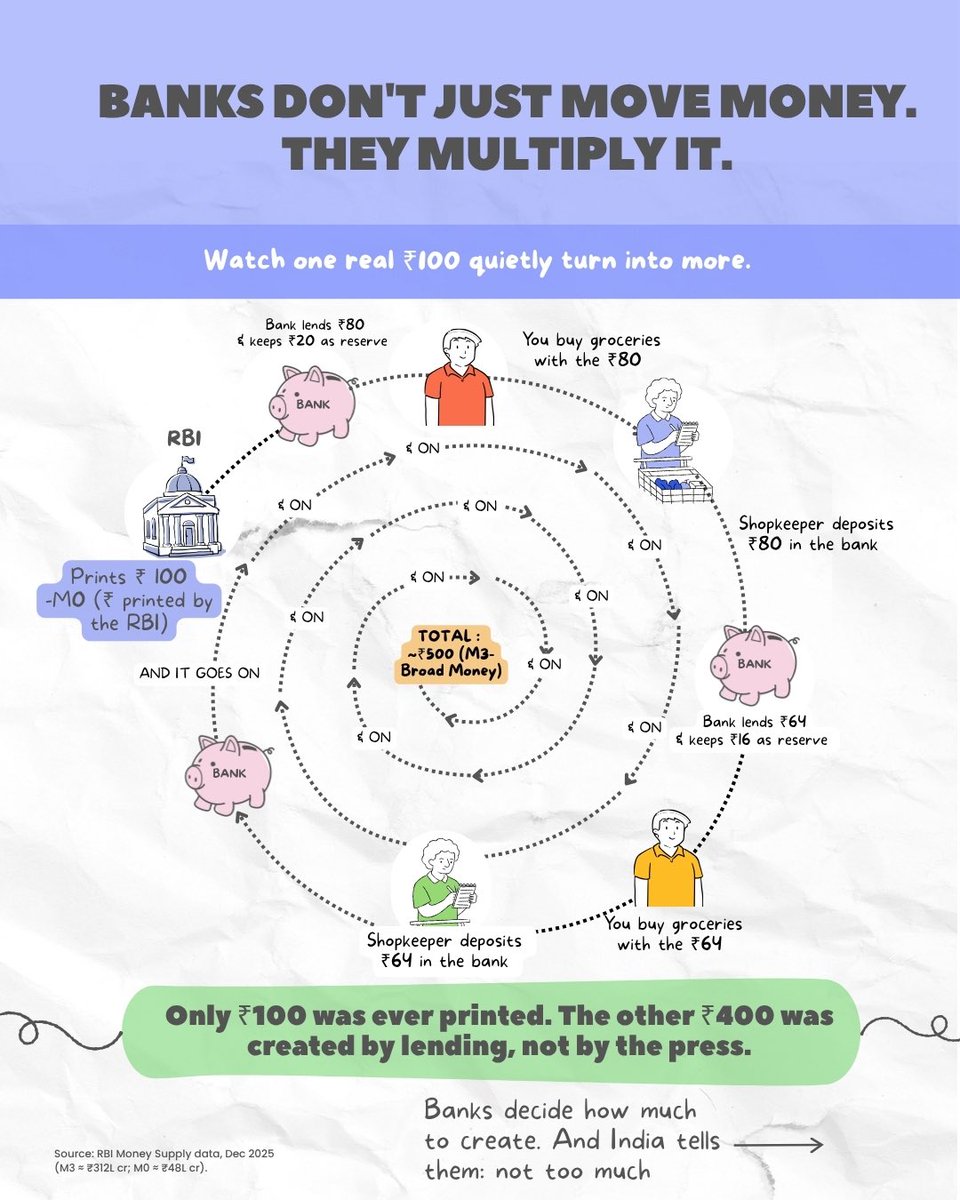
Did you know your ₹100 in the bank isn’t sitting in a vault?
It’s lent, spent, and re-deposited within hours. One printed ₹100 turns into ₹500 across the economy. Banks decide how much.
India runs this slower than the rest of the world. 50% credit-to-GDP against a global 148%. On purpose.
The instinct was built in 1969 and never left. It’s the shield that kept India out of 2008. It’s also the ceiling.
You can’t fully have one without the other..
A $5 million Indian startup just patented the motor every global automaker has been failing to build for a decade.
Bengaluru based Vimag Labs has been granted its fifth Indian patent for something called a Virtual Magnet Synchronous Motor, or VMSM.
It runs an electric motor without any rare earth magnet inside it.
Almost every EV today uses a Permanent Magnet Synchronous Motor. These have fixed rare earth magnets physically built into the rotor.
Vimag's motor does not. It creates and controls the magnetic field using software, power electronics, and control algorithms in real time.
The supply chain problem it solves is enormous.
• China controls about 91% of global rare earth refining and separation.
• China produces 94% of the world's sintered permanent magnets, the exact type used in EV motors.
• China holds only 35% of global rare earth reserves. Its power comes from processing, not from owning the minerals.
China has been using that control as a weapon.
• In April 2025, China imposed export controls on seven heavy rare earth elements and all related magnets. Exports collapsed and carmakers in the US and Europe were forced to cut production.
• In October 2025, China extended the rules to any foreign-made product containing 0.1% or more Chinese rare earth content, even if made entirely outside China.
• Prices outside China have spiked up to sixfold. EV makers report roughly $500 in added material cost per vehicle.
• Licensing approvals for European firms have fallen below 25% in some sectors.
Every major automaker has been trying to escape this.
Tesla switched to rare earth motors in 2017 and has said its next generation motors in 2026 will go rare earth free again. Stellantis and GM are funding Niron Magnetics, a US startup building iron nitrogen magnets.
Neither has said when it reaches production.
Valeo has been working on a rare earth free motor since 2022. And It is not expected to reach the market until 2028 at the earliest. Honda has announced its own funding into alternatives.
Vimag has already run 87,600 engineering hours on this, has active pilots with two wheeler and passenger car manufacturers, signed a manufacturing agreement with Jendamark, and is scaling toward commercial vehicles and industrial systems from 200 kW to 600 kW.
It is also building versions for robotics, defence, and cooling systems.
Now the part worth being careful about.
This is still a $5 million Series A company running pilots, not mass production. Motors that work in a lab or a pilot fleet do not always survive cost, durability, and efficiency testing at scale.
Software defined magnetic fields require heavy power electronics, and that adds its own cost and failure points. Valeo has been at this for four years and is still two years from market.
Analysts estimate the West would need 15 to 30 years to rebuild an independent rare earth supply chain.
Building a motor that does not need rare earths at all skips that entire problem.