Extremely grateful to the whole team who made this possible and Grotjahn lab fro teaching me all things CryoEM. ❤️
More fun stuff in the preprint, feedback is always welcome !
Peeking through blue skies to share our pre-print, from my postdoc work in the Grotjahn Lab :D @nani_grotjahn
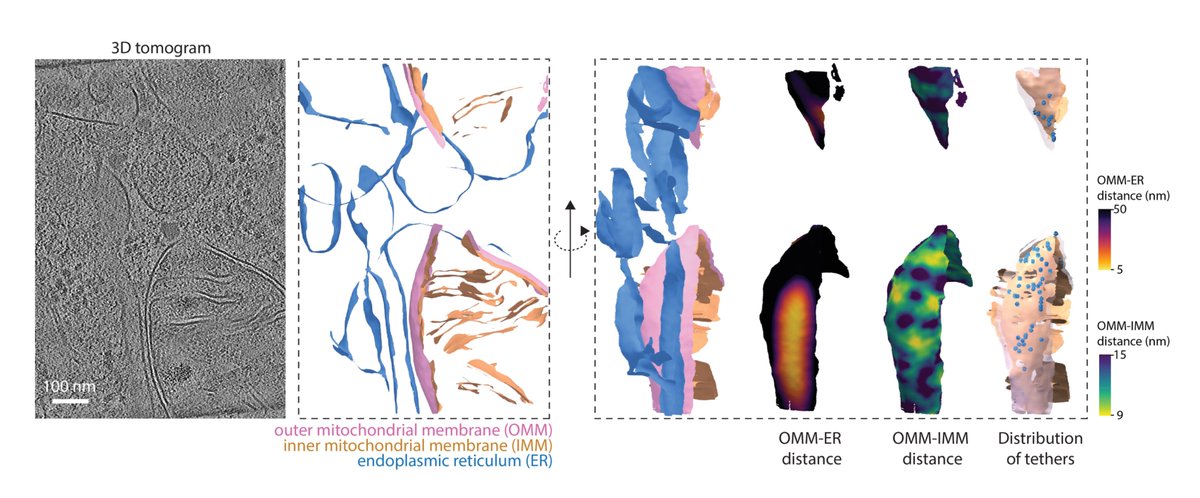
We ask how mtDNA replication is coordinated with mitochondrial fission across membranes.
🧵
https://t.co/gBZcyvvJa0
5/ We also see close ER-mito contacts overlapping with tethers at replicating mtDNA. We propose that a gradient of ATAD3A determines positioning of the fission machinery. This gradient in turn is defined by replication state of mtDNA, reminiscent of MinCDE gradient in bacteria.
The Infosys Prize 2025 in Life Sciences is awarded to Dr. Anjana Badrinarayanan, Associate Professor at the National Centre for Biological Sciences, Bangalore.
Her research on genome maintenance and DNA repair explains how cells protect and recover their genetic material.
Dr. Badrinarayanan’s studies help us understand the essential processes that keep living systems stable and healthy.
@anjbadri@NCBS_Bangalore
#infosysprize #infosyssciencefoundation #lifesciences #genomeresearch #DNArepair #NCBS #scientificinnovation #biology
I genetically engineered the amazing Arabidopsis to mimic the striking patterns of my Tradescantia zebrina🧬🌱
From concept to creation, here's the story behind transforming this plant into a living work of art! (1/7) 🧵"
Latest work from our group @Esoftbio@NCBS_Bangalore, led by Sree @padmanabh97, is out today in @NatureComms! In colab with @DeepaAgashe @c_kurzthaler we report that the physical confinement acts as a selective pressure on bacterial growth in 3D! [1/16]
https://t.co/VErWWENCL9
SpotMAX, our software tool for analysing multi-dimensional microscopy data, is finally out! 🎉 And conveniently, I just presented it at the #I2K conference 😀
A multi-year-long effort of many great collaborators and users. But what can SpotMAX do? A small thread
Excited to share our @Nature paper introducing constraint metrics for #mtDNA! Constraint models are powerful tools that were missing for mtDNA—until now. By applying our model to #gnomAD, we reveal which sites in mtDNA are most crucial for health & disease https://t.co/QeJVWhVnhI
Thrilled to share the last review of the lab led by @Tabara_LC and @MayukoSegawa on the mechanisms regulating mitochondrial morphology!!! @MRC_MBU
Just out in @NatRevMCB. Thanks @lisa_heinke for the smooth editorial process!